

Verified IIA-CIA-Part3 exam dumps Q&As with Correct 413 Questions and Answers
IIA IIA-CIA-Part3 Test Engine PDF - All Free Dumps from UpdateDumps
IIA IIA-CIA-Part3 Exam Syllabus Topics:
| Topic | Details |
|---|---|
| Topic 1 |
|
| Topic 2 |
|
| Topic 3 |
|
| Topic 4 |
|
| Topic 5 |
|
| Topic 6 |
|
NEW QUESTION 163
A limitation of transfer prices based on actual cost is that they:
- A. Charge inefficiencies to the department that is transferring the goods.
- B. Must be adjusted by some markup.
- C. Lack clarity and administrative convenience.
- D. Can lead to suboptimal decisions for the company as a whole.
Answer: D
Explanation:
The optimal transfer price of a selling division should be set at a point that will have the most desirable economic effect on the firm as a whole while at the same time continuing to motivate the management of every division to perform efficiently. Setting the transfer price based on actual costs rather than standard costs would give the selling division little incentive to control costs.
NEW QUESTION 164
Which of the following is not an appropriate basis for measuring the cost of property, plant, and equipment?
- A. All costs incurred in the construction of a plant building, from excavation to completion, should be considered as part of the asset's cost.
- B. The purchase price, freight costs and installation costs of a productive asset should be included in the asset's cost.
- C. Proceeds obtained in the process of readying land for its intended purpose, such as from the sale of cleared timber, should be recognized immediately as income.
- D. The costs of improvements to equipment incurred after its acquisition should be added to the asset's cost if they increase future service potential.
Answer: C
Explanation:
Accordingly, items of property, plant, and equipment PPE that meet the recognition criterion are initially measured at cost. The cost includes the purchase price minus trade discounts and rebates. plus purchase taxes) and the directly attributable costs of bringing the assets to working condition for their intended use. Directly attributable costs include site preparation, installation, initial delivery and handling architect and equipment fees, costs of removing the assets and restoring the site. etc. Accordingly, the cost of land includes the 5 'f obtaining the land and readying it for its intended uses. but it is inappropriate to recognize the pro, ' ,,is n rated to site preparation immediately in profit or loss. They should be treated as reductions in the price of the land.
NEW QUESTION 165
RLF Corporation had profit before taxes of US $60,000 for the year. Included in this amount were depreciation of US $5,000. a charge of US $6,000 for the amortization of bond discounts, and US $4,000 for interest expense. The estimated cash flow for the period is:
- A. US $66,000
- B. US $60,000
- C. US $49,000
- D. US $71,000
Answer: D
Explanation:
To determine cash flow for the period, all noncash expenses should be added back to profit. Adding the US $5,000 of depreciation and the US $6,000 of discount amortization to the US $60,000 of profit produces a cash flow of US $71,000.
NEW QUESTION 166
An organization's balance sheet indicates that the total asset amount and the total capital stock amount remained unchanged from one year to the next, and no dividends were declared or paid. However, the organization reported a loss of $200,000. Which of the following describes the most likely year-over-year change to the organization's total liabilities and total stockholder equity?
- A. The total liabilities and total stockholder equity both decreased.
- B. The total liabilities decreased, and the total stockholder equity increased.
- C. The total liabilities increased, and the total stockholder equity decreased.
- D. The total liabilities and total stockholder equity both increased.
Answer: C
NEW QUESTION 167
A manufacturer produces a quality product for which it charges a little more than some competing items but gives its consumers a more liberal warranty policy. The product carries a 5-year warranty that covers both labor and materials charges. Which of the following defines the appropriate method of accounting for the warranty?
- A. Sales warranty.
- B. Cash basis
- C. Recognition of a provision.
- D. Tax basis.
Answer: C
Explanation:
A provision is a liability of uncertain timing and amount A liability is a present obligation arising from past events, the settlement of which is expected to result in an outflow of resources embodying economic benefits. Whether a past event results in a present obligation is usually clear. Thus, it is clear from the circumstances that the entity's sale of goods without warranty is an obligating event that resulted in a present obligation for the issuance of warranty costs. Recognition of provisions is appropriate when the entity has a legal or constructive present obligation resulting from a past event (called an obligating event), it is probable that an outflow of economic benefits will be necessary to settle the obligation, and its amount can be reliably estimated. Assuming that the amount of warranty costs can be reliably estimated all though they are uncertain in timing and amount compared with a trade payable, for example) and that the outflow is probable in these circumstances, "more likely than not"), the manufacturer's contractual present obligating should result in recognition of a provision.
NEW QUESTION 168
Which of the following IT strategies is most effective for responding to competitive pressures created by the marketplace?
- A. Promote closer linkage between organizational strategy and information.
- B. Enhance the functionality of application systems.
- C. Provide users with greater online access to information systems.
- D. Expand the use of automated controls.
Answer: B
NEW QUESTION 169
According to Porter's model of competitive strategy, which of the following is a generic strategy?
1. Differentiation.
2. Competitive advantage.
3. Focused differentiation.
4. Cost focus.
- A. 1, 2, 3, and 4
- B. 2 only
- C. 1, 3, and 4 only
- D. 3 and 4 only
Answer: C
NEW QUESTION 170
An internal auditor observed that the organization's disaster recovery solution will make use of a code site in a town several miles away Which of the following is likely to be a characteristic of this disaster recovery solution?
- A. Recovery time is expected to be less than one week
- B. Data is synchronized in real lime
- C. Servers are not available and need to be procured
- D. Recovery resources and data restore processes have not been defined
Answer: C
NEW QUESTION 171
While auditing a marketing department, the internal auditor discovered that the product life cycle model was used to structure the marketing mix.
The manager has asked the auditor for advice about increasing advertising of various products. During which stage of the life cycle would it be appropriate to advertise that the company's product is the lowest price and best quality of all competitors?
- A. Maturity stage.
- B. Decline stage.
- C. Introduction stage.
- D. Growth stage.
Answer: A
Explanation:
The maturity stage is the ideal time for advertising lower prices and superior quality because this is the period during a product's life when competition is greatest. Due to the availability of many alternatives or substitutes, a firm has reasons to set itself apart. Because price and quality are both concerns of customers during the maturity stage, it is ideal for the firm to differentiate its product by advertising low prices and higher quality.
NEW QUESTION 172
The economic order quantity is the size of the order that minimizes total inventory costs which include ordering and holding (carrying) costs. It can be calculated using the formula: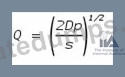
If:
Q = order size in units
D = annual demand in units
P = cost per purchase order
S = carrying cost per year for one unit of inventory
If the annual demand decreases by 36% the optimal order size will
- A. Decrease by 6%.
- B. Increase by 20%.
- C. Increase by 6%.
- D. Decrease by 20%.
Answer: D
Explanation:
D decreases by 36%, that is, from 100% to 64%. Because .64 is the square of .8, the EOQ for .64D (Q1) equals 80% of the EOQ for D(Q).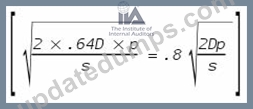
NEW QUESTION 173
In the years after the mind-service point of a depreciable asset which of the following depreciation methods will result in the highest depreciation expense?
- A. Sum of the years' digits
- B. Double-declining balance
- C. Straight line
- D. Declining balance
Answer: A
NEW QUESTION 174
Which of the following issues would be of most concern to an auditor relating to an organization's Internet security policy?
- A. Auditor documentation.
- B. Data integrity.
- C. Rejected and suspense item controls.
- D. System efficiency.
Answer: B
Explanation:
Controls are intended to ensure the integrity, confidentiality, and availability of information. An auditor relies on the integrity of the system's data and programs in making critical decisions throughout the audit process.
NEW QUESTION 175
An entity borrows funds from its bank for a one-year period. The bank charges interest at a
nominal rate of 15% per annum, on a discount basis, and requires a 10% compensating balance. The effective annual interest rate on the loan is:
- A. 17.65%
- B. 20.00%
- C. 25.00%
- D. 16.67%
Answer: B
Explanation:
Discount interest is subtracted before the loan proceeds are paid to the borrower.
A compensating balance is an amount that the borrower must keep on deposit with the lender. The effective annual interest rate is increased by both the discount interest arrangement and by the compensating balance requirement: The effective rate equals the nominal rate dividend by one minus the sum of the nominal rate and 'the compensating balance percentage, or 20% [.15 - 1.0 - .15 - .1 O)].
NEW QUESTION 176
The internal auditor of a bank has developed a multiple regression model which has been
used for a number of gears to estimate the amount of interest income from commercial loans.
During the current year, the auditor applies the model and discovers that the r2 value has decreased dramatically, but the model otherwise seems to be working okay. Which of the following conclusions is justified by the change?
- A. Some new factors not included in the model are causing interest income to change.
- B. Regression analysis is no longer an appropriate technique to estimate interest income.
- C. A linear regression analysis would increase the model's reliability.
- D. Changing to a cross-sectional regression analysis should cause r- to increase.
Answer: A
Explanation:
The coefficient of determination r-) is the amount of variation in the dependent variable interest income) that is explained by the independent variables. In this case, less of the change in interest income is explained by the model. Thus, some other factor must be causing interest income to change. This change merits audit investigation. In preparing the annual profit plan for the coming year, Wilkens Company wants to determine the cost behavior pattern of the maintenance costs. Wilkens has decided to use linear regression by employing the equation = a + bx for maintenance costs. The prior year's data regarding maintenance hours and costs, and the results of the regression analysis, are given below and in the opposite column.
NEW QUESTION 177
Physical distribution is the moving of finished products to:
- A. Shipping point.
- B. Consumers.
- C. Warehouses.
- D. Retail outlets.
Answer: B
Explanation:
Physical distribution is the efficient management of supply chains. It controls value-added flows from suppliers to consumers.
NEW QUESTION 178
Which of the following focuses on finding statistical relationships in order to create profiles?
- A. Data mining.
- B. Data analysis.
- C. Process analysis.
- D. Process mining.
Answer: B
Explanation:
Explanation/Reference: https://www.researchgate.net/profile/Mohamed_Hammad11/post/ What_instrument_is_used_to_analyze_qualitative_descriptive_data/attachment/59d659ca79197b80779af218/ AS%3A543750520664064%401506651634578/download/CHAPTER+6-+DATA+ANALYSIS+AND
+INTERPRETATION.pdf
NEW QUESTION 179
......
100% Passing Guarantee - Brilliant IIA-CIA-Part3 Exam Questions PDF: https://prepaway.updatedumps.com/IIA/IIA-CIA-Part3-updated-exam-dumps.html