

[2022] IIA-CIA-Part3 Actual Exam Dumps, IIA-CIA-Part3 Practice Test
UpdateDumps IIA-CIA-Part3 dumps & Certified Internal sure practice dumps
NEW QUESTION 106
Which of the following does not provide operational assurance that a computer system is operating properly?
- A. Performing a system audit.
- B. Making system changes.
- C. Conducting system monitoring.
- D. Testing policy compliance.
Answer: B
NEW QUESTION 107
Using an EOQ analysis (assuming a constant demand), it is determined that the optimal order quantity is 2,500. The company desires a safety stock of 500 units. A 5-day lead time is needed for delivery. Annual inventory holding costs equal 25% of the average inventory level. It costs the company US $4 per unit to buy the product, which it sells for US $8. It costs the company US $150 to place a detailed order, and the monthly demand for the product is 4,000 units.
Annual inventory holding costs equal:
- A. US$1,750
- B. US$750
- C. US$2,250
- D. US$1,250
Answer: A
Explanation:
Given that demand is constant and the EOQ is 2,500 units, the average inventory level without regard to safety stock is 1,250 units (2.500 + 2). Adding safety stock results in an average level of 1,750 units (1,250 + 500). Given also that annual holding costs are 25% of average inventory and that unit cost is US $4. total annual holding cost is US $1,750 [(1,750 units x US $4) x 25%].
NEW QUESTION 108
Which of the following cybersecurity-related activities is most likely to be performed by the second line of defense?
- A. Administer security procedures, training, and testing.
- B. implement vulnerability management with internal and external scans.
- C. Monitor incidents, key risk indicators, and remediation
- D. Deploy intrusion detection systems and conduct penetration testing
Answer: B
NEW QUESTION 109
IAS 34, interim Financial Reporting, provides guidelines for interim reporting stating that enterprises:
- A. Need not disclose basic and diluted earnings per share each quarter.
- B. Must determine income tax expense by applying progressive tax rates to income on a quarterly basis.
- C. May prorate extraordinary items over four quarters.
- D. May use estimates based on sales margins for interim inventory valuation although a different method is used for annual reporting.
Answer: D
Explanation:
Essentially the same reporting methods should be used for interim and annual financial statements. However, the preparation of interim financial reports ordinarily requires a greater use of estimates. For example. IAS 34 states that complete inventory-taking and valuation may not be required at interim dates. Estimates based on sales margins may suffice. Copper Co. had the pre-closing trial balance at December 31 shown below. Additional information: The balance of opening inventory was US $140,000. The long term debt pays interest at a rate of 10% per annum, payable every 12 months. The debt was issued on July 1 of the current year and originally had 5 years to maturity. The assets classified as property, plant, and equipment have a 10-year estimated useful life and were 1 year old at the start of the current year Straight-line depreciation is used.
NEW QUESTION 110
The most important reason to use risk assessment in audit planning is to:
- A. Assist in developing audit programs.
- B. Enhance assurance provided to management.
- C. Improve budgeting accuracy.
- D. Identify redundant controls.
Answer: B
NEW QUESTION 111
Data regarding four different products manufactured by an organization are presented as follows. Direct material and direct labor are readily available from the respective resource markets.
However, the manufacturer is limited to a maximum of 3,000 machine hours per month.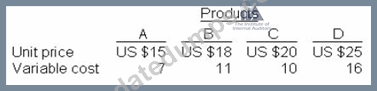
Units Produced per Machine Hour: A: 3 B: 4 C: 2 D: 3
The product that is the most profitable for the manufacturer in this situation is
- A. Product C
- B. Product A
- C. Product D
- D. Product B
Answer: D
Explanation:
Answer (B) is correct. When resources are limited, maximum profits are achieved by maximizing the dollar contribution margin per limited or constraining factor. In this situation, machine hours are the constraining factor. Product B has a contribution margin per machine hour of US $28 [A x (US $18 - $11)], which is greater than that of Product A [3 x (US $15 - $7) = US $24], Product C [2 x (US $20 - $10) = US $20], or Product D [3 x (US $25 - $16) = US $27].
NEW QUESTION 112
The best approach for minimizing the likelihood of software incompatibilities leading to unintelligible messages is for a company and its customers to:
- A. Each write their own version of the EDI-related software.
- B. Acquire their software from the same software vendor.
- C. Agree to use the same software in the same ways indefinitely.
- D. Agree to synchronize their updating of EDI-related software.
Answer: D
Explanation:
EDI entails the exchange of common business data converted into standard message formats. Thus, two crucial requirements are that the participants agree on transaction formats and that translation software be developed to convert messages into a form understandable by other companies. Thus, if one company changes its software, its trading partners must also do so.
NEW QUESTION 113
Which of the following statements is true regarding the relationship between an individual's average tax rate and marginal tax rate?
- A. In a regressive personal tax system, an individual's marginal tax rate is normally greater than his average tax rate.
- B. In a progressive personal tax system, an individual's marginal tax rate is normally greater than his average tax rate.
- C. In a regressive personal tax system, an individual's marginal tax rate is normally equal to his average tax rate.
- D. In a progressive personal tax system, an individual's marginal tax rate is normally equal to his average tax rate.
Answer: B
NEW QUESTION 114
In regression analysis, which of the following correlation coefficients represents the strongest relationship between the independent and dependent variables?
- A. -.89
- B. .75
- C. 1.03
- D. -02
Answer: A
Explanation:
Because the range of values is between -1 and 1.89 suggests a very strong inverse relationship between the independent and dependent variables. A value of -1 signifies a perfect inverse relationship, and a value of 1 signifies a perfect direct relationship.
NEW QUESTION 115
For a multinational organization, which of the following is a disadvantage of an ethnocentric staffing policy?
1. It significantly raises compensation and staffing costs.
2. It produces resentment among the organization's employees in host countries.
3. It limits career mobility for parent-country nationals.
4. It can lead to cultural myopia.
- A. 1 and 4 only
- B. 1, 2, and 4 only
- C. 2 and 3 only
- D. 1, 2, and 3 only
Answer: B
NEW QUESTION 116
An organization is considering the outsourcing of its business processes related to payroll and information technology functions. Which of the following is the most significant area of concern for management regarding this proposed agreement?
- A. Ensuring that payments to the vendor are appropriate and timely for the services delivered.
- B. Ensuring that the vendor has complete management control of the outsourced process.
- C. Ensuring that there are means of monitoring the efficiency of the outsourced process.
- D. Ensuring that there are means of monitoring the effectiveness of the outsourced process.
Answer: D
NEW QUESTION 117
The entity has a fixed assets balance of:
- A. US $16
- B. US $58
- C. US $0
- D. US $64
Answer: B
Explanation:
Total assets given as US $100) equals the sum of cash given as US $10), accounts receivable US $26), inventory, and fixed assets. Inventory can be determined because it is included in current, but not quick, assets, and the current and quick ratios are known.
Current assets equal US $42 1.4 current ratio x $30 current liabilities), and the quick assets equal US $36 1 2 quick ratio = $30 current liabilities). Thus, inventory, which is the only difference in this question between current and quick assets, equals US $6 $42 -$36). Fixed assets must then equal US $58 $100 total assets - $10 cash - $26 accounts receivable - $6 inventory).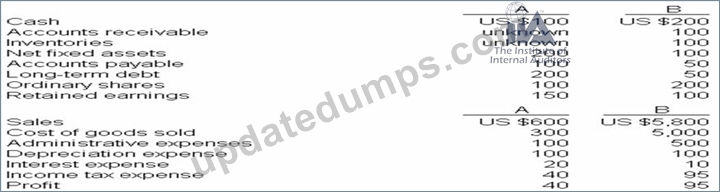
NEW QUESTION 118
An entity obtaining short-term financing with trade credit will pay a higher percentage financing cost, everything else being equal, when the:
- A. Items purchased have a lower price.
- B. Items purchased have a higher price.
- C. Supplier offers a longer discount period.
- D. Discount percentage is lower.
Answer: C
Explanation:
If the discount period is longer, the days of extra credit obtained by forgoing the discount are fewer. Assuming other factors are constant, the result is that the cost of trade credit, that is, the cost of not taking the discount, is greater.
NEW QUESTION 119
According to IIA guidance, which of the following corporate social responsibility (CSR)
evaluation activities may be performed by the internal audit activity?
1.Consult on CSR program design and implementation.
2.Serve as an advisor on CSR governance and risk management.
3.Review third parties for contractual compliance with CSR terms.
4.Identify and mitigate risks to help meet the CSR program objectives.
- A. 1, 2, and 4
- B. 2, 3, and 4
- C. 1, 2, and 3
- D. 1, 3, and 4
Answer: C
NEW QUESTION 120
Which of the following types of date analytics would be used by a hospital to determine which patients are likely to require remittance for additional treatment?
- A. Diagnostic analytics.
- B. Descriptive analytics.
- C. Prescriptive analytics.
- D. Predictive analytics.
Answer: D
NEW QUESTION 121
At the introduction stage of an innovative product, the profit growth is normally slow due to:
- A. Expensive sales promotion.
- B. High competition. C A mass market
- C. Available alternatives.
Answer: A
Explanation:
The introduction stage is characterized by slow sales growth and lack of profits because of the high expenses of promotion and selective distribution to generate awareness of the
product and encourage customers to try it. Thus, the per-customer cost is high. Competitors are few, basic versions of the product are produced, and higher-income customers innovators) are usually targeted. Cost-plus prices are charged. They may initially be high to permit cost recovery when unit sales are low. The strategy is to infiltrate the market, plan for financing to cope with losses, build supplier relations, increase production and marketing efforts, and plan for competition.
NEW QUESTION 122
One of the primary advantages of budgeting is that it:
- A. Is continually adapted to fit changing circumstances.
- B. Requires departmental managers to make plans in conjunction with the plans of other interdependent departments.
- C. Bases the profit plan on estimates.
- D. Does not take the place of management and administration.
Answer: B
Explanation:
A budget is a quantitative model of a plan of action developed by management. A budget functions as an aid to planning, coordination, and control. Thus, a budget helps management to allocate resources efficiently and to ensure that subunit goals are congruent with those of other subunits and of the organization.
NEW QUESTION 123
The costs of quality that are incurred in detecting units of product that do not conform to product specifications are referred to as
- A. Prevention costs.
- B. Appraisal costs.
- C. Failure costs.
- D. Rework costs.
Answer: B
Explanation:
Appraisal embraces such activities as statistical quality control programs, inspection, and testing. Appraisal costs are those costs such as test equipment maintenance and destructive testing) incurred to detect which products do not conform to specifications.
NEW QUESTION 124
When comparing the residual income of several investment centers the validity of comparisons may be destroyed by:
- A. Common amounts of invested capital for each investment center.
- B. Consistent use of an imputed interest rate.
- C. Differences in the relative amount of income.
- D. Peculiarities of each investment center.
Answer: D
Explanation:
Residual income is income of an investment center, minus an imputed interest charge for invested capital. The theory is that earning an income greater than residual income indicates that expansion is desirable. However, comparisons of investment centers based on residual income may be misleading because of differences in products, markets, costs, and local conditions.
NEW QUESTION 125
A value-added tax is collected on the basis of:
- A. The profit earned on an entity's sales.
- B. The value of an entity's sales to related companies.
- C. The difference between the selling price of a real estate property and the amount the entity originally paid for it.
- D. The difference between the value of an entity's sales and the value of its purchases from other domestic entities.
Answer: D
Explanation:
A value-added tax is similar to a retail sales tax on consumer goods. It is applied to the difference between the value of an entity's sales and the value of its purchases from other entities, that is. to the value added to the input In effect, a value-added tax is a national tax that penalizes consumption.
NEW QUESTION 126
......
IIA-CIA-Part3 Actual Questions and Braindumps: https://prepaway.updatedumps.com/IIA/IIA-CIA-Part3-updated-exam-dumps.html