

UpdateDumps 1z0-997-22 Dumps PDF - 100% Passing Guarantee
1z0-997-22 Braindumps Real Exam Updated on Mar 27, 2023 with 145 Questions
NEW QUESTION 56
You are working as a security consultant with a global insurance organization which is using Microsoft Azure Active Directory as an identity provider to manage user login/passwords. When a user logs in to Oracle Cloud Infrastructure (OCI) console, it should get authenticated by Azure AD.
Which set of steps are required to be configured in OCI to meet this requirement?
- A. Setup Azure AD as an Identity Provider, map Azure AD groups to OCI groups, set up the IAM policies to govern access to Azure AD groups.
- B. Setup Azure AD as an Enterprise Application, map Azure AD users, groups and policies to OCI groups and users.
- C. Setup Azure AD as an Enterprise Application, configure OCI for single sign-on, map Azure AD groups to OCI groups, set up the IAM policies to govern access to Azure AD groups.
- D. Setup Azure AD as an Identity Provider, import users and groups from Azure AD to OCI, set up IAM policies to govern access to Azure AD groups.
Answer: A
NEW QUESTION 57
You are working as a solution architect for an online retail store to create a portal to allow the users to pay for their groceries using credit cards. Since the application is not fully compliant with the Payment Card Industry Data Security Standard (PCI DSS), your company is looking to use a third party payment service to process credit card payments.
The third party service allows a maximum of Spelunk IP addresses 5 public IP addresses at a time However, your website is using Oracle Cloud Infrastructure (OCI) Instance Pool Auto Scaling policy to create up to create up to 15 Instances during peak traffic demand, which are launched In VCN private in VCN private subnets and attached to an OCI public Load Balancer. Upon user payment, the portal connects to the payment service over the Interne! to complete the transaction What solution can you implement to make sure that all compute Instances can connect to the third party system to process the payments aw peak traffic demand?
- A. Whitelist the Internet Gateway Public IP on the third party service and route all payment requests through the Internet Gateway.
- B. Route payment request from the compute instances through the OCI Load Balancer, which will then be routed to the third party service.
- C. Create an OCI Command Line Interface (CLI) script to automatically reserve public IP address for the compute instances. On the third-party services, whitelist the Reserved public IP.
- D. Route credit card payment request from the compute instances through the NAT Gateway. On the third-party services, whitelist the public IP associated with the NAT Gateway.
Answer: D
Explanation:
https://docs.oracle.com/en-us/iaas/Content/Balance/Concepts/balanceoverview.htm
NEW QUESTION 58
A manufacturing company is planning to migrate their on-premises database to Oracle Cloud Infrastructure and has hired you for the migration. Customer has provided following information regarding their existing on-premises database:
Database version, database character set, storage for data staging, acceptable length of system outage.
What additional information do you need from customer in order to recommend a suitable migration method? (Choose Two)
- A. Top 5 longest running queries.
- B. Number of active connections.
- C. Data types used in the on-premises database.
- D. Elapsed time since database was last patched.
- E. On-Premises host operating system and version.
Answer: C,E
NEW QUESTION 59
You are developing a Serverless function for your company's IoT project. This function should access Oracle Cloud Infrastructure (OCI) Object Storage to store some files. You choose Oracle Functions to deploy this function on OCI. However, your security team doesn't allow you to carry any API Token or RSA Key to authenticate the function against the OCI API to access the Object Storage.
What should you do to get this function to access OCI Object Storage without carrying any static authentication files? (Choose the best answer.)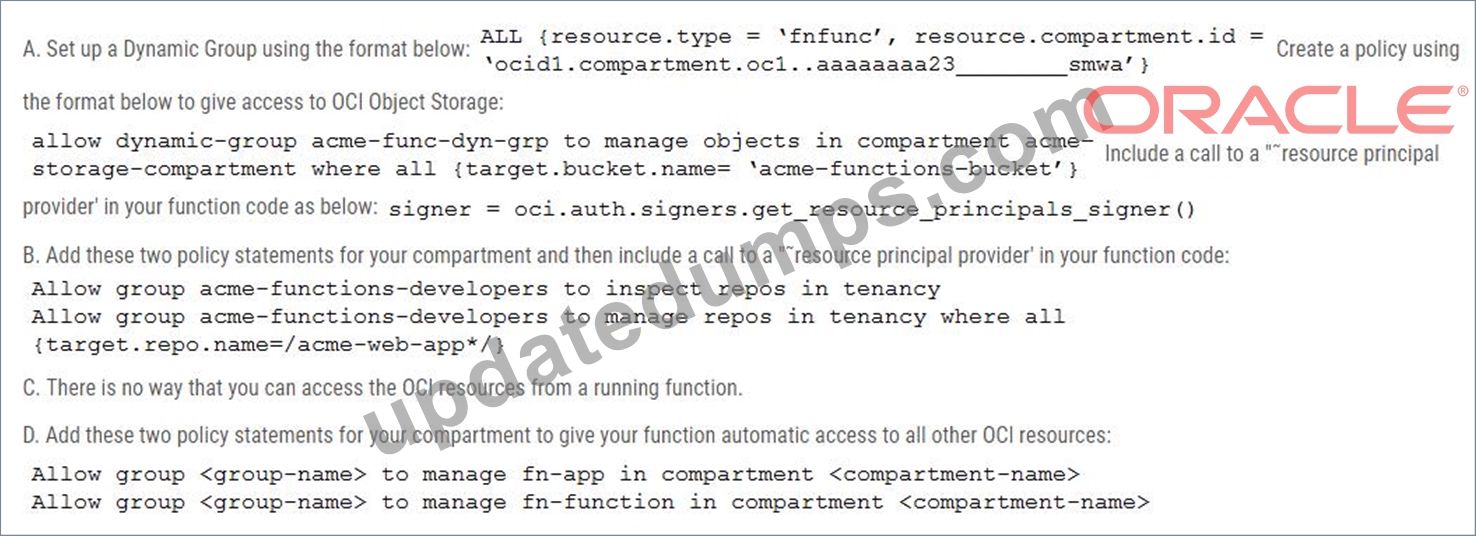
- A. Option C
- B. Option D
- C. Option A
- D. Option B
Answer: C
Explanation:
https://blogs.oracle.com/cloud-infrastructure/getting-started-with-oracle-functions-and-object-storage
NEW QUESTION 60
You work for a retail company and they developed a Microservices based shopping application that needs to access Oracle Autonomous Database from the application. As an Architect, you have been tasked to treat all of the application components as Kubernetes native objects, such as the microservices, Oracle Autonomous database, Kubernetes services, etc.
What should you do to make sure that you can use Kubernetes constructs to manage the life cycle of the application components, including Oracle Autonomous Database? (Choose the best answer.)
- A. Install and secure the OCI Service Broker for Kubernetes. Then provision and bind to the required Oracle Cloud Infrastructure services.
- B. Provision an Oracle Autonomous Database and then use OCI Service Broker to access the database as a native component to your Kubernetes cluster.
- C. Create a service from the Kubernetes cluster and point to the Oracle Autonomous Database using its FQDN.
- D. Create an Oracle Cloud Infrastructure (OCI) Service Gateway and connect to the Oracle Autonomous Database using the private IP address from the microservice.
Answer: A
Explanation:
OCI Service Broker for Kubernetes is an implementation of the Open Service Broker API. OCI Service Broker for Kubernetes is specifically for interacting with Oracle Cloud Infrastructure services from Kubernetes clusters. It includes three service broker adapters to bind to the following Oracle Cloud Infrastructure services: Object Storage Autonomous Transaction Processing Autonomous Data Warehouse
NEW QUESTION 61
You are tasked with backing up your data using Oracle Cloud Infrastructure Block Volume service.
When you are finalizing your block volume backup schedule, which of the following two are valid considerations for your backup plan? (Choose Two)
- A. Frequency: How often you want to back up your data.
- B. Location: Determine the Object Store Bucket where the backups will be stored.
- C. Number of stored backups: How many backups you need to keep available and the deletion schedule for those you no longer need.
- D. Encryption: Whether to use your own key to encrypt your volume backups.
- E. Governance: Tagging of backups so you can capture backup related API calls through the Audit service.
Answer: A,C
NEW QUESTION 62
A civil engineering company is running an online portal In which engineers can upload there constructions photos, videos, and other digital files.
There is a new requirement for you to implement: the online portal must offload the digital content to an Object Storage bucket for a period of 72 hours. After the provided time limit has elapsed, the portal will hold all the digital content locally and wait for the next offload period.
Which option fulfills this requirement?
- A. Create a pre-authenticated URL for the entire Object Storage bucket to read and list the content with an expiration of 72 hours.
- B. Create a pre authenticated URL for the entire Object Storage bucket to write content with an expiration of 72 hours.
- C. Create a pre authenticated URL lot each object that Is uploaded to the Object Storage bucket with an expiration of 72 hours.
- D. Create a Dynamic Group with matching rule for the portal compute Instance and grant access to the Object Storage bucket for 72 hours.
Answer: B
Explanation:
Pre-authenticated requests provide a way to let users access a bucket or an object without having their own credentials, as long as the request creator has permission to access those objects.
For example, you can create a request that lets operations support user upload backups to a bucket without owning API keys. Or, you can create a request that lets a business partner update shared data in a bucket without owning API keys.
When creating a pre-authenticated request, you have the following options:
You can specify the name of a bucket that a pre-authenticated request user has write access to and can upload one or more objects to.
You can specify the name of an object that a pre-authenticated request user can read from, write to, or read from and write to.
Scope and Constraints
Understand the following scope and constraints regarding pre-authenticated requests:
Users can't list bucket contents.
You can create an unlimited number of pre-authenticated requests.
There is no time limit to the expiration date that you can set.
You can't edit a pre-authenticated request. If you want to change user access options in response to changing requirements, you must create a new pre-authenticated request.
The target and actions for a pre-authenticated request are based on the creator's permissions. The request is not, however, bound to the creator's account login credentials. If the creator's login credentials change, a pre-authenticated request is not affected.
You cannot delete a bucket that has a pre-authenticated request associated with that bucket or with an object in that bucket.
NEW QUESTION 63
Your company has recently deployed a new web application that uses Oracle functions Your manager Instructed you to Implement major manage your systems more effectively. You know that Oracle functions automatically monitors functions on your behalf reports metrics through Service Metrics.
Which two metrics are collected and made available by this feature?
- A. length of time a function runs
- B. number of concurrent connections
- C. number of times a function is invoked
- D. amount of CPU used by a function
- E. number of times a function is removed
Answer: A,C
Explanation:
https://docs.cloud.oracle.com/en-us/iaas/Content/Functions/Reference/functionsmetrics.htm you can monitor the health, capacity, and performance of functions you've deployed to Oracle Functions by using metrics Oracle Functions monitors function execution, and collects and reports metrics such as:
The number of times a function is invoked.
The length of time a function runs for.
The number of times a function failed.
The number of requests to invoke a function that returned a '429 Too Many Requests' error in the response (known as 'throttled function invocations').
NEW QUESTION 64
To serve web traffic for a popular product, your cloud engineer has provisioned four BM.Standard2.52 instances, event spread across two availability domains in the us-asburn-1 region: LoadBalancer is used to deliver the traffic across instances.
After several months, the product grows even more popular and you need additional compute capacity. As a result, an engineer provisioned two additional VM.Standard2.8 instances.
You register the two VM. Standard2. 8 Instances with your load Balancer Backend sot and quickly find that the VM Standard2.8 Instances running at 100% of CPU utilization but the BM.Standard2 .52 instances have significant CPU capacity that's unused.
Which option is the most cost effective and uses instances capacity most effectively?
- A. Configure your Load Balance, with weighted round robin policy to distribute traffic to the compute instances, with more weight assigned to bare metal instances.
- B. Configure Autoscaling instance pool with LoadBalancer to add up to 3 more BM.Standard2.52 Instances when triggered. Shut off VM.Standard2.8 instances.
- C. Configure LoadBalancer with two VM Standard2.8 instances and use Autoscalling Instant pool to add up to two additional VM instances. Shut off BM.Standard2.52 instances.
- D. Route traffic to BM.Standard2.52 and VM Standard2.8 instances directly using DNS and Health Checks. Shut off the load Balances.
Answer: A
Explanation:
Customer have 4 BM.Standard2.52 and After several months he need additional compute capacity customer find The VM Standard2.8 Instances running at 100% of CPU utilization but the BM.Standard2 .52 instances have significant CPU capacity that unused.
so the customer need to check the Load balance policy to make sure the 4 BM and VM is utilize correctly
NEW QUESTION 65
Your organization is planning on using Oracle Cloud Infrastructure (OCI) File Storage Service (FSS). You will be deploying multiple compute instance in Oracle Cloud Infrastructure(OCI) and mounting the file system to these compute instances.
The file system will hold payment data processed by a Database instance and utilized by compute instances to create a overall inventory report. You need to restrict access to this data for specific compute instances and must be allowed/blocked per compute instance's CIDR block.
Which option can you use to secure access?
- A. Use stateless Security List rule to restrict access from known IP addresses only.
- B. Create and configure OCI Web Application Firewall service with built in DNS based intelligent routing.
- C. Use 'Export option' feature of FSS to restrict access to the mounted file systems.
- D. Create a new VCN security list, choose SOURCE TYPE as Service and SOURCE SERVICE as FSS. Add stateless ingress and egress rules for specific IP address and CIDR blocks.
Answer: C
NEW QUESTION 66
You are tasked with building a highly available, fault tolerant web application for your current employer. The security team is concerned about an increase in malicious web-based attacks across the internet and asked what you can do to add a higher level of security to the website.
How should you architect the solution on Oracle Cloud Infrastructure (OCI) to meet all requirements defined by your organization? (Choose the best answer.)
- A. Deploy at least 3 web application servers, each in a different fault domain, using a regional private subnet. Place a public load balancer in a regional public subnet and create a backend set for all of the web application servers. Deploy a Web Application Firewall (WAF) and configure the load balancer public IP address as the origin.
- B. Deploy at least 3 web application servers, each in a different fault domain, using a regional public subnet. Ensure that each web application server is assigned a public IP address. Deploy a Web Application Firewall (WAF) and configure one Origin for each public IP address.
- C. Deploy at least 3 web application servers, each in a different fault domain, using a regional public subnet. Use the OCI Traffic Management service to create a load balancing policy that will resolve DNS evenly between all web servers.
- D. Deploy at least 3 web application servers, each in a different fault domain, using a regional private subnet. Place a public load balancer in a regional public subnet and create a backend set for all of the web application servers. Create a Geolocation steering policy in Traffic Management and add an answer pool that directs to the public IP address of the load balancer. Configure a global catch-all rule to use this answer pool.
Answer: A
NEW QUESTION 67
You work for a German company as the Lead Oracle Cloud Infrastructure architect. You have designed a highly scalable architecture for your company's business critical application which uses the Load Balancer service auto which uses the Load Balancer service, autoscaling configuration for the application servers and a 2 Node VM Oracle RAC database. During the peak utilization period of the- application yon notice that the application is running slow and customers are complaining. This is resulting in support tickets being created for API timeouts and negative sentiment from the customer base.
What are two possible reasons for this application slowness?
- A. The Load Balancer configuration is not sending traffic to the listener of the application servers.
- B. Autoscaling configuration for the application servers didn't happen due to IAM policy that's blocking access to the application server compartment
- C. Autoscaling configuration for the application servers didn't happen due to compartment quota breach of the VM shapes used by the application servers.
- D. The Load Balancer doesn't have a Network Security Group to allow traffic to the application servers.
- E. Autoscaling configuration for the application servers didn't happen due to service limit breach of the VM shapes used by the application servers
Answer: C,E
Explanation:
Autoscaling
Autoscaling enables you to automatically adjust the number of Compute instances in an instance pool based on performance metrics such as CPU utilization. This helps you provide consistent performance for your end users during periods of high demand, and helps you reduce your costs during periods of low demand.
Prerequisites
- You have an instance pool. Optionally, you can attach a load balancer to the instance pool. For steps to create an instance pool and attach a load balancer, see Creating an Instance Pool.
- Monitoring is enabled on the instances in the instance pool. For steps to enable monitoring, see Enabling Monitoring for Compute Instances.
- The instance pool supports the maximum number of instances that you want to scale to. This limit is determined by your tenancy's service limits.
About Service Limits and Usage
When you sign up for Oracle Cloud Infrastructure, a set of service limits are configured for your tenancy.
The service limit is the quota or allowance set on a resource. For example, your tenancy is allowed a maximum number of compute instances per availability domain. These limits are generally established with your Oracle sales representative when you purchase Oracle Cloud Infrastructure.
Compartment Quotas
Compartment quotas are similar to service limits; the biggest difference is that service limits are set by Oracle, and compartment quotas are set by administrators, using policies that allow them to allocate resources with a high level of flexibility.
NEW QUESTION 68
There are two compartments: Networks and Devlnstances
There are two groups: NetworkAdmins with a user named Nick, and Devs with a user named Dave The following IAM policies are being used:
*Allow group NetworkAdmins to manage virtual-network-family in compartment Networks
*Allow group NetworkAdmins to manage instance-family in compartment Networks
*Allow group Devs to use virtual-network-family in compartment Networks
*Allow group Devs to manage all-resources in compartment Devlnstances
Nick creates a VCN in Networks compartment. Dave creates a VCN in Devlnstances compartment.
Which of the following statements is INCORRECT?
- A. Dave cannot launch new instances in Networks compartment
- B. Nick launches instances in Networks using VCN in Devlnstances compartment
- C. Dave launches instances in Devlnstances using the VCN in Networks compartment
- D. Nick cannot launch new instances in Devlnstances compartment
Answer: B
NEW QUESTION 69
A customer is in a process of shifting their web based Sales application from their own data center located in US West to OCI India West (Mumbai) region. They want to do it in a controlled manner and initially only 1% of the traffic will be steered to the servers in OCI. After verification of everything is working as expected, the company is gradually planning to increase the ratio until they are comfortable with fully migrating all traffic to OCI.
Which of the following solution can be used in this situation?
- A. OCI DNS and OCI Load Balancer Service
- B. OCI DNS and Traffic Management with Geolocation Steering policy
- C. OCI DNS and Traffic Management with Failover Steering policy
- D. OCI DNS and Traffic Management with Load Balancer Steering policy
Answer: B
Explanation:
STEERING POLICIES is A framework to define the traffic management behavior for your zones. Steering policies contain rules that help to intelligently serve DNS answers.
FAILOVER
Failover policies allow you to prioritize the order in which you want answers served in a policy (for example, Primary and Secondary). Oracle Cloud Infrastructure Health Checks are leveraged to determine the health of answers in the policy. If the Primary Answer is determined to be unhealthy, DNS traffic will automatically be steered to the Secondary Answer.
LOAD_BALANCE
Load Balancer policies allow distribution of traffic across multiple endpoints. Endpoints can be assigned equal weights to distribute traffic evenly across the endpoints or custom weights may be assigned for ratio load balancing. Oracle Cloud Infrastructure Health Checks are leveraged to determine the health of the endpoint. DNS traffic will be automatically distributed to the other endpoints, if an endpoint is determined to be unhealthy.
ROUTE_BY_GEO
Geolocation-based steering policies distribute DNS traffic to different endpoints based on the location of the end user. Customers can define geographic regions composed of originating continent, countries or states/provinces (North America) and define a separate endpoint or set of endpoints for each region.
ROUTE_BY_ASN
ASN-based steering policies enable you to steer DNS traffic based on Autonomous System Numbers (ASN).
DNS queries originating from a specific ASN or set of ASNs can be steered to a specified endpoint.
ROUTE_BY_IP
IP Prefix-based steering policies enable customers to steer DNS traffic based on the IP Prefix of the originating query.
NEW QUESTION 70
A manufacturing company is planning to migrate their on-premises database to OCI and has hired you for the migration. Customer has provided following information regarding their existing onpremises database:
Database version, host operating system and version, database character set, storage for data staging, acceptable length of system outage.
What additional information do you need from customer in order to recommend a suitable migration method? Choose two
- A. Top 5 longest running queries
- B. Number of active connections
- C. On-premises host operating system and version
- D. Elapsed time since database was last patched
- E. Data types used in the on-premises database
Answer: C,E
Explanation:
Not all migration methods apply to all migration scenarios. Many of the migration methods apply only if specific characteristics of the source and destination databases match or are compatible. Moreover, additional factors can affect which method you choose for your migration from among the methods that are technically applicable to your migration scenario.
Some of the characteristics and factors to consider when choosing a migration method are:
On-premises database version
Database service database version
On-premises host operating system and version
On-premises database character set
Quantity of data, including indexes
Data types used in the on-premises database
Storage for data staging
Acceptable length of system outage
Network bandwidth
NEW QUESTION 71
A telecom company has an application running in Oracle Cloud Infrastructure (OCI) Germany Central (eu-frankfurt-1) region. They want to configure Disaster Recovery (DR) site in the OCI UK South (uk-london-1) region. Which is the most cost effective option to help set up application and persistence layers in the DR site?
- A. Application layer: Set us a public laod balancerin the eu-frankfurt-1 region. Create a backend set with instances running in bothuk-frankfurt-1 and uk-london-1 regions.
Persistence layer: Set up OCI Object Storage replication from eu-frankfurt-1 region to uk-london-1 region. - B. Application layer: configure Traffic Management steering policy with Failover policy between servers in eu-frankfurt-1 and uk-london-1 regions.
Persistence layer: set up policy to schedule cross-region automated backups of file systems in File Storage service between eu-frankfurt-1 and uk-london-1 regions. - C. Application layer: configure Traffic Management steering policy with Load Balancing policy between servers in eu-frankfurt-1 and uk-london-1 regions.
Persistence layer: set up policy to schedule cross-region automated backups of block volumes between eu-frankfurt-1 and uk-london-1 regions. - D. Application layer: configure events service rule in eu-frankfurt-1 region to filter Health Checks event failure and route traffic to uk-london-1 region in the event of a disaster.
Persistence layer: set up policy to schedule cross-region automated backups of block volumes between eu-frankfurt-1 and uk-london-1 regions.
Answer: C
NEW QUESTION 72
Your company needs to migrate a business critical application from your data center to Oracle Cloud Infrastructure (OCI). The application runs on Oracle Database and both the application and database servers run on Oracle Linux version 7. The application server is WebLogic server running on multiple 4-core servers and the database is deployed as an Oracle Database Enterprise Edition RAC database on 2 servers (4-cores each).
Which method of database migration should you choose so that the application has minimal impact? (Choose the best answer.)
- A. Deploy Autonomous Transaction Processing Database on OCI and use the MV2ADB tool for the database migration.
- B. Deploy Virtual Machine RAC DB system on OCI and use the Oracle Database Backup module with RMAN to migrate the data from customer on-premises to OCI.
- C. Deploy Exadata Cloud Service Base rack and use Oracle Data Pump tool to migrate the data from customer on-premises to OCI.
- D. Deploy Virtual Machine RAC DB system on OCI and use the ZDM tool for the database migration.
Answer: D
Explanation:
https://docs.oracle.com/en/database/oracle/zero-downtime-migration/19.2/zdmug/introduction-to-zero-downtime-migration.html#GUID-FF4CA22F-CC83-4118-AF26-6E7BE224717F
NEW QUESTION 73
A company has an application that processes confidential dat
a. The data is currently stored in an on-premises data center. A solution architect needs to move this data to Oracle Cloud Infrastructure (OCI) Object Storage and ensure data is encrypted in-transit to OCI.
Which two steps should the solution architect perform to set up the most cost-effective connection between on-premises data center and OCI?
- A. Set up private end point for accessing Object Storage.
- B. Set up VPN Connect between the customer equipment and the Dynamic Routing Gateway.
- C. Configure a private peering connection on the Oracle FastConnect
- D. Set up an IPsec tunnel between the customer equipment and software VPN on an oci instance
- E. Configure a service gateway accessing Object Storage.
- F. Attach an Internet Gateway to Virtual Cloud network(VCN).
Answer: B,E
NEW QUESTION 74
You are currently working for a public health care company based in the United Stats. Their existing patient records runs in an on-premises data center and the customer is sending tape backups offsite as part of their recovery planning.
You have developed an alternative archival solution using Oracle Cloud Infrastructure (OCI) that will save the company a significant amount of mom on a yearly basis. The solution involves storing data in an OCI Object Storage bucket After reviewing your solution with the customer global Compliance (GRC) team they have highlighted the following security requirements:
* All data less than 1 year old must be accessible within 2 hour.
* All data must be retained for at least 10 years and be accessible within 48 hours
* AH data must be encrypted at rest
* No data may be transmitted across the public Internet
Which two options meet the requirements outlined by the customer GRC team?
- A. Provision a FastConnect link to the closest OCI region and configure a public peering virtual circuit
- B. Provision a FastConnect link to the closest OCI region and configure a private peering virtual circuit.
- C. Create an OCI Object Storage Standard tier bucket Configure a lifecycle policy to archive any object that Is older than 365 days
- D. Create a VPN connection between your on premises data center and OCI. Create a Virtual Cloud Network (VCN) along with an OCI Service Gateway for OCI Object Storage.
- E. Create an OCI Object Storage Standard tier bucket. Configure a lifecycle policy to delete any object that is older than 7 years
Answer: A,C
Explanation:
The Oracle Services Network is a conceptual network in Oracle Cloud Infrastructure that is reserved for Oracle services. These services have public IP addresses that you typically reach over the internet. However, you can access the Oracle Services Network without the traffic going over the internet. There are different ways, depending on which of your hosts need the access:
Hosts in your on-premises network:
- Private access through a VCN with FastConnect private peering or VPN Connect: The on-premises hosts use private IP addresses and reach the Oracle Services Network by way of the VCN and the VCN's service gateway.
- Public access with FastConnect public peering: The on-premises hosts use public IP addresses.
regarding which Fastconnect Public peering: To access public services in Oracle Cloud Infrastructure without using the internet. For example, Object Storage, the Oracle Cloud Infrastructure Console and APIs, or public load balancers in your VCN. Communication across the connection is with IPv4 public IP addresses. Without FastConnect, the traffic destined for public IP addresses would be routed over the internet. With FastConnect, that traffic goes over your private physical connection.
so Answer 4 will be the best answer that meets the customer requirement A service gateway lets your virtual cloud network (VCN) privately access specific Oracle services without exposing the data to the public internet. No internet gateway or NAT is required to reach those specific services. The resources in the VCN can be in a private subnet and use only private IP addresses. The traffic from the VCN to the Oracle service travels over the Oracle network fabric and never traverses the internet.
Object Lifecycle Management lets you automatically manage the archiving and deletion of objects. By using Object Lifecycle Management to manage your Object Storage and Archive Storage data, you can reduce your storage costs and the amount of time you spend managing data.
NEW QUESTION 75
A global media organization is working on a project which lets users upload their videos on their site. After upload is complete, the video should be automatically processed by an Al algorithm. The algorithm will try to recognize actions in the videos so that it can be used to show related advertisements in future. The development team wants to focus on writing Al code and don't want to worry about underlying infrastructure for high-availability, scalability, security and monitoring.
Which OCI services should you recommend for this project?
- A. Use Object Storage for storing videos, OCI Events service and OCI Functions
- B. Use OCI Resource Manager to manage the underlying infrastructure, OCI Functions and OCI Events service.
- C. Use Oracle Container Engine for Kubernetes (OKE) for deployment of Al Code, OCI Notifications and Object Storage
- D. Use OCI Events service for triggering automatic processing of video, Oracle Container Engine for Kubernetes (OKE) and OCI Digital Assistant
Answer: A
Explanation:
Oracle Functions is a fully managed, multi-tenant, highly scalable, on-demand, Functions-as-a-Service platform. It is built on enterprise-grade Oracle Cloud Infrastructure and powered by the Fn Project open source engine. Use Oracle Functions (sometimes abbreviated to just Functions) when you want to focus on writing code to meet business needs.
The serverless and elastic architecture of Oracle Functions means there's no infrastructure administration or software administration for you to perform. You don't provision or maintain compute instances, and operating system software patches and upgrades are applied automatically. Oracle Functions simply ensures your app is highly-available, scalable, secure, and monitored. With Oracle Functions, you can write code in Java, Python, Node, Go, and Ruby (and for advanced use cases, bring your own Dockerfile, and Graal VM). You can then deploy your code, call it directly or trigger it in response to events, and get billed only for the resources consumed during the execution.
You can create automation based on state changes for your Oracle Cloud Infrastructure resources by using event types, rules, and actions. When the function is executing inside the container, the function can read from and write to other resources and services running in the same subnet (for example, Database as a Service). The function can also read from and write to other shared resources (for example, Object Storage), and other Oracle Cloud Services.
NEW QUESTION 76
......
1z0-997-22 Dumps With 100% Verified Q&As - Pass Guarantee or Full Refund: https://prepaway.updatedumps.com/Oracle/1z0-997-22-updated-exam-dumps.html