

2026 Verified NSE5_FNC_AD_7.6 dumps Q&As on your Fortinet Network Security Expert Exam Questions Certain Success!
NSE5_FNC_AD_7.6 Exam Dumps - 100% Marks In NSE5_FNC_AD_7.6 Exam!
Fortinet NSE5_FNC_AD_7.6 Exam Syllabus Topics:
| Topic | Details |
|---|---|
| Topic 1 |
|
| Topic 2 |
|
| Topic 3 |
|
| Topic 4 |
|
NEW QUESTION # 32
An administrator wants FortiNAC-F to return a group of user-defined RADIUS attributes in RADIUS responses.
Which condition must be true to achieve this?
- A. The device models in the inventory view must be configured for proxy-based authentication.
- B. The requesting device must support RFC 5176.
- C. RADIUS accounting must be enabled on the FortiNAC-F RADIUS server configuration.
- D. Inbound RADIUS requests must contain the Calling-Station-ID attribute.
Answer: D
Explanation:
In FortiNAC-F, the RADIUS Attribute Groups feature allows administrators to return customized RADIUS attributes (such as specific VLAN IDs, filter IDs, or vendor-specific attributes) in an Access-Accept packet sent back to a network device. This is particularly useful for supporting "Generic RADIUS" devices that are not natively supported but can be managed using standard AVPairs.
According to the FortiNAC-F Generic RADIUS Wired Cookbook and the RADIUS Attribute Groups section of the Administration Guide, there is one critical prerequisite for this feature to function: the inbound RADIUS request must contain the Calling-Station-ID attribute. The Calling-Station-ID typically contains the MAC address of the connecting endpoint. Because FortiNAC-F is a host-centric system, it uses the MAC address as the unique identifier to look up the host record, evaluate the associated Network Access Policy, and determine which Logical Network (and thus which Attribute Group) should be applied. If the incoming request lacks this attribute, FortiNAC-F cannot reliably identify the host and, as a safety mechanism, will not include any user-defined RADIUS attributes in the response. This ensures that unauthorized or unidentifiable devices do not receive privileged access through misapplied attributes.
"Configure a set of attributes that must be included in the RADIUS Access-Accept packet returned by FortiNAC... Requirement: Inbound RADIUS request must contain Calling-Station-Id. Otherwise, FortiNAC will not include the RADIUS attributes. This attribute is used to identify the host and its current state within the FortiNAC database." - FortiNAC-F 7.6.0 Generic RADIUS Wired Cookbook: Configure RADIUS Attribute Groups.
NEW QUESTION # 33
When creating a user or host profile, which three criteria can you apply? (Choose three.)
- A. Host or user attributes
- B. Location
- C. Adapter current VLAN
- D. Host or user group memberships
- E. An applied access policy
Answer: A,B,D
Explanation:
TheUser/Host Profileis the primary mechanism in FortiNAC-F for identifying and categorizing endpoints to determine their level of network access. According to theFortiNAC-F Administration Guide, a profile is built using a combination of criteria that define " Who " is connecting, " What " device they are using, and " Where
" they are located on the network.
The three main categories of criteria available in the configuration are:
Host or User Attributes (B):This includes specific details such as the host ' s operating system, the user ' s role (e.g., Employee, Contractor), or custom attributes assigned to the record.
Host or User Group Memberships (A):Profiles can be configured to match endpoints that are members of specific internal FortiNAC groups or synchronized directory groups (like LDAP or Active Directory groups).
This allows for broad policy application based on organizational structure.
Location (E):The " Where " component allows administrators to restrict a profile match to specific physical or logical areas of the network, such as a particular switch, a group of ports, or a specific SSID.
Criteria like an " applied access policy " (D) are theoutcomeof a profile match rather than a criterion used to define the profile itself. Similarly, the " Adapter current VLAN " (C) is a dynamic state that changes based on enforcement and is not a standard static identifier used for profile matching.
" User/Host Profiles are used to identify the hosts and users to which a policy will apply. Profiles are created by selecting various criteria in theWho/What(Attributes and Groups) andWhere(Locations) sections.
Attributes can include Host Role, User Role, and OS. Group memberships allow matching based on internal or directory-based groups. Location criteria allow for filtering based on the device or port where the host is connected. " -FortiNAC-F Administration Guide: User/Host Profile Configuration.
NEW QUESTION # 34
An administrator has created several device profiling rules and evaluated all existing devices in the database.
Some of the devices appear in the profiled devices view because they matched a rule, but they remain unknown and the registration column in the profiled devices view shows " No " .
What is the most likely cause?
- A. The confirm device profiling rule option is not enabled.
- B. The devices match more than one device profiling rule.
- C. The devices have persistent agents installed, and the point of connection has PA optimization enabled.
- D. The device profiling rule has registration set to manual.
Answer: A
NEW QUESTION # 35
An organization wants to add a FortiNAC-F Manager to simplify their large FortiNAC-F deployment.
Which two policy types can be managed globally? (Choose two.)
- A. Network Access
- B. Authentication
- C. Supplicant EasyConnect
- D. Endpoint Compliance
Answer: A,D
Explanation:
The FortiNAC-F Manager is designed to centralize the management of multiple Control and Application (CA) appliances, ensuring consistent security posture across a distributed enterprise. To achieve this, the Manager allows administrators to define and distribute specific types of policies globally rather than configuring them on each individual CA.
According to the FortiNAC Manager Guide, the two primary policy types that are managed globally are:
Network Access Policies (D): These policies define the "If-Then" logic for network entry. By managing these at the global level, an administrator can ensure that a "Contractor" receives the same restricted access regardless of which branch office or campus they connect to.
Endpoint Compliance Policies (B): Global management of compliance policies-which consist of scans and configurations-allows for a unified security baseline. For example, a global policy can mandate that all Windows devices across the entire organization must have a specific antivirus version installed and active before gaining access to the production network.
While the Manager provides visibility into authentication events and can synchronize directory data, the specific Authentication (A) configurations (like local RADIUS secrets or specific LDAP server links) are often localized to the CA to account for site-specific infrastructure. Supplicant EasyConnect (C) is a feature set for onboarding, but the structural "Global Policy" engine focuses primarily on the Access and Compliance frameworks.
"The FortiNAC Manager enables Global Policy Management, allowing for the creation and distribution of policies across all managed CA appliances. This includes Network Access Policies, which control VLAN and ACL assignment, and Endpoint Compliance Policies, which define the security requirements for hosts. Centralizing these policies ensures that security standards are enforced uniformly across the global network fabric." - FortiNAC Manager Administration Guide: Global Policy Management Overview.
NEW QUESTION # 36
While deploying FortiNAC-F devices in a 1+1 HA configuration, the administrator has chosen to use the shared IP address option.
Which condition must be met for this type of deployment?
- A. The primary and secondary administrative interfaces are on the same subnet.
- B. The isolation network type is layer 3.
- C. There is a direct cable link between FortiNAC-F devices.
- D. The isolation network type is Layer 2.
Answer: A
Explanation:
In a 1+1 High Availability (HA) deployment, FortiNAC-F supports two primary methods for management access: individual IP addresses or a Shared IP Address (also known as a Virtual IP or VIP). The Shared IP option is part of a Layer 2 HA design, which simplifies administration by providing a single URL or IP that always points to whichever appliance is currently in the "Active" or "In Control" state.
For a Shared IP configuration to function correctly, the Primary and Secondary administrative interfaces (port1) must be on the same subnet. This requirement exists because the Shared IP is a logical address that is dynamically assigned to the physical interface of the active unit. Since only one unit can own the IP at a time, both units must reside on the same broadcast domain (Layer 2) to ensure that ARP requests for the Shared IP are correctly answered and that the gateway remains reachable regardless of which unit is active. If the appliances were on different subnets (a Layer 3 HA design), a shared IP could not be used because it cannot "float" across different network segments; instead, administrators would need to manage each unit via its unique physical IP or use a FortiNAC Manager.
"For L2 HA configurations, click the Use Shared IP Address checkbox and enter the Shared IP Address information... If your Primary and Secondary Servers are not in the same subnet, do not use a shared IP address. The shared IP address moves between appliances during a failover and recovery and requires both units to reside on the same network." - FortiNAC-F High Availability Reference Manual: Shared IP Configuration.
NEW QUESTION # 37
A user was attempting to register their host through the registration captive portal. After successfully registering, the host remained in the registration VLAN. Which two conditions would cause this behavior?
(Choose two.)
- A. The port default VLAN is the same as the Registration VLAN.
- B. There is no agent installed on the host.
- C. There is another unregistered host on the same port
- D. The wrong agent s installed.
Answer: A,C
Explanation:
The process of moving a host from aRegistration VLANto aProduction VLAN(Access VLAN) is a fundamental part of the FortiNAC-F " VLAN steering " workflow. When a host successfully registers via the captive portal, FortiNAC-F evaluates its Network Access Policies to determine the correct VLAN. If the host remains stuck in the Registration VLAN despite a successful registration, it is typically due to port-level restrictions or the presence of other unregistered devices.
The two most common reasons for this behavior as per the documentation are:
The port default VLAN is the same as the Registration VLAN:If the " Default VLAN " field in the switch port
' s model configuration is set to the same ID as the Registration VLAN, the port will not change state because FortiNAC-F believes it is already in its " normal " or " forced " state.
There is another unregistered host on the same port:FortiNAC-F maintains the security posture of the physical port. If multiple hosts are connected to a single port (e.g., via a hub or unmanaged switch) and at least one host remains " Rogue " (unregistered), FortiNAC-F will generally keep the entire port in the isolation
/registration VLAN to prevent the unregistered host from gaining unauthorized access to the production network.
Issues with agents (A, B) typically prevent a host from completing compliance or registration but do not usually result in a " stuck " statusafterregistration has already been marked as successful in the system.
" If a port is identified as havingMultiple Hosts, and those hosts require different levels of access, FortiNAC remains in the most restrictive state (Registration or Isolation) until all hosts on that port are authorized...
Additionally, verify theDefault VLANsetting for the port; if the Default VLAN and Registration VLAN match, the system will not trigger a VLAN change upon registration. " -FortiNAC-F Administration Guide:
Troubleshooting Host Management.
NEW QUESTION # 38
While discovering network infrastructure devices, a switch appears in the inventory topology with a question mark (?) on the icon. What would cause this?
- A. A read-only SNMP community siring was used.
- B. SNMP is not enabled on the switch.
- C. The wrong SNMP community string was entered during discovery.
- D. The SNMP ObjectlD is not recognized by FortiNAC-F.
Answer: D
Explanation:
In FortiNAC-F, theInventory topologyuses specific icons to represent the status and model of discovered network infrastructure. When a switch or other network device is discovered via SNMP, FortiNAC-F retrieves itsSystem ObjectID (sysObjectID)to identify the specific make and model. This OID is then compared against the internal database of supported device mappings.
Aquestion mark (?)icon appearing on a discovered switch indicates that while the discovery process successfully communicated with the device (meaning SNMP credentials were correct), theSNMP ObjectID is not recognizedor mapped in the current version of FortiNAC-F. This essentially means the device is " unsupported " by the current software out-of-the-box. Because the OID is unknown, FortiNAC-F does not know which CLI or SNMP command set to use for critical functions like L2 polling (host visibility) or VLAN switching (enforcement). To resolve this, an administrator can manually " Set Device Mapping " to a similar existing model or a " Generic SNMP Device " if only basic L3 visibility is required.
" Discovered devices displaying a ' ? ' iconindicate the currently running version does not have a mapping for that device ' sSystem OID(device is not supported). Device mappings are used to manage the device by performing functions such as L2/L3 Polling, Reading, and Switching VLANs. " -Fortinet Technical Tip:
Options for devices unable to be modeled in Inventory.
NEW QUESTION # 39
Refer to the exhibit.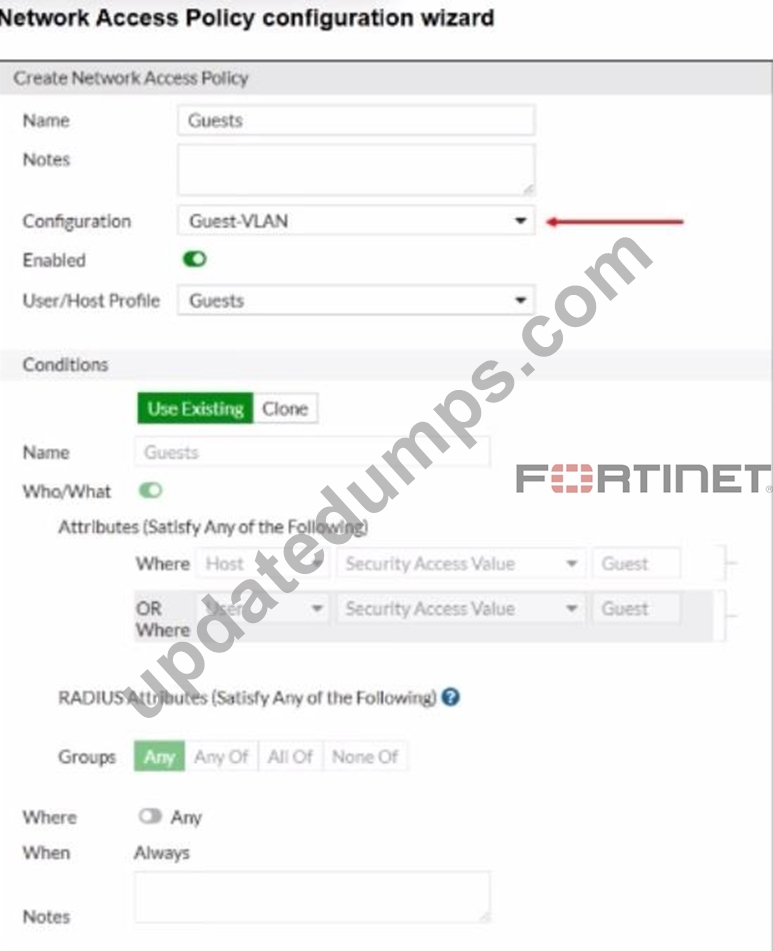
When configuring guest access using a network access policy, where would an administrator configure the Guest-VLAN value?
- A. In the Model configuration
- B. In the User/Host profile
- C. In the Guest template
- D. in the Guest portal configuration
Answer: A
Explanation:
The correct answer is A . In the exhibit, Guest-VLAN is selected as the network access policy Configuration
. That policy configuration points to a logical network, but the actual access value for that logical network is not defined inside the guest template, user/host profile, or guest portal. The FortiNAC-F study guide explains that logical networks translate policy-level names into device-specific access values, and those values are configured in the Model Configuration of the infrastructure device. It specifically states that device-specific configurations for infrastructure devices associate the configuration values with the devices, and that after a logical network is created, it appears within the model configuration of each modeled infrastructure device.
So, Guest-VLAN is the logical network selected by the network access policy, while the actual VLAN ID, VLAN name, SSID role, controller group, or vendor-specific access value is configured under the relevant switch, AP, controller, or firewall Model Configuration . Option B is wrong because the guest template defines guest account properties such as role, security/access value, password settings, account duration, and login availability. Option C is wrong because the user/host profile defines the matching condition for guests.
Option D is wrong because the guest portal controls onboarding or login behavior, not the infrastructure access value used to provision the endpoint.
NEW QUESTION # 40
As part of a company policy, all end stations must be scanned for compliance each day. The security administrators want to satisfy this requirement without any necessary interaction from the end user. Which two agents can provide that functionality? (Choose two.)
- A. Dissolvable
- B. Passive
- C. Mobile
- D. Persistent
Answer: B,D
Explanation:
The correct answers are B and C . The persistent agent is the strongest fit because it is installed and stays resident on the endpoint. The study guide states that after deployment, the persistent agent communicates back to FortiNAC-F every 15 minutes and performs scheduled scans in the background, transparent to the end user. That directly satisfies the requirement for recurring compliance scans without user involvement.
The passive agent can also scan Windows domain end stations without end-user interaction. The guide states that the passive agent is deployed through login/logoff scripts and administrative templates, and that passive agent registration can register and scan hosts associated with LDAP or Active Directory users. If enabled, the passive agent scans the host to verify compliance with the appropriate endpoint policy.
Option A is wrong because the dissolvable agent is a run-once agent that requires manual end-user interaction in the captive portal, then removes itself after reporting results. Option D is not the best answer for this requirement because the mobile agent is specifically for Android onboarding and is manually installed; it is not the general solution for daily compliance scanning of all end stations.
NEW QUESTION # 41
Refer to the exhibits.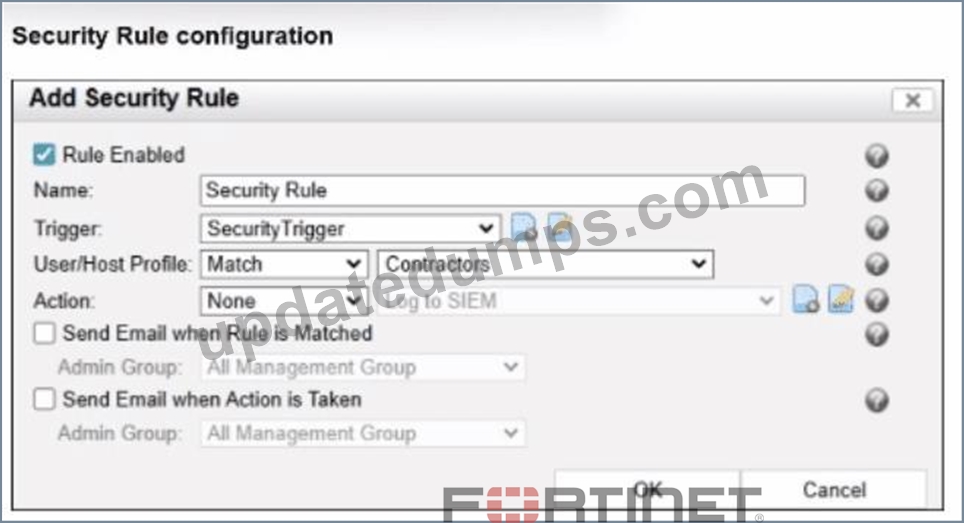
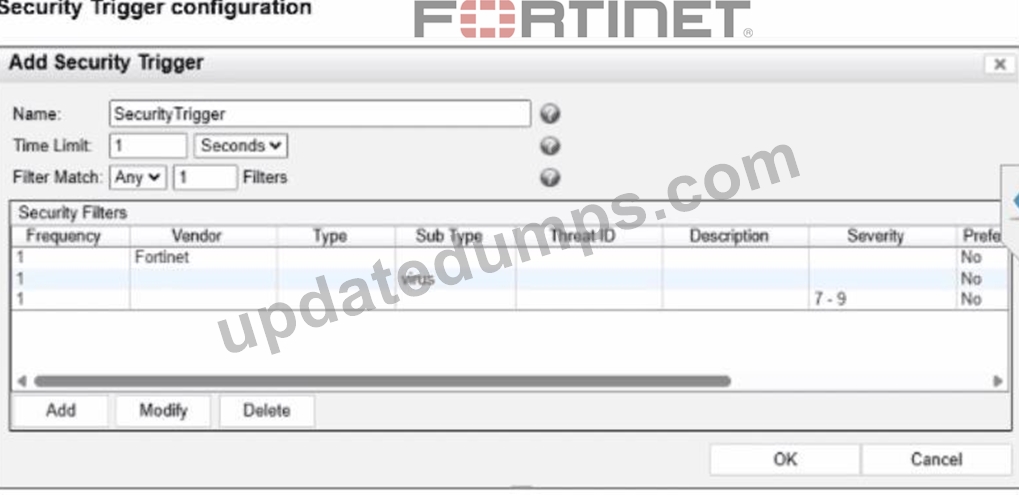
Given the current configuration, what would happen if a contractor triggered two of the defined security filters?
- A. Three security events and one security alarm would be generated.
- B. A security alarm and two security events would be generated.
- C. A security event and a security alarm would be generated.
- D. Two security events would be generated, but no security alarm would be generated
Answer: B
Explanation:
The correct answer is B . In the trigger exhibit, the Filter Match setting is configured as Any 1 Filters , meaning the security trigger is satisfied when any one of the defined filters matches within the configured time window. The contractor triggers two of the defined filters, so two separate security events are generated because FortiNAC-F creates a security event whenever a security filter matches. The study guide confirms that each matched filter generates a security event, and when a trigger contains multiple filters, multiple matched filters can be associated with the resulting alarm.
The security rule exhibit also shows User/Host Profile: Match Contractors . Because the triggering user is a contractor, the user/host profile condition is satisfied. Once the trigger is satisfied and the user/host profile matches, FortiNAC-F generates a security alarm . The fact that Action is set to None does not stop the alarm from being generated; it only means no automated or manual response action is executed from that rule.
Option A is wrong because the contractor profile matches, so an alarm is generated. Option C is wrong because only two filters were triggered, not three. Option D is wrong because two filters matched, so two events are generated, not one.
NEW QUESTION # 42
When FortiNAC-F is managing VPN clients connecting through FortiGate, why must the clients run a FortiNAC-F agent?
- A. To transparently update The client IP address upon successful authentication
- B. To validate the endpoint policy compliance
- C. To collect user authentication details
- D. To collect the client IP address and MAC address
Answer: D
Explanation:
When FortiNAC-F manages VPN clients through a FortiGate, the agent plays a fundamental role in device identification that standard network protocols cannot provide on their own. In a standard VPN connection, the FortiGate establishes a Layer 3 tunnel and assigns a virtual IP address to the client. While the FortiGate sends a syslog message to FortiNAC-F containing the username and this assigned IP address, it typically does not provide the hardware (MAC) address of the remote endpoint's physical or virtual adapter.
FortiNAC-F relies on the MAC address as the primary unique identifier for all host records in its database. Without the MAC address, FortiNAC-F cannot correlate the incoming VPN session with an existing host record to apply specific policies or track the device's history. By running either a Persistent or Dissolvable Agent, the endpoint retrieves its own MAC address and communicates it directly to the FortiNAC-F service interface. This allows the "IP to MAC" mapping to occur. Once FortiNAC-F has both the IP and the MAC, it can successfully identify the device, verify its status, and send the appropriate FSSO tags or group information back to the FortiGate to lift network restrictions.
Furthermore, while the agent can also perform compliance checks (Option D), the architectural requirement for the agent in a managed VPN environment is primarily driven by the need for session data correlation-specifically the collection of the IP and MAC address pairing.
"Session Data Components: * User ID (collected via RADIUS, syslog and API from the FortiGate). * Remote IP address for the remote user connection (collected via syslog and API from the FortiGate and from the FortiNAC agent). * Device IP and MAC address (collected via FortiNAC agent). ... The Agent is used to provide the MAC address of the connecting VPN user (IP to MAC)." - FortiNAC-F FortiGate VPN Integration Guide: How it Works Section.
NEW QUESTION # 43
As part of a FortiNAC-F integration with FortiGate for management of VPN users, what must be configured on FortiGate to keep FortiNAC-F up to date with VPN session information?
- A. Security Fabric integration
- B. SNMP traps
- C. RADIUS accounting
- D. Syslog messages
Answer: D
Explanation:
The correct answer is D . For FortiGate VPN integration, FortiNAC-F depends on syslog from FortiGate to receive VPN user, IP address, and session information. The FortiNAC-F study guide states that after a remote user successfully authenticates and establishes a VPN connection, FortiGate sends user, IP, and session information to FortiNAC-F using syslog. This keeps FortiNAC-F aware of the VPN session so it can apply the correct access control state and update FortiGate when the device becomes trusted.
Option A is wrong because SNMP traps are commonly used for infrastructure events, link traps, or third-party event inputs, but this VPN workflow uses FortiGate syslog. Option B is wrong because RADIUS accounting can update session information in some NAC workflows, but the FortiGate VPN integration described in the guide uses syslog. Option C is wrong because Security Fabric integration is not the required mechanism for keeping FortiNAC-F updated with VPN session details in this scenario.
NEW QUESTION # 44
How can an administrator configure FortiNAC-F to normalize incoming syslog event levels across vendors?
- A. Configure the vendor OUI settings.
- B. Configure event to alarm mappings.
- C. Configure the security rule settings.
- D. Configure severity mappings.
Answer: D
Explanation:
FortiNAC-F serves as a central manager for security events originating from a diverse ecosystem of third- party security appliances, such as FortiGate, Check Point, and Cisco. Each vendor utilizes its own internal scale forseverity levelswithin syslog messages (e.g., Check Point uses a 1-5 scale, while others may use 0-7).
To provide a consistent response regardless of the source, FortiNAC-F usesSeverity Mappingsto normalize these incoming values.
According to theFortiNAC-F Administration Guide, severity mappings allow the administrator to translate vendor-specific threat levels into standardizedFortiNAC Security Levels(such as High, Medium, or Low Violation). When a syslog message arrives, the parser extracts the vendor ' s severity code, and the system immediately references theSecurity Event Severity Level Mappingstable to determine how that event should be categorized internally. This normalization is vital because it allows a singleSecurity Alarmto be configured to respond to any " High Violation " event, whether it was reported as a " Critical " by one vendor or a " Level
5 " by another. Without these mappings, the administrator would have to create separate, redundant security rules for every vendor to account for their different naming conventions and numerical scales.
" Each vendor defines its own severity levels for syslog messages. The following table shows the equivalent FortiNAC security level... To normalize these events, configure theSeverity Level Mappingsfound in the device integration guides. This allows FortiNAC to generate a consistent security event that can then trigger an alarm regardless of the reporting vendor ' s specific terminology. " -FortiNAC-F Administration Guide:
Vendor Severity Levels and Syslog Management.
NEW QUESTION # 45
Refer to the exhibit.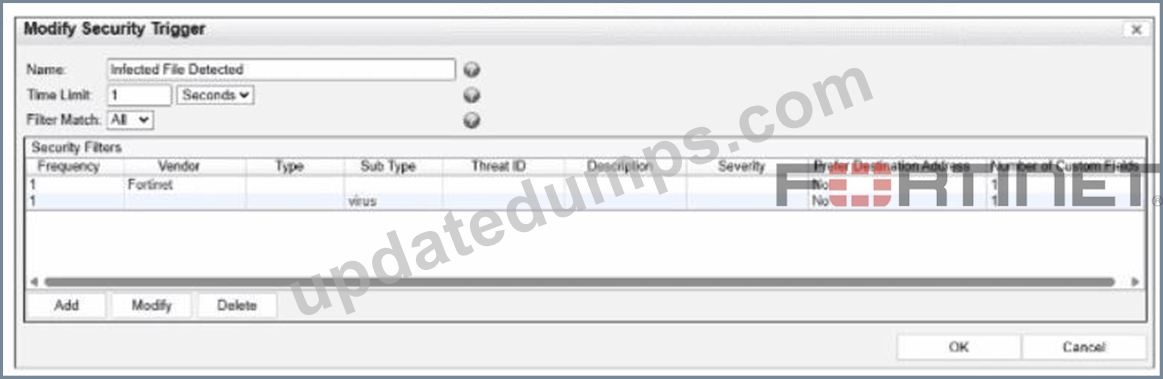
What would FortiNAC-F generate if only one of the security fitters is satisfied?
- A. A normal alarm
- B. A security alarm
- C. A security event
- D. A normal event
Answer: D
Explanation:
In FortiNAC-F,Security Triggersare used to identify specific security-related activities based on incoming data such as Syslog messages or SNMP traps from external security devices (like a FortiGate or an IDS).
These triggers act as a filtering mechanism to determine if an incoming notification should be escalated from a standard system event to aSecurity Event.
According to theFortiNAC-F Administrator Guideand relevant training materials for versions 7.2 and 7.4, theFilter Matchsetting is the critical logic gate for this process. As seen in the exhibit, the " Filter Match " configuration is set to " All " . This means that for the Security Trigger named " Infected File Detected " to " fire " and generate a Security Event or a subsequent Security Alarm,every single filterlisted in the Security Filters table must be satisfied simultaneously by the incoming data.
In the provided exhibit, there are two filters: one looking for the Vendor " Fortinet " and another looking for the Sub Type " virus " . If only one of these filters is satisfied (for example, a message from Fortinet that does not contain the " virus " subtype), the logic for the Security Trigger is not met. Consequently, FortiNAC-F does not escalate the notification. Instead, it processes theincoming data as aNormal Event, which is recorded in the Event Log but does not trigger the automated security response workflows associated with security alarms.
" The Filter Match option defines the logic used when multiple filters are defined. If ' All ' is selected, then all filter criteria must be met in order for the trigger to fire and aSecurity Eventto be generated. If the criteria are not met, the incoming data is processed as anormal event. If ' Any ' is selected, the trigger fires if at least one of the filters matches. " -FortiNAC-F Administration Guide: Security Triggers Section.
NEW QUESTION # 46
While discovering network infrastructure devices, a switch appears in the inventory topology with a question mark (?) on the icon. What would cause this?
- A. A read-only SNMP community siring was used.
- B. SNMP is not enabled on the switch.
- C. The wrong SNMP community string was entered during discovery.
- D. The SNMP ObjectlD is not recognized by FortiNAC-F.
Answer: D
Explanation:
In FortiNAC-F, the Inventory topology uses specific icons to represent the status and model of discovered network infrastructure. When a switch or other network device is discovered via SNMP, FortiNAC-F retrieves its System ObjectID (sysObjectID) to identify the specific make and model. This OID is then compared against the internal database of supported device mappings.
A question mark (?) icon appearing on a discovered switch indicates that while the discovery process successfully communicated with the device (meaning SNMP credentials were correct), the SNMP ObjectID is not recognized or mapped in the current version of FortiNAC-F. This essentially means the device is "unsupported" by the current software out-of-the-box. Because the OID is unknown, FortiNAC-F does not know which CLI or SNMP command set to use for critical functions like L2 polling (host visibility) or VLAN switching (enforcement). To resolve this, an administrator can manually "Set Device Mapping" to a similar existing model or a "Generic SNMP Device" if only basic L3 visibility is required.
"Discovered devices displaying a '?' icon indicate the currently running version does not have a mapping for that device's System OID (device is not supported). Device mappings are used to manage the device by performing functions such as L2/L3 Polling, Reading, and Switching VLANs." - Fortinet Technical Tip: Options for devices unable to be modeled in Inventory.
NEW QUESTION # 47
When working with a FortiNAC-F Manager and cluster management, what will occur when a cluster manager recovers from a non-responsive state?
- A. It automatically returns to the manager state.
- B. It will be removed from the cluster and placed in a standalone group.
- C. It rejoins the cluster as a worker node.
- D. It will perform a health check and be demoted to standby.
Answer: C
Explanation:
The correct answer is C . In FortiNAC-F Manager clustering, the active cluster management role is the leader role, and other cluster members operate as worker nodes. Fortinet's FortiNAC-F 7.6 Manager Cluster Guide states that when a worker is promoted to leader during automatic transition, the original leader becomes a worker node when it comes back online. It also explains that a cluster has one leader and can have multiple workers, with leader/worker roles used for cluster management and heartbeat exchange.
So, if the cluster manager becomes non-responsive and another node takes over leadership, the recovered manager does not automatically reclaim the leader role. It rejoins as a worker node. Option A is wrong because recovery does not automatically remove it into a standalone group. Option B is wrong because automatic return to the previous manager/leader state would create instability and possible split-brain behavior. Option D is wrong because "standby" is not the role described for FortiNAC-F Manager clustering in this context; the documented cluster roles are leader and worker.
NEW QUESTION # 48
Refer to the exhibits.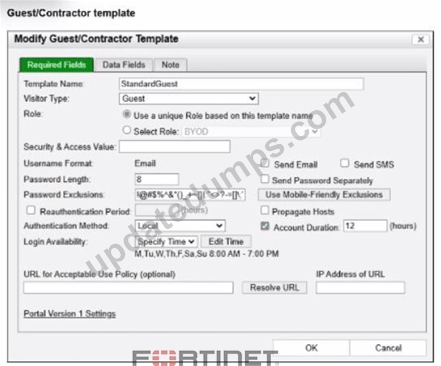
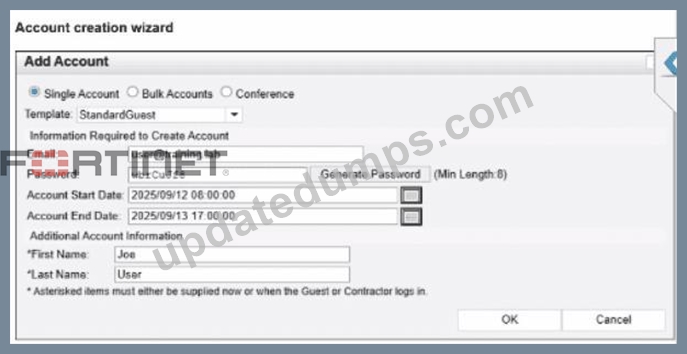
Based on the given configurations and settings, on which date and time would a guest account created at 8:00 AM on 2025/09/12 expire?
- A. 2025/09/12 at 8:00 PM
- B. 2025/09/12 at 7:00 PM
- C. 2025/09/12 at 17:00:00
- D. 2025/09/13 at 17:00:00
Answer: D
Explanation:
Questions no:22
Verified answer: D
Comprehensive and Detailed 250 to 300 words each Explanation with Exact Matched Extract from FortiNAC- F Administrator library and documentation for current versions (including F 7.2, 7.4, and 7.6) documents:
In FortiNAC-F, the expiration of a guest or contractor account is determined by the configuration settings within theAccount Creation Wizardand the associatedGuest/Contractor Template. While a template can define a default " Account Duration " (as seen in the 12-hour setting in the second exhibit), theAccount Creation Wizardallows an administrator to manually specify or override the start and end parameters for a specific user session.
According to theFortiNAC-F Administration Guideregarding guest management, theAccount End Datefield in the creation wizard is the definitive timestamp for when the account object will be disabled or deleted from the system. In the provided exhibit (Account Creation Wizard), the administrator has explicitly set theAccount Start Dateto2025/09/12 08:00:00and theAccount End Dateto2025/09/13 17:00:00.
Even though the template indicates an " Account Duration " of 12 hours, this value typically serves as a pre- populated default. When a manual date and time are entered into the wizard, those specific values take precedence for that individual account. The account will remain active and valid until5:00 PM (17:00:00)on the following day,2025/09/13. It is also important to note the " Login Availability " from the template (8:00 AM - 7:00 PM); while the accountexistsuntil the 13th at 17:00:00, the user would only be able to authenticate during the active hours defined by the login schedule on both days.
" When creating an account, the administrator can select a template to provide default settings. However, specific values such as theAccount End Datecan be modified within theAccount Creation Wizard. The date and time specified in the ' Account End Date ' field determines the absolute expiration of the account. Once this time is reached, the account is moved to an expired state and the user ' s network access is revoked. " - FortiNAC-F Administration Guide: Guest and Contractor Account Management.
NEW QUESTION # 49
Two FortiNAC-F devices have been configured as a 1 + 1 HA pair. The primary server went offline and a successful failover to the secondary has occurred. What happens if the primary server comes back online?
- A. The secondary server will update the primary and the servers will load balance until an administrator forces the primary to resume full control.
- B. The primary server will determine that the secondary has control and power down for maintenance.
- C. The primary and secondary servers will resume communication and the secondary will maintain control.
- D. After five successful heartbeats between the servers, the primary server will resume control.
Answer: C
Explanation:
The correct answer is A . In a FortiNAC-F 1+1 HA deployment, failover from primary to secondary is automatic, but failback to the primary is not automatic . The study guide states that if the primary device or its network connectivity fails, the secondary assumes control automatically, but restoration of a failed-over HA deployment is a manual administrator-driven process. It further explains that after the cause of the failover is resolved, the administrator must use the Resume Control button to transfer control back to the primary server.
That means when the primary comes back online, it does not immediately take over again. The pair can resume HA communication, but the secondary remains the in-control node until an administrator deliberately returns control to the primary. Option B is wrong because FortiNAC-F 1+1 HA is active-passive, not load- balanced. Option C is wrong because the restored primary does not power itself down for maintenance.
Option D is a trap: five failed heartbeats are used in failure detection and gateway validation logic, not as an automatic failback timer. The exam point is simple: automatic failover, manual failback .
NEW QUESTION # 50
During the testing of a newly modeled infrastructure switch, the administrator is not seeing hosts as they connect or move from one port to another. What would cause this issue?
- A. Layer 3 polling is failing.
- B. Contact polling is not configured.
- C. The default scheduled polling is disabled.
- D. MAC notification traps are misconfigured.
Answer: D
Explanation:
The correct answer is A . When FortiNAC-F needs near real-time Layer 2 visibility, it relies on link traps, MAC notification traps, RADIUS, or scheduled/manual Layer 2 polling. The study guide explains that MAC notification traps contain the MAC address learned or removed from the switch MAC address table and the associated port, allowing FortiNAC-F to update its database when hosts connect, disconnect, or move. It also states that MAC notification traps are the preferred method for learning and updating Layer 2 information.
If a newly modeled switch does not show hosts as they connect or move between ports, the likely problem is that MAC notification traps are not correctly configured or not reaching FortiNAC-F . Layer 3 polling failure would affect IP-to-MAC correlation, not the ability to learn which switch port a MAC address is connected to. Disabled scheduled polling could delay updates, but it would not be the best explanation when the expected behavior is immediate host detection during connection or movement testing. Contact polling only checks whether the device is reachable; it does not collect host MAC-to-port visibility.
NEW QUESTION # 51
Which two requirements must be met to set up an N+1 HA cluster? (Choose two.)
- A. A FortiNAC-F device designated as a secondary
- B. A dedicated VLAN for primary and secondary synchronization
- C. A FortiNAC-F manager
- D. At least two FortiNAC-F devices designated as primary
Answer: A,C
Explanation:
TheN+1 High Availability (HA)architecture was introduced in FortiNAC-F version 7.6 to provide a more scalable and flexible redundancy model compared to the traditional 1+1 active/passive setup. In an N+1 configuration, a single secondary (standby) appliance can provide coverage for multiple primary (active) Control and Application (CA) appliances.
To set up an N+1 HA cluster, there are two fundamental structural requirements:
A FortiNAC-F Manager (FortiNAC-M):Unlike standard 1+1 HA, which can be configured directly between two CAs, N+1 management is centralized. The FortiNAC-M acts as the orchestrator that manages the failover groups, monitors the health of the primaries, and coordinates the promotion of the secondary server if a primary fails.
A FortiNAC-F device designated as a Secondary:The cluster must have one appliance explicitly configured with theSecondary failover role. This device remains in a standby state, receiving database replications from all N primaries in its group until it is called upon to take over the functions of a failed unit.
While a cluster can support multiple primaries (D), it does not strictly require " at least two " to function as an N+1 group; it simply requires N primaries (where N # 1). Additionally, N+1 is typically a Layer 3 managed solution via the Manager, meaning it does not mandate a " dedicated VLAN " for synchronization like some Layer 2 HA deployments.
" In FortiNAC-F 7.6,FortiNAC-Mfunctions as a manager to manage the N+1 Failover Groups... enabling N+M high availability for CAs. To create an N+1 Failover group, you should add thesecondary CAto the FortiNAC-M first, then add the primary CAs. The secondary CA is designed to take over the functionality of any single failed primary component. " -FortiNAC-F 7.6.0 N+1 Failover Reference Manual.
NEW QUESTION # 52
When preparing network infrastructure devices for visibility, what are the two main advantages of using MAC notification traps on supported devices instead of link-up and link-down traps? (Choose two.)
- A. Faster visibility updates with only a slight increase in processing.
- B. Hosts connecting to downstream non-managed hubs are immediately learned.
- C. Overhead on FortiNAC-F and the infrastructure device is reduced.
- D. MAC notification traps include IP address information.
Answer: B,C
Explanation:
Comprehensive and Detailed Explanation From Exact Extract of FortiNAC-F 7.6 Administrator Guide or Knowledge:
Exact Extract:
The FortiNAC-F study guide states that MAC notification traps are preferred because FortiNAC-F does not need to connect back to the infrastructure device every time a link-up or link-down trap is received. The required MAC and port information is already included in the MAC notification trap, which makes database updates faster and uses fewer resources. It also states that hosts and devices connected through hubs or IP phones are seen immediately, even when the downstream device cannot generate link-up or link-down traps.
Technical Deep Dive:
The correct answers are B and C . With link-up/link-down traps, the trap only tells FortiNAC-F that an interface changed state. FortiNAC-F then has to perform an L2 poll against the switch forwarding table to discover which MAC address appeared or disappeared. That means extra SNMP/CLI activity, more delay, and more processing on both FortiNAC-F and the switch. The guide confirms that link traps trigger FortiNAC- F to perform a Layer 2 poll, while MAC notification traps directly contain the learned or removed MAC address and associated port.
Option A is wrong because MAC notification traps are Layer 2 visibility events. They identify MAC address and port , not IP address. IP-to-MAC correlation comes from Layer 3 polling or DHCP fingerprinting, not MAC notification traps. Option D is badly worded and should not be selected: MAC notification traps do provide faster updates, but the processing overhead is reduced, not slightly increased.
Operationally, on supported switches you enable SNMP traps for MAC address-table changes and point the trap destination to FortiNAC-F. On Cisco-style infrastructure, this is usually done with commands such as snmp-server host < FortiNAC-IP > version 2c < community > plus MAC notification trap configuration. Do not enable MAC notification traps on uplinks, because uplinks learn many downstream MAC addresses and would create misleading endpoint-location data.
NEW QUESTION # 53
A user was attempting to register their host through the registration captive portal. After successfully registering, the host remained in the registration VLAN. Which two conditions would cause this behavior? (Choose two.)
- A. The port default VLAN is the same as the Registration VLAN.
- B. There is no agent installed on the host.
- C. There is another unregistered host on the same port
- D. The wrong agent s installed.
Answer: A,C
Explanation:
The process of moving a host from a Registration VLAN to a Production VLAN (Access VLAN) is a fundamental part of the FortiNAC-F "VLAN steering" workflow. When a host successfully registers via the captive portal, FortiNAC-F evaluates its Network Access Policies to determine the correct VLAN. If the host remains stuck in the Registration VLAN despite a successful registration, it is typically due to port-level restrictions or the presence of other unregistered devices.
The two most common reasons for this behavior as per the documentation are:
The port default VLAN is the same as the Registration VLAN: If the "Default VLAN" field in the switch port's model configuration is set to the same ID as the Registration VLAN, the port will not change state because FortiNAC-F believes it is already in its "normal" or "forced" state.
There is another unregistered host on the same port: FortiNAC-F maintains the security posture of the physical port. If multiple hosts are connected to a single port (e.g., via a hub or unmanaged switch) and at least one host remains "Rogue" (unregistered), FortiNAC-F will generally keep the entire port in the isolation/registration VLAN to prevent the unregistered host from gaining unauthorized access to the production network.
Issues with agents (A, B) typically prevent a host from completing compliance or registration but do not usually result in a "stuck" status after registration has already been marked as successful in the system.
"If a port is identified as having Multiple Hosts, and those hosts require different levels of access, FortiNAC remains in the most restrictive state (Registration or Isolation) until all hosts on that port are authorized... Additionally, verify the Default VLAN setting for the port; if the Default VLAN and Registration VLAN match, the system will not trigger a VLAN change upon registration." - FortiNAC-F Administration Guide: Troubleshooting Host Management.
NEW QUESTION # 54
A network administrator is troubleshooting a network access issue for a specific host. The administrator suspects the host is being assigned a different network access policy than expected.
Where would the administrator look to identify which network access policy, if any, is being applied to a particular host?
- A. The Port Properties view of the hosts port
- B. The Policy Logs view
- C. The Connections view
- D. The Policy Details view for the host
Answer: D
Explanation:
When troubleshooting network access in FortiNAC-F, it is often necessary to verify exactly why a host has been granted a specific level of access. Since FortiNAC-F evaluates policies from the top down and assigns access based on the first match, an administrator needs a clear way to see the results of this evaluation for a specific live endpoint.
The Policy Details (C) view is the designated tool for this purpose. By navigating to the Hosts > Hosts (or Adapter View) in the Administration UI, an administrator can search for the specific MAC address or IP of the host in question. Right-clicking on the host record reveals a context menu from which Policy Details can be selected. This view provides a real-time "look" into the policy engine's decision for that specific host, showing the Network Access Policy that was matched, the User/Host Profile that triggered the match, and the resulting Network Access Configuration (VLAN/ACL) currently applied.
While Policy Logs (A) provide a historical record of all policy transitions across the system, they are often too high-volume to efficiently find a single host's current state. The Connections view (B) shows the physical port and basic status but lacks the granular policy logic breakdown. The Port Properties (D) view shows the configuration of the switch interface itself, which is only one component of the final access determination.
"To identify which policy is currently applied to a specific endpoint, use the Policy Details view. Navigate to Hosts > Hosts, select the host, right-click and choose Policy Details. This window displays the specific Network Access Policy, User/Host Profile, and Network Access Configuration currently in effect for that host record." - FortiNAC-F Administration Guide: Policy Details and Troubleshooting.
NEW QUESTION # 55
Refer to the exhibit.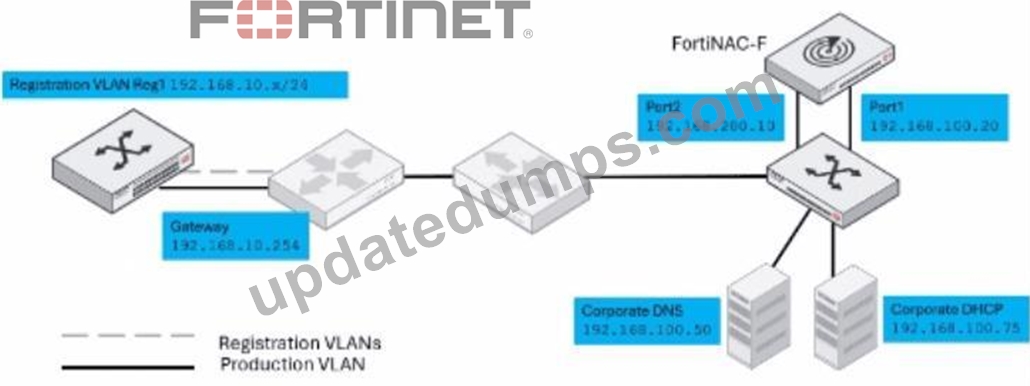
Given this topology, and a layer 3 registration network configuration, which IP address would be designated in the DHCP relay configuration for the registration network?
- A. 192.168.100.20
- B. 192.168.10.254
- C. 192.168.200.10
- D. 192.168.100 75
Answer: C
Explanation:
The correct answer is D . In a Layer 3 registration or isolation network design, DHCP requests from the isolated registration VLAN are not served locally on that VLAN by a normal production DHCP server.
Instead, the registration VLAN's DHCP relay must forward DHCP traffic to FortiNAC-F port2 , because port2 is the captive network service interface. The study guide states that in Layer 3 captive networks, DHCP traffic is relayed to port2 from the captive networks, and that the FortiNAC-F port2 interface provides DHCP, DNS, and captive portal services for hosts assigned to those captive networks.
In the exhibit, the registration VLAN is 192.168.10.x/24 , with gateway 192.168.10.254 . That gateway is where the DHCP relay would be configured, but it is not the relay destination. The relay destination must be the FortiNAC-F port2 address, shown as 192.168.200.10 . The corporate DHCP server 192.168.100.75 is for production network addressing, not registration isolation. The FortiNAC-F port1 address 192.168.100.20 is the administrative or production-facing interface, not the captive network service interface. Therefore, the DHCP relay should point to 192.168.200.10 .
NEW QUESTION # 56
......
Pass Your NSE5_FNC_AD_7.6 Exam Easily With 100% Exam Passing Guarantee: https://prepaway.updatedumps.com/Fortinet/NSE5_FNC_AD_7.6-updated-exam-dumps.html