

Microsoft New 2026 AI-900 Test Tutorial (Updated 336 Questions)
AI-900 Exam Questions Dumps, Selling Microsoft Products
For more info read reference:
Microsoft AI-900 Official Certification Learning Site
Training and Certification Guide
NEW QUESTION # 11
For each of the following statements, select Yes if the statement is true. Otherwise, select No.
NOTE: Each correct selection is worth one point.
Answer:
Explanation:
Reference:
https://docs.microsoft.com/en-us/azure/bot-service/bot-builder-tutorial-add-qna
NEW QUESTION # 12
Match the principles of responsible AI to appropriate requirements.
To answer, drag the appropriate principles from the column on the left to its requirement on the right. Each principle may be used once, more than once, or not at all. You may need to drag the split bar between panes or scroll to view content.
NOTE: Each correct selection is worth one point.
Answer:
Explanation:
Explanation: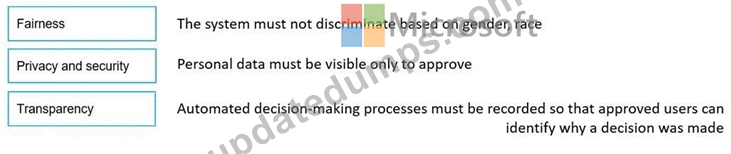
According to the Microsoft Azure AI Fundamentals (AI-900) official study guide and the Microsoft Learn module "Identify guiding principles for responsible AI", responsible AI is built upon six foundational principles: Fairness, Reliability and Safety, Privacy and Security, Inclusiveness, Transparency, and Accountability. Each principle serves to guide the ethical design, deployment, and management of artificial intelligence systems.
* Fairness - This principle ensures that AI systems treat all people fairly and do not discriminate based on personal attributes such as gender, race, or age. The Microsoft Learn content emphasizes that "AI systems should treat everyone fairly" and that organizations must evaluate datasets and model outputs for bias. In this scenario, "The system must not discriminate based on gender, race" clearly aligns with Fairness because it directly addresses equitable treatment and unbiased decision-making.
* Privacy and Security - Microsoft's responsible AI framework stresses that "AI systems must be secure and respect privacy." This means personal data should be safeguarded, processed lawfully, and visible only to authorized users. The statement "Personal data must be visible only to approved users" reflects the importance of protecting sensitive information and controlling access-precisely the intent of the Privacy and Security principle.
* Transparency - Transparency refers to ensuring that users understand how AI systems operate and make decisions. Microsoft notes that "AI systems should be understandable and users should be able to know why decisions are made." The requirement "Automated decision-making processes must be recorded so that approved users can identify why a decision was made" directly supports this principle.
Transparency promotes trust and accountability by documenting the reasoning behind AI outputs.
Reliability and Safety, though another core principle, does not directly relate to any of the provided statements in this question.
NEW QUESTION # 13
You need to generate images based on user prompts. Which Azure OpenAI model should you use?
- A. Whisper
- B. GPT-4
- C. GPT-3
- D. DALL-E
Answer: D
NEW QUESTION # 14
Match the principles of responsible AI to appropriate requirements.
To answer, drag the appropriate principles from the column on the left to its requirement on the right. Each principle may be used once, more than once, or not at all. You may need to drag the split bar between panes or scroll to view content.
NOTE: Each correct selection is worth one point.
Answer:
Explanation: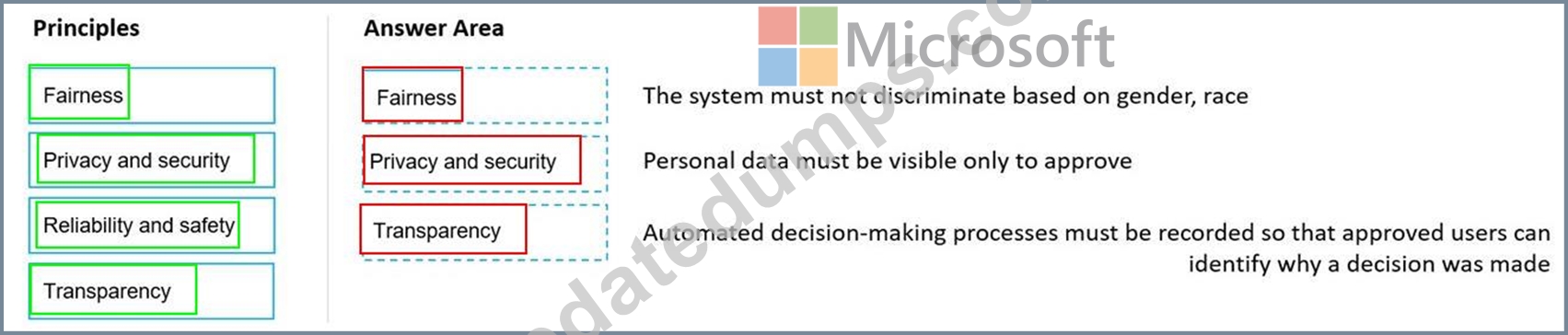
Reference:
https://docs.microsoft.com/en-us/azure/cloud-adoption-framework/innovate/best-practices/trusted-ai
https://docs.microsoft.com/en-us/learn/modules/responsible-ai-principles/4-guiding-principles
NEW QUESTION # 15
You have a dataset that contains information about taxi journeys that occurred during a given period.
You need to train a model to predict the fare of a taxi journey.
What should you use as a feature?
- A. the trip distance of individual taxi journeys
- B. the trip ID of individual taxi journeys
- C. the fare of individual taxi journeys
- D. the number of taxi journeys in the dataset
Answer: A
Explanation:
The label is the column you want to predict. The identified Features are the inputs you give the model to predict the Label.
Example:
The provided data set contains the following columns:
rate_code: The rate type of the taxi trip is a feature.
passenger_count: The number of passengers on the trip is a feature.
trip_time_in_secs: The amount of time the trip took. You want to predict the fare of the trip before the trip is completed. At that moment, you don't know how long the trip would take. Thus, the trip time is not a feature and you'll exclude this column from the model.
trip_distance: The distance of the trip is a feature.
payment_type: The payment method (cash or credit card) is a feature.
fare_amount: The total taxi fare paid is the label.
Reference:
https://docs.microsoft.com/en-us/dotnet/machine-learning/tutorials/predict-prices
NEW QUESTION # 16
Match the Microsoft guiding principles for responsible AI to the appropriate descriptions.
To answer, drag the appropriate principle from the column on the left to its description on the right. Each principle may be used once, more than once, or not at all.
NOTE: Each correct selection is worth one point.
Answer:
Explanation:
NEW QUESTION # 17
For each of the following statements, select Yes if the statement is true. Otherwise, select No. NOTE: Each correct selection is worth one point.
Answer:
Explanation:
Explanation:
NEW QUESTION # 18
For each of the following statements, select Yes if the statement is true. Otherwise, select No.
NOTE: Each correct selection is worth one point.
Answer:
Explanation: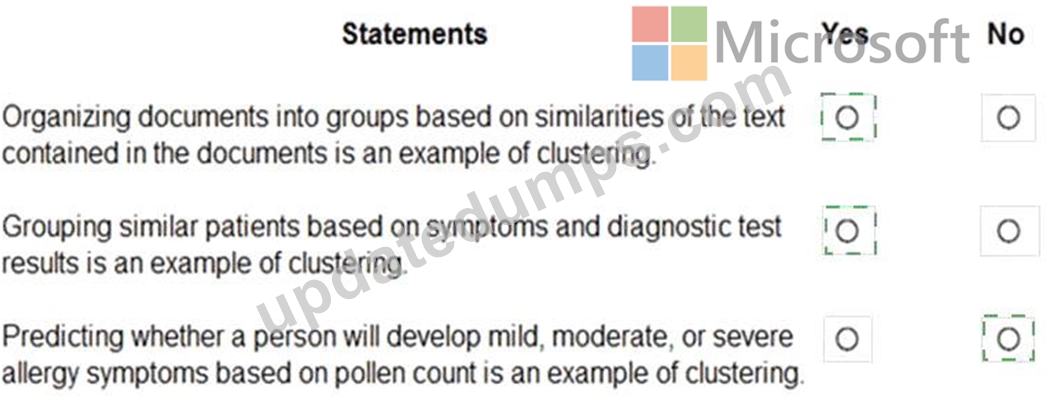
Explanation:
This question evaluates understanding of clustering-an unsupervised learning technique explained in the Microsoft Azure AI Fundamentals (AI-900) official study guide and Microsoft Learn module "Explore fundamental principles of machine learning." Clustering involves finding natural groupings within data without prior knowledge of output labels. The algorithm identifies similarities among data points and groups them accordingly, with each group (or cluster) containing items that are more similar to each other than to those in other groups.
* Organizing documents into groups based on similarities of the text contained in the documents # YesThis is a classic clustering application. In text analytics or natural language processing (NLP), clustering algorithms such as K-means or hierarchical clustering are used to group documents with similar content or topics. According to Microsoft Learn, "clustering identifies relationships in data and groups items that share common characteristics." Therefore, organizing text documents based on content similarity is a textbook example of clustering.
* Grouping similar patients based on symptoms and diagnostic test results # YesThis is another example of clustering. In healthcare analytics, clustering can be used to segment patients with similar health patterns or risks. The study guide emphasizes that clustering can "discover natural groupings in data such as customers with similar buying patterns or patients with similar clinical results." Thus, this task correctly describes unsupervised clustering because it does not involve predicting a known outcome but grouping based on similarity.
* Predicting whether a person will develop mild, moderate, or severe allergy symptoms based on pollen count # NoThis is a classification problem, not clustering. Classification is a supervised learning technique where the model is trained with labeled data to predict predefined categories (in this case, mild, moderate, or severe). Microsoft Learn clearly distinguishes between clustering (discovering hidden patterns) and classification (predicting predefined categories).
NEW QUESTION # 19
What are two tasks that can be performed by using computer vision? Each correct answer presents a complete solution.
NOTE: Each correct selection is worth one point.
- A. Detect brands in an image.
- B. Predict stock prices.
- C. Detect the color scheme in an image
- D. Extract key phrases.
- E. Translate text between languages.
Answer: A,D
Explanation:
Explanation
B: Azure's Computer Vision service gives you access to advanced algorithms that process images and return information based on the visual features you're interested in. For example, Computer Vision can determine whether an image contains adult content, find specific brands or objects, or find human faces.
E: Computer Vision includes Optical Character Recognition (OCR) capabilities. You can use the new Read API to extract printed and handwritten text from images and documents. It uses the latest models and works with text on a variety of surfaces and backgrounds. These include receipts, posters, business cards, letters, and whiteboards. The two OCR APIs support extracting printed text in several languages.
Reference:
https://docs.microsoft.com/en-us/azure/cognitive-services/computer-vision/overview
NEW QUESTION # 20
You plan to deploy an Azure Machine Learning model as a service that will be used by client applications.
Which three processes should you perform in sequence before you deploy the model? To answer, move the appropriate processes from the list of processes to the answer area and arrange them in the correct order.
Answer:
Explanation:
1 - data preparation
2 - model training
3 - model evaluation
Reference:
https://docs.microsoft.com/en-us/azure/machine-learning/concept-ml-pipelines
NEW QUESTION # 21
To complete the sentence, select the appropriate option in the answer area.
Answer:
Explanation:
Explanation
Text Description automatically generated
Reference:
https://docs.microsoft.com/en-us/azure/machine-learning/how-to-label-data
NEW QUESTION # 22
For each of the following statements, select Yes if the statement is true. Otherwise, select No.
NOTE: Each correct selection is worth one point.
Answer:
Explanation:
Explanation:
Box 1: Yes
Azure bot service can be integrated with the powerful AI capabilities with Azure Cognitive Services.
Box 2: Yes
Azure bot service engages with customers in a conversational manner.
Box 3: No
The QnA Maker service creates knowledge base, not Question: 55
Note: You can use the QnA Maker service and a knowledge base to add Question:-and-answer support to your bot. When you create your knowledge base, you seed it with Questions and answers.
Reference:
https://docs.microsoft.com/en-us/azure/bot-service/bot-builder-tutorial-add-qna
NEW QUESTION # 23
To complete the sentence, select the appropriate option in the answer area.
Answer:
Explanation:
Reference:
https://docs.microsoft.com/en-us/azure/cognitive-services/custom-vision-service/getting-started-build-a-classifier
NEW QUESTION # 24
You have a dataset that contains information about taxi journeys that occurred during a given period.
You need to train a model to predict the fare of a taxi journey. What should you use as a feature?
- A. the trip distance of individual taxi journeys
- B. the trip ID of individual taxi journeys
- C. the fare of individual taxi journeys
- D. the number of taxi journeys in the dataset
Answer: A
Explanation:
The label is the column you want to predict. The identified Featuresare the inputs you give the model to predict the Label.
Example:
The provided data set contains the following columns:
passenger_count: The number of passengers on the trip is a feature.
trip_time_in_secs: The amount of time the trip took. You want to predict the fare of the trip before the trip is completed. At that moment, you don't know how long the trip would take. Thus, the trip time is not a feature and you'll exclude this column from the model.
trip_distance: The distance of the trip is a feature.
payment_type: The payment method (cash or credit card) is a feature. fare_amount: The total taxi fare paid is the label.
Reference:
https://docs.microsoft.com/en-us/dotnet/machine-learning/tutorials/predict-prices
NEW QUESTION # 25
Your website has a chatbot to assist customers.
You need to detect when a customer is upset based on what the customer types in the chatbot. Which type of AI workload should you use?
- A. anomaly detection
- B. semantic segmentation
- C. regression
- D. natural language processing
Answer: D
Explanation:
Natural language processing (NLP) is used for tasks such as sentiment analysis, topic detection, language detection, key phrase extraction, and document categorization.
Sentiment Analysis is the process of determining whether a piece of writing is positive, negative or neutral. Reference:
https://docs.microsoft.com/en-us/azure/architecture/data-guide/technology-choices/natural-language- processing
NEW QUESTION # 26
Match the services to the appropriate descriptions.
To answer, drag the appropriate service from the column on the left to its description on the right. Each service may be used once, more than once, or not at all.
NOTE: Each correct match is worth one point
Answer:
Explanation:
NEW QUESTION # 27
For each of the following statements, select Yes if the statement is true. Otherwise, select No.
NOTE: Each correct selection is worth one point.
Answer:
Explanation:
Explanation
The Text Analytics API is a cloud-based service that provides advanced natural language processing over raw text, and includes four main functions: sentiment analysis, key phrase extraction, named entity recognition, and language detection.
Box 1: Yes
You can detect which language the input text is written in and report a single language code for every document submitted on the request in a wide range of languages, variants, dialects, and some regional/cultural languages. The language code is paired with a score indicating the strength of the score.
Box 2: No
Box 3: Yes
Named Entity Recognition: Identify and categorize entities in your text as people, places, organizations, date/time, quantities, percentages, currencies, and more. Well-known entities are also recognized and linked to more information on the web.
Reference:
https://docs.microsoft.com/en-us/azure/cognitive-services/text-analytics/overview
NEW QUESTION # 28
You are authoring a Language Understanding (LUIS) application to support a music festival.
You want users to be able to ask questions about scheduled shows, such as: "Which act is playing on the main stage?" The question "Which act is playing on the main stage?" is an example of which type of element?
- A. an intent
- B. an entity
- C. an utterance
- D. a domain
Answer: C
Explanation:
Explanation
Utterances are input from the user that your app needs to interpret.
Reference:
https://docs.microsoft.com/en-us/azure/cognitive-services/LUIS/luis-concept-utterance
NEW QUESTION # 29
Select the answer that correctly completes the sentence.
Answer:
Explanation:
Explanation:
According to the Microsoft Azure AI Fundamentals (AI-900) official study guide and the Microsoft Learn module "Identify features of common machine learning types", the classification technique is a type of supervised machine learning used to predict which category or class a new observation belongs to, based on patterns learned from labeled training data.
In this scenario, a banking system that predicts whether a loan will be repaid is dealing with a binary outcome-either the loan will be repaid or will not be repaid. These two possible results represent distinct classes, making this problem a classic example of binary classification. During training, the model learns from historical data containing features such as customer income, credit score, loan amount, and repayment history, along with labeled outcomes (repaid or defaulted). After training, it can classify new applications into one of these two categories.
The AI-900 curriculum distinguishes between three key supervised and unsupervised learning approaches:
* Classification: Predicts discrete categories (e.g., spam/not spam, fraud/not fraud, will repay/won't repay).
* Regression: Predicts continuous numerical values (e.g., house prices, sales forecast, temperature).
* Clustering: Groups data based on similarity without predefined labels (e.g., customer segmentation).
Since the banking problem focuses on predicting a categorical outcome rather than a continuous numeric value, it fits squarely into the classification domain. In Azure Machine Learning, such tasks can be performed using algorithms like Logistic Regression, Decision Trees, or Support Vector Machines (SVMs), all configured for categorical prediction.
Therefore, per Microsoft's official AI-900 learning objectives, a banking system predicting whether a loan will be repaid represents a classification type of machine learning problem.
NEW QUESTION # 30
You have the following apps:
* App1: Understands the public perception of a brand or topic
* App2: Applies profanity filters to speech-to-text
What does each app use? To answer, select the appropriate options in the answer area.
NOTE: Each correct selection is worth one point.
Answer:
Explanation: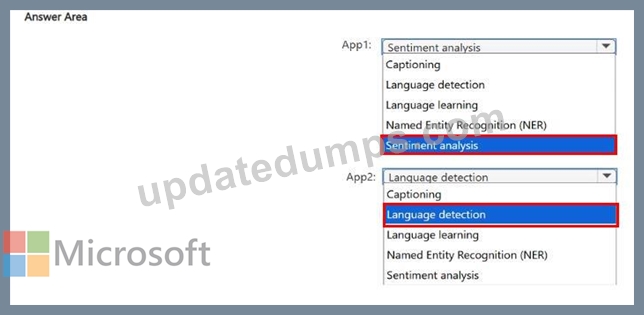
NEW QUESTION # 31
You are building a chatbot that will use natural language processing (NLP) to perform the following actions based on the text input of a user:
* Accept customer orders.
* Retrieve support documents.
* Retrieve order status updates.
Which type of NLP should you use?
- A. language modeling
- B. sentiment analysis
- C. translation
- D. named entity recognition
Answer: A
Explanation:
In the Microsoft Azure AI Fundamentals (AI-900) curriculum, language modeling is described as a core component of Natural Language Processing (NLP) that enables an AI system to understand, interpret, and generate human language in context. The AI-900 Microsoft Learn module "Identify features of Natural Language Processing workloads" explains that language modeling is used to analyze user input and determine intent - essential for conversational systems like chatbots.
In this question, the chatbot must:
* Accept customer orders.
* Retrieve support documents.
* Retrieve order status updates.
All these tasks require the bot to understand user intent and context from text input. This understanding process is driven by language modeling, which predicts meaning and structure within sentences, enabling the system to decide what action to take next.
Microsoft Learn distinguishes between various NLP techniques:
* Sentiment analysis detects emotional tone (positive/negative/neutral).
* Translation converts text between languages.
* Named Entity Recognition (NER) identifies specific entities like names or dates.However, none of these individually allow a system to process commands, requests, or user intents - that capability is part of language modeling, which powers LUIS (Language Understanding Intelligent Service) or the modern Azure Cognitive Service for Language.
Therefore, to build a chatbot that can interpret commands and respond contextually - such as processing orders or retrieving documents - you must use language modeling.
NEW QUESTION # 32
Your company wants to build a recycling machine for bottles. The recycling machine must automatically identify bottles of the correct shape and reject all other items.
Which type of AI workload should the company use?
- A. conversational AI
- B. natural language processing
- C. anomaly detection
- D. computer vision
Answer: D
Explanation:
Azure's Computer Vision service gives you access to advanced algorithms that process images and return information based on the visual features you're interested in. For example, Computer Vision can determine whether an image contains adult content, find specific brands or objects, or find human faces.
Reference:
https://docs.microsoft.com/en-us/azure/cognitive-services/computer-vision/overview
NEW QUESTION # 33
......
AI-900 Cert Guide PDF 100% Cover Real Exam Questions: https://prepaway.updatedumps.com/Microsoft/AI-900-updated-exam-dumps.html