

[Feb 08, 2022] New Updated DP-201 Exam Questions 2022
Updated Free Microsoft DP-201 Test Engine Questions with 207 Q&As
Preparation Materials and Resources
The Microsoft DP-201 exam is not easy and that is why you should take it with seriousness. If you want to pass the test at your first attempt, you need to devote enough time to preparation. It is recommended that you start studying for the exam with reviewing its objectives. Then you can proceed with the official preparation options available on the Microsoft webpage. The vendor offers the candidates two ways to prepare for the DP-201 test:
- Instructor-led training: this is a paid course delivered under the guidance of the Microsoft authorized trainer. It lasts two days and is intended for the data professionals, data architects, as well as business intelligence professionals who want to enhance their expertise in data platform technologies available on the Microsoft Azure platform.
- Online learning: this training is available free of charge. There are several learning paths tackling various aspects of the Microsoft DP-201 exam.
The students can use these training tools separately or in combination. Additionally, you can search for the relevant resources on other learning platforms.
How much DP-201 Exam Cost
The price of the DP-201 exam is $165 USD.
NEW QUESTION 120
Which Azure Data Factory components should you recommend using together to import the customer data from Salesforce to Data Lake Storage? To answer, select the appropriate options in the answer area.
NOTE: Each correct selection is worth one point.
Answer:
Explanation: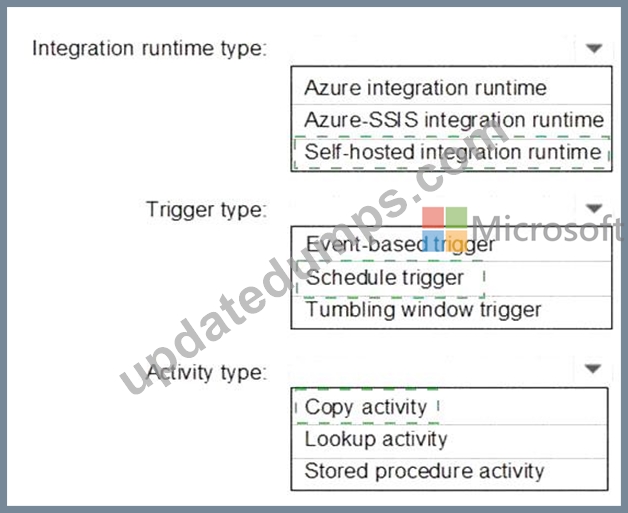
Explanation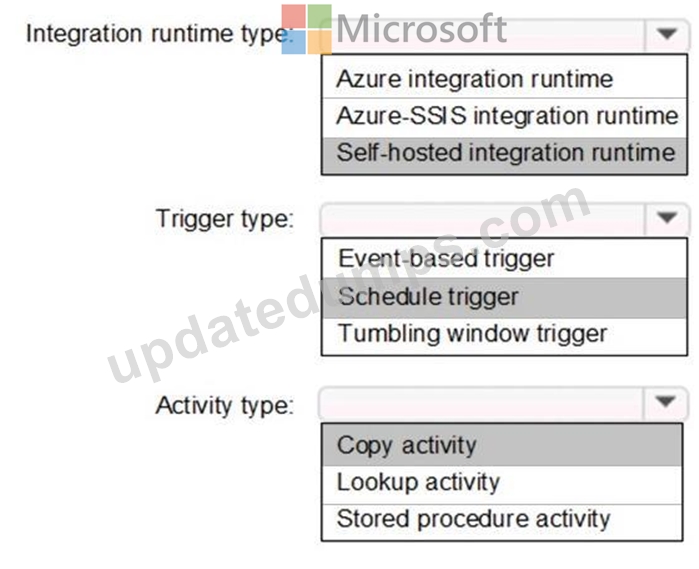
Box 1: Self-hosted integration runtime
A self-hosted IR is capable of nunning copy activity between a cloud data stores and a data store in private network.
Box 2: Schedule trigger
Schedule every 8 hours
Box 3: Copy activity
Scenario:
* Customer data, including name, contact information, and loyalty number, comes from Salesforce and can be imported into Azure once every eight hours. Row modified dates are not trusted in the source table.
* Product data, including product ID, name, and category, comes from Salesforce and can be imported into Azure once every eight hours. Row modified dates are not trusted in the source table.
NEW QUESTION 121
What should you recommend as a batch processing solution for Health Interface?
- A. Azure Stream Analytics
- B. Azure Data Factory
- C. Azure Databricks
- D. Azure CycleCloud
Answer: A
Explanation:
Scenario: ADatum identifies the following requirements for the Health Interface application:
Support a more scalable batch processing solution in Azure.
Reduce the amount of time it takes to add data from new hospitals to Health Interface.
Data Factory integrates with the Azure Cosmos DB bulk executor library to provide the best performance when you write to Azure Cosmos DB.
Reference:
https://docs.microsoft.com/en-us/azure/data-factory/connector-azure-cosmos-db Design data processing solutions Testlet 5 Case study This is a case study. Case studies are not timed separately. You can use as much exam time as you would like to complete each case. However, there may be additional case studies and sections on this exam. You must manage your time to ensure that you are able to complete all questions included on this exam in the time provided.
To answer the questions included in a case study, you will need to reference information that is provided in the case study. Case studies might contain exhibits and other resources that provide more information about the scenario that is described in the case study. Each question is independent of the other questions in this case study.
At the end of this case study, a review screen will appear. This screen allows you to review your answers and to make changes before you move to the next section of the exam. After you begin a new section, you cannot return to this section.
To start the case study
To display the first question in this case study, click the Next button. Use the buttons in the left pane to explore the content of the case study before you answer the questions. Clicking these buttons displays information such as business requirements, existing environment, and problem statements. If the case study has an All Information tab, note that the information displayed is identical to the information displayed on the subsequent tabs. When you are ready to answer a question, click the Question button to return to the question.
Overview
You are a data engineer for Trey Research. The company is close to completing a joint project with the government to build smart highways infrastructure across North America. This involves the placement of sensors and cameras to measure traffic flow, car speed, and vehicle details.
You have been asked to design a cloud solution that will meet the business and technical requirements of the smart highway.
Solution components
Telemetry Capture
The telemetry capture system records each time a vehicle passes in front of a sensor. The sensors run on a custom embedded operating system and record the following telemetry data:
* Time
* Location in latitude and longitude
* Speed in kilometers per hour (kmph)
* Length of vehicle in meters
Visual Monitoring
The visual monitoring system is a network of approximately 1,000 cameras placed near highways that capture images of vehicle traffic every 2 seconds. The cameras record high resolution images. Each image is approximately 3 MB in size.
Requirements. Business
The company identifies the following business requirements:
* External vendors must be able to perform custom analysis of data using machine learning technologies.
* You must display a dashboard on the operations status page that displays the following metrics: telemetry, volume, and processing latency.
* Traffic data must be made available to the Government Planning Department for the purpose of modeling changes to the highway system. The traffic data will be used in conjunction with other data such as information about events such as sporting events, weather conditions, and population statistics. External data used during the modeling is stored in on-premises SQL Server 2016 databases and CSV files stored in an Azure Data Lake Storage Gen2 storage account.
* Information about vehicles that have been detected as going over the speed limit during the last 30 minutes must be available to law enforcement officers. Several law enforcement organizations may respond to speeding vehicles.
* The solution must allow for searches of vehicle images by license plate to support law enforcement investigations. Searches must be able to be performed using a query language and must support fuzzy searches to compensate for license plate detection errors.
Requirements. Security
The solution must meet the following security requirements:
* External vendors must not have direct access to sensor data or images.
* Images produced by the vehicle monitoring solution must be deleted after one month. You must minimize costs associated with deleting images from the data store.
* Unauthorized usage of data must be detected in real time. Unauthorized usage is determined by looking for unusual usage patterns.
* All changes to Azure resources used by the solution must be recorded and stored. Data must be provided to the security team for incident response purposes.
Requirements. Sensor data
You must write all telemetry data to the closest Azure region. The sensors used for the telemetry capture system have a small amount of memory available and so must write data as quickly as possible to avoid losing telemetry data.
Design data processing solutions
Testlet 6
Case study
This is a case study. Case studies are not timed separately. You can use as much exam time as you would like to complete each case. However, there may be additional case studies and sections on this exam. You must manage your time to ensure that you are able to complete all questions included on this exam in the time provided.
To answer the questions included in a case study, you will need to reference information that is provided in the case study. Case studies might contain exhibits and other resources that provide more information about the scenario that is described in the case study. Each question is independent of the other questions in this case study.
At the end of this case study, a review screen will appear. This screen allows you to review your answers and to make changes before you move to the next section of the exam. After you begin a new section, you cannot return to this section.
To start the case study
To display the first question in this case study, click the Next button. Use the buttons in the left pane to explore the content of the case study before you answer the questions. Clicking these buttons displays information such as business requirements, existing environment, and problem statements. If the case study has an All Information tab, note that the information displayed is identical to the information displayed on the subsequent tabs. When you are ready to answer a question, click the Question button to return to the question.
Overview
Litware, Inc. owns and operates 300 convenience stores across the US. The company sells a variety of packaged foods and drinks, as well as a variety of prepared foods, such as sandwiches and pizzas.
Litware has a loyalty club whereby members can get daily discounts on specific items by providing their membership number at checkout.
Litware employs business analysts who prefer to analyze data by using Microsoft Power BI, and data scientists who prefer analyzing data in Azure Databricks notebooks.
Requirements. Business Goals
Litware wants to create a new analytics environment in Azure to meet the following requirements:
* See inventory levels across the stores. Data must be updated as close to real time as possible.
* Execute ad hoc analytical queries on historical data to identify whether the loyalty club discounts increase sales of the discounted products.
* Every four hours, notify store employees about how many prepared food items to produce based on historical demand from the sales data.
Requirements. Technical Requirements
Litware identifies the following technical requirements:
* Minimize the number of different Azure services needed to achieve the business goals.
* Use platform as a service (PaaS) offerings whenever possible and avoid having to provision virtual machines that must be managed by Litware.
* Ensure that the analytical data store is accessible only to the company's on-premises network and Azure services.
* Use Azure Active Directory (Azure AD) authentication whenever possible.
* Use the principle of least privilege when designing security.
* Stage inventory data in Azure Data Lake Storage Gen2 before loading the data into the analytical data store. Litware wants to remove transient data from Data Lake Storage once the data is no longer in use.
Files that have a modified date that is older than 14 days must be removed.
* Limit the business analysts' access to customer contact information, such as phone numbers, because this type of data is not analytically relevant.
* Ensure that you can quickly restore a copy of the analytical data store within one hour in the event of corruption or accidental deletion.
Requirements. Planned Environment
Litware plans to implement the following environment:
* The application development team will create an Azure event hub to receive real-time sales data, including store number, date, time, product ID, customer loyalty number, price, and discount amount, from the point of sale (POS) system and output the data to data storage in Azure.
* Customer data, including name, contact information, and loyalty number, comes from Salesforce, a SaaS application, and can be imported into Azure once every eight hours. Row modified dates are not trusted in the source table.
* Product data, including product ID, name, and category, comes from Salesforce and can be imported into Azure once every eight hours. Row modified dates are not trusted in the source table.
* Daily inventory data comes from a Microsoft SQL server located on a private network.
* Litware currently has 5 TB of historical sales data and 100 GB of customer data. The company expects approximately 100 GB of new data per month for the next year.
* Litware will build a custom application named FoodPrep to provide store employees with the calculation results of how many prepared food items to produce every four hours.
* Litware does not plan to implement Azure ExpressRoute or a VPN between the on-premises network and Azure.
NEW QUESTION 122
You are designing a new application that uses Azure Cosmos DB. The application will support a variety of data patterns including log records and social media mentions.
You need to recommend which Cosmos DB API to use for each data pattern. The solution must minimize resource utilization.
Which API should you recommend for each data pattern? To answer, select the appropriate options in the answer area.
NOTE: Each correct selection is worth one point.
Answer:
Explanation:
Explanation
Log records: SQL
Social media mentions: Gremlin
You can store the actual graph of followers using Azure Cosmos DB Gremlin API to create vertexes for each user and edges that maintain the "A-follows-B" relationships. With the Gremlin API, you can get the followers of a certain user and create more complex queries to suggest people in common. If you add to the graph the Content Categories that people like or enjoy, you can start weaving experiences that include smart content discovery, suggesting content that those people you follow like, or finding people that you might have much in common with.
References:
https://docs.microsoft.com/en-us/azure/cosmos-db/social-media-apps
NEW QUESTION 123
You need to design the authentication and authorization methods for sensors.
What should you recommend? To answer, select the appropriate options in the answer area.
NOTE: Each correct selection is worth one point.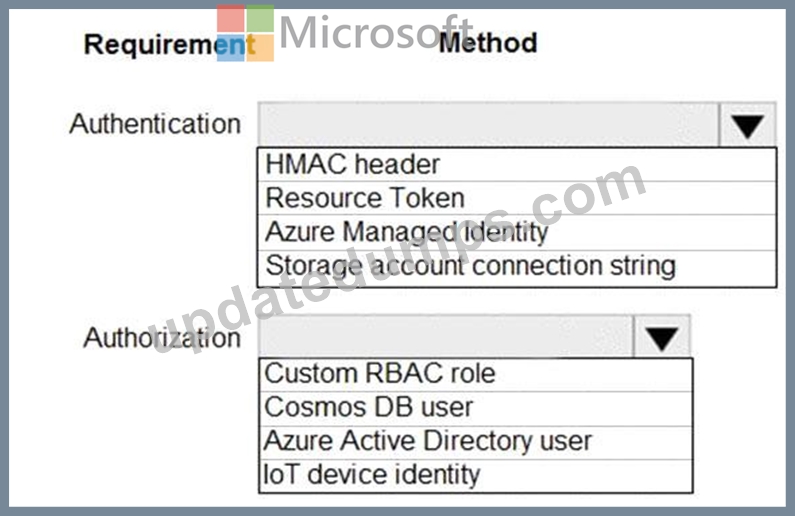
Answer:
Explanation:
Explanation
Sensor data must be stored in a Cosmos DB named treydata in a collection named SensorData Sensors must have permission only to add items to the SensorData collection Box 1: Resource Token Resource tokens provide access to the application resources within a Cosmos DB database.
Enable clients to read, write, and delete resources in the Cosmos DB account according to the permissions they've been granted.
Box 2: Cosmos DB user
You can use a resource token (by creating Cosmos DB users and permissions) when you want to provide access to resources in your Cosmos DB account to a client that cannot be trusted with the master key.
References:
https://docs.microsoft.com/en-us/azure/cosmos-db/secure-access-to-data
NEW QUESTION 124
Note: This question is part of a series of questions that present the same scenario. Each question in the series contains a unique solution that might meet the stated goals. Some question sets might have more than one correct solution, while others might not have a correct solution.
After you answer a question in this section, you will NOT be able to return to it. As a result, these questions will not appear in the review screen.
You have an Azure SQL database that has columns. The columns contain sensitive Personally Identifiable Information (PII) data.
You need to design a solution that tracks and stores all the queries executed against the PII data. You must be able to review the data in Azure Monitor, and the data must be available for at least 45 days.
Solution: You add classifications to the columns that contain sensitive data. You turn on Auditing and set the audit log destination to use Azure Blob storage.
Does this meet the goal?
- A. Yes
- B. No
Answer: A
Explanation:
Explanation
Explanation:
Auditing has been enhanced to log sensitivity classifications or labels of the actual data that were returned by the query. This would enable you to gain insights on who is accessing sensitive data.
Reference:
https://azure.microsoft.com/en-us/blog/announcing-public-preview-of-data-discovery-classification-for- microsoft-azure-sql-data-warehouse/
NEW QUESTION 125
Which Azure service and feature should you recommend using to manage the transient data for Data Lake Storage? To answer, select the appropriate options in the answer area.
NOTE: Each correct selection is worth one point.
Answer:
Explanation:
Explanation
Scenario: Stage inventory data in Azure Data Lake Storage Gen2 before loading the data into the analytical data store. Litware wants to remove transient data from Data Lake Storage once the data is no longer in use.
Files that have a modified date that is older than 14 days must be removed.
Service: Azure Data Factory
Clean up files by built-in delete activity in Azure Data Factory (ADF).
ADF built-in delete activity, which can be part of your ETL workflow to deletes undesired files without writing code. You can use ADF to delete folder or files from Azure Blob Storage, Azure Data Lake Storage Gen1, Azure Data Lake Storage Gen2, File System, FTP Server, sFTP Server, and Amazon S3.
You can delete expired files only rather than deleting all the files in one folder. For example, you may want to only delete the files which were last modified more than 13 days ago.
Feature: Delete Activity
Reference:
https://azure.microsoft.com/sv-se/blog/clean-up-files-by-built-in-delete-activity-in-azure-data-factory/
NEW QUESTION 126
A company plans to use Azure SQL Database to support a line of business applications. The application will manage sensitive employee data.
The solution must meet the following requirements:
* Encryption must be performed by the application.
* Only the client application must have access keys for encrypting and decrypting data.
* Data must never appear as plain text in the database.
* The strongest possible encryption method must be used.
* Searching must be possible on selected data.
What should you recommend? To answer, select the appropriate options in the answer area.
NOTE: Each correct selection is worth one point.
Answer:
Explanation:
Explanation
Box 1: Always Encrypted with deterministic encryption
Deterministic encryption always generates the same encrypted value for any given plain text value. Using deterministic encryption allows point lookups, equality joins, grouping and indexing on encrypted columns.
However, it may also allow unauthorized users to guess information about encrypted values by examining patterns in the encrypted column, especially if there is a small set of possible encrypted values, such as True/False, or North/South/East/West region. Deterministic encryption must use a column collation with a binary2 sort order for character columns.
Box 2: Always Encrypted with Randomized encryption
* Randomized encryption uses a method that encrypts data in a less predictable manner. Randomized encryption is more secure, but prevents searching, grouping, indexing, and joining on encrypted columns.
Note: With Always Encrypted the Database Engine never operates on plaintext data stored in encrypted columns, but it still supports some queries on encrypted data, depending on the encryption type for the column. Always Encrypted supports two types of encryption: randomized encryption and deterministic encryption.
Use deterministic encryption for columns that will be used as search or grouping parameters, for example a government ID number. Use randomized encryption, for data such as confidential investigation comments, which are not grouped with other records and are not used to join tables.
References:
https://docs.microsoft.com/en-us/sql/relational-databases/security/encryption/always-encrypted-database-engine
NEW QUESTION 127
You are planning the deployment of two separate Azure Cosmos DB databases named db1 and db2.
You need to recommend a deployment strategy that meets the following requirements:
* Costs for both databases must be minimized.
* Db1 must meet an SLA of 99.99% for both reads and writes.
* Db2 must meet an SLA of 99.99% for writes and 99.999% for reads.
Which deployment strategy should you recommend for each database? To answer, select the appropriate options in the answer area.
NOTE: Each correct selection is worth one point.
Answer:
Explanation: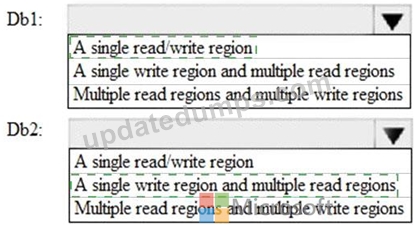
Explanation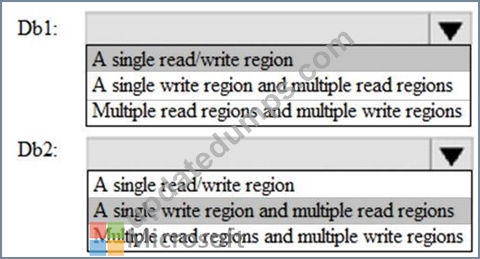
Db1: A single read/write region
Db2: A single write region and multi read regions
References:
https://docs.microsoft.com/en-us/azure/cosmos-db/high-availability
NEW QUESTION 128
You need to design the encryption strategy for the tagging data and customer data.
What should you recommend? To answer, drag the appropriate setting to the correct drop targets. Each source may be used once, more than once, or not at all. You may need to drag the split bar between panes or scroll to view content.
NOTE: Each correct selection is worth one point.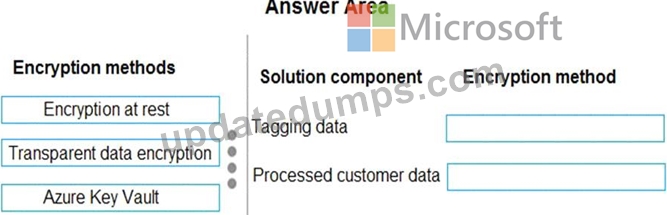
Answer:
Explanation:
Explanation
All cloud data must be encrypted at rest and in transit.
Box 1: Transparent data encryption
Encryption of the database file is performed at the page level. The pages in an encrypted database are encrypted before they are written to disk and decrypted when read into memory.
Box 2: Encryption at rest
Encryption at Rest is the encoding (encryption) of data when it is persisted.
References:
https://docs.microsoft.com/en-us/sql/relational-databases/security/encryption/transparent-data-encryption?view=
https://docs.microsoft.com/en-us/azure/security/azure-security-encryption-atrest
NEW QUESTION 129
You need to recommend a solution that meets the data platform requirements of Health Interface. The solution must minimize redevelopment efforts for the application.
What should you include in the recommendation?
- A. Azure SQL Data Warehouse
- B. Azure Cosmos DB that uses the SQL API
- C. Azure Cosmos DB that uses the Table API
- D. Azure SQL Database
Answer: B
Explanation:
Scenario: ADatum identifies the following requirements for the Health Interface application:
Reduce the amount of development effort to rewrite existing SQL queries.
Upgrade to a data storage solution that will provide flexible schemas and increased throughput for writing data. Data must be regionally located close to each hospital, and reads must display be the most recent committed version of an item.
Reduce the amount of time it takes to add data from new hospitals to Health Interface.
Support a more scalable batch processing solution in Azure.
NEW QUESTION 130
You need to recommend a solution to quickly identify all the columns in Health Review that contain sensitive health data.
What should you include in the recommendation?
- A. SQL Server auditing
- B. data masking
- C. Azure tags
- D. classifications
Answer: D
Explanation:
Data Discovery & Classification introduces a set of advanced capabilities aimed at protecting data and not just the data warehouse itself. Classification/Labeling - Sensitivity classification labels tagged on the columns can be persisted in the data warehouse itself.
References:
https://azure.microsoft.com/sv-se/blog/announcing-public-preview-of-data-discovery-classification-formicrosoft-azure-sql-data-warehouse/
Topic 5, Data Engineer for Trey Research
Overview
You are a data engineer for Trey Research. The company is close to completing a joint project with the government to build smart highways infrastructure across North America. This involves the placement of sensors and cameras to measure traffic flow, car speed, and vehicle details.
You have been asked to design a cloud solution that will meet the business and technical requirements of the smart highway.
Solution components
Telemetry Capture
The telemetry capture system records each time a vehicle passes in front of a sensor. The sensors run on a custom embedded operating system and record the following telemetry data:
* Time
* Location in latitude and longitude
* Speed in kilometers per hour (kmph)
* Length of vehicle in meters
Visual Monitoring
The visual monitoring system is a network of approximately 1,000 cameras placed near highways that capture images of vehicle traffic every 2 seconds. The cameras record high resolution images. Each image is approximately 3 MB in size.
Requirements: Business
The company identifies the following business requirements:
* External vendors must be able to perform custom analysis of data using machine learning technologies.
* You must display a dashboard on the operations status page that displays the following metrics: telemetry, volume, and processing latency.
* Traffic data must be made available to the Government Planning Department for the purpose of modeling changes to the highway system. The traffic data will be used in conjunction with other data such as information about events such as sporting events, weather conditions, and population statistics. External data used during the modeling is stored in on-premises SQL Server 2016 databases and CSV files stored in an Azure Data Lake Storage Gen2 storage account.
* Information about vehicles that have been detected as going over the speed limit during the last 30 minutes must be available to law enforcement officers. Several law enforcement organizations may respond to speeding vehicles.
* The solution must allow for searches of vehicle images by license plate to support law enforcement investigations. Searches must be able to be performed using a query language and must support fuzzy searches to compensate for license plate detection errors.
Requirements: Security
The solution must meet the following security requirements:
* External vendors must not have direct access to sensor data or images.
* Images produced by the vehicle monitoring solution must be deleted after one month. You must minimize costs associated with deleting images from the data store.
* Unauthorized usage of data must be detected in real time. Unauthorized usage is determined by looking for unusual usage patterns.
* All changes to Azure resources used by the solution must be recorded and stored. Data must be provided to the security team for incident response purposes.
Requirements: Sensor data
You must write all telemetry data to the closest Azure region. The sensors used for the telemetry capture system have a small amount of memory available and so must write data as quickly as possible to avoid losing telemetry data.
NEW QUESTION 131
A company installs IoT devices to monitor its fleet of delivery vehicles. Data from devices is collected from Azure Event Hub.
The data must be transmitted to Power BI for real-time data visualizations.
You need to recommend a solution.
What should you recommend?
- A. Azure Stream Analytics
- B. Azure HDInsight with Storm
- C. Apache Spark in Azure Databricks
- D. Azure HDInsight with Spark Streaming
Answer: A
Explanation:
Step 1: Get your IoT hub ready for data access by adding a consumer group.
Step 2: Create, configure, and run a Stream Analytics job for data transfer from your IoT hub to your Power BI account.
Step 3: Create and publish a Power BI report to visualize the data.
References:
https://docs.microsoft.com/en-us/azure/iot-hub/iot-hub-live-data-visualization-in-power-bi
NEW QUESTION 132
Note: This question is part of a series of questions that present the same scenario. Each question in the series contains a unique solution that might meet the stated goals. Some question sets might have more than one correct solution, while others might not have a correct solution.
After you answer a question in this section, you will NOT be able to return to it. As a result, these questions will not appear in the review screen.
You have an Azure SQL database that has columns. The columns contain sensitive Personally Identifiable Information (PII) data.
You need to design a solution that tracks and stores all the queries executed against the PII data. You must be able to review the data in Azure Monitor, and the data must be available for at least 45 days.
Solution: You execute a daily stored procedure that retrieves queries from Query Store, looks up the column classifications, and stores the results in a new table in the database.
Does this meet the goal?
- A. Yes
- B. No
Answer: B
Explanation:
Explanation
Instead add classifications to the columns that contain sensitive data and turn on Auditing.
Note: Auditing has been enhanced to log sensitivity classifications or labels of the actual data that were returned by the query. This would enable you to gain insights on who is accessing sensitive data.
Reference:
https://azure.microsoft.com/en-us/blog/announcing-public-preview-of-data-discovery-classification-for-microsof
NEW QUESTION 133
You are planning the deployment of two separate Azure Cosmos DB databases named db1 and db2.
You need to recommend a deployment strategy that meets the following requirements:
Costs for both databases must be minimized.
Db1 must meet an SLA of 99.99% for both reads and writes.
Db2 must meet an SLA of 99.99% for writes and 99.999% for reads.
Which deployment strategy should you recommend for each database? To answer, select the appropriate options in the answer area.
NOTE: Each correct selection is worth one point.
Answer:
Explanation:
References:
https://docs.microsoft.com/en-us/azure/cosmos-db/high-availability
NEW QUESTION 134
You need to recommend a storage solution for a sales system that will receive thousands of small files per minute. The files will be in JSON, text, and CSV formats. The files will be processed and transformed before they are loaded into a data warehouse in Azure Synapse Analytics. The files must be stored and secured in folders.
Which storage solution should you recommend?
- A. Azure Blob storage
- B. Azure Data Lake Storage Gen2
- C. Azure SQL Database
- D. Azure Cosmos DB
Answer: B
Explanation:
Azure provides several solutions for working with CSV and JSON files, depending on your needs. The primary landing place for these files is either Azure Storage or Azure Data Lake Store.1 Azure Data Lake Storage is an optimized storage for big data analytics workloads.
Incorrect Answers:
D: Azure Blob Storage containers is a general purpose object store for a wide variety of storage scenarios.
Blobs are stored in containers, which are similar to folders.
Reference:
https://docs.microsoft.com/en-us/azure/architecture/data-guide/scenarios/csv-and-json
NEW QUESTION 135
You need to ensure that emergency road response vehicles are dispatched automatically.
How should you design the processing system? To answer, select the appropriate options in the answer area.
NOTE: Each correct selection is worth one point.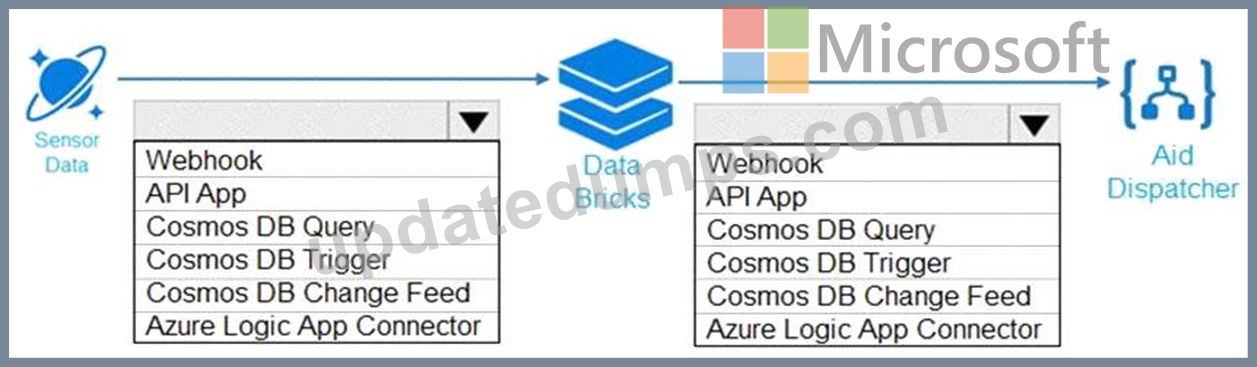
Answer:
Explanation:
Explanation
Box1: API App
* Events generated from the IoT data sources are sent to the stream ingestion layer through Azure HDInsight Kafka as a stream of messages. HDInsight Kafka stores streams of data in topics for a configurable of time.
* Kafka consumer, Azure Databricks, picks up the message in real time from the Kafka topic, to process the data based on the business logic and can then send to Serving layer for storage.
* Downstream storage services, like Azure Cosmos DB, Azure SQL Data warehouse, or Azure SQL DB, will then be a data source for presentation and action layer.
* Business analysts can use Microsoft Power BI to analyze warehoused data. Other applications can be built upon the serving layer as well. For example, we can expose APIs based on the service layer data for third party uses.
Box 2: Cosmos DB Change Feed
Change feed support in Azure Cosmos DB works by listening to an Azure Cosmos DB container for any changes. It then outputs the sorted list of documents that were changed in the order in which they were modified.
The change feed in Azure Cosmos DB enables you to build efficient and scalable solutions for each of these patterns, as shown in the following image:
References:
https://docs.microsoft.com/bs-cyrl-ba/azure/architecture/example-scenario/data/realtime-analytics-vehicle-iot?vie
NEW QUESTION 136
You are designing the security for a mission critical Azure SQL database named DB1. DB1 contains several columns that store Personally Identifiable Information (PII) data You need to recommend a security solution that meets the following requirements:
* Ensures that DB1 is encrypted at rest
* Ensures that data from the columns containing PII data is encrypted in transit Which security solution should you recommend for DB1 and the columns? To answer, select the appropriate options in the answer area.
NOTE: Each correct selection is worth one point.
Answer:
Explanation:
Explanation:
DB1: Transparent Data Encryption
Azure SQL Database currently supports encryption at rest for Microsoft-managed service side and client-side encryption scenarios.
Support for server encryption is currently provided through the SQL feature called Transparent Data Encryption.
Columns: Always encrypted
Always Encrypted is a feature designed to protect sensitive data stored in Azure SQL Database or SQL Server databases. Always Encrypted allows clients to encrypt sensitive data inside client applications and never reveal the encryption keys to the database engine (SQL Database or SQL Server).
Note: Most data breaches involve the theft of critical data such as credit card numbers or personally identifiable information. Databases can be treasure troves of sensitive information. They can contain customers' personal data (like national identification numbers), confidential competitive information, and intellectual property. Lost or stolen data, especially customer data, can result in brand damage, competitive disadvantage, and serious fines--even lawsuits.
References:
https://docs.microsoft.com/en-us/azure/security/fundamentals/encryption-atrest
https://docs.microsoft.com/en-us/azure/security/fundamentals/database-security-overview
NEW QUESTION 137
You plan to ingest streaming social media data by using Azure Stream Analytics. The data will be stored in files in Azure Data Lake Storage, and then consumed by using Azure Databricks and PolyBase in Azure SQL Data Warehouse.
You need to recommend a Stream Analytics data output format to ensure that the queries from Databricks and PolyBase against the files encounter the fewest possible errors. The solution must ensure that the files can be queried quickly and that the data type information is retained.
What should you recommend?
- A. JSON
- B. CSV
- C. Avro
- D. Parquet
Answer: C
Explanation:
Explanation
The Avro format is great for data and message preservation.
Avro schema with its support for evolution is essential for making the data robust for streaming architectures like Kafka, and with the metadata that schema provides, you can reason on the data. Having a schema provides robustness in providing meta-data about the data stored in Avro records which are self-documenting the data.
References:
http://cloudurable.com/blog/avro/index.html
NEW QUESTION 138
You are designing a solution that will use Azure Table storage. The solution will log records in the following entity.
You are evaluating which partition key to use based on the following two scenarios:
* Scenario1: Minimize hotspots under heavy write workloads.
* Scenario2: Ensure that date lookups are as efficient as possible for read workloads.
Which partition key should you use for each scenario? To answer, select the appropriate options in the answer area.
NOTE: Each correct selection is worth one point.
Answer:
Explanation:
Explanation
References:
https://docs.microsoft.com/en-us/rest/api/storageservices/designing-a-scalable-partitioning-strategy-for-azure-tab
NEW QUESTION 139
You have an on-premises MySQL database that is 800 GB in size.
You need to migrate a MySQL database to Azure Database for MySQL. You must minimize service interruption to live sites or applications that use the database.
What should you recommend?
- A. Import and export
- B. Azure Database Migration Service
- C. Dump and restore
- D. MySQL Workbench
Answer: B
Explanation:
You can perform MySQL migrations to Azure Database for MySQL with minimal downtime by using the newly introduced continuous sync capability for the Azure Database Migration Service (DMS). This functionality limits the amount of downtime that is incurred by the application.
Reference:
https://docs.microsoft.com/en-us/azure/mysql/howto-migrate-online
NEW QUESTION 140
A company has many applications. Each application is supported by separate on-premises databases.
You must migrate the databases to Azure SQL Database. You have the following requirements:
* Organize databases into groups based on database usage.
* Define the maximum resource limit available for each group of databases.
You need to recommend technologies to scale the databases to support expected increases in demand.
What should you recommend?
- A. Database sharding
- B. Elastic pools
- C. Read scale-out
- D. Managed instances
Answer: B
Explanation:
SQL Database elastic pools are a simple, cost-effective solution for managing and scaling multiple databases that have varying and unpredictable usage demands. The databases in an elastic pool are on a single Azure SQL Database server and share a set number of resources at a set price.
You can configure resources for the pool based either on the DTU-based purchasing model or the vCore- based purchasing model.
Incorrect Answers:
D: Database sharding is a type of horizontal partitioning that splits large databases into smaller components, which are faster and easier to manage.
Reference:
https://docs.microsoft.com/en-us/azure/sql-database/sql-database-elastic-pool
NEW QUESTION 141
You plan to create a real-time monitoring app that alerts users when a device travels more than 200 meters away from a designated location.
You need to design an Azure Stream Analytics job to process the data for the planned app. The solution must minimize the amount of code developed and the number of technologies used.
What should you include in the Stream Analytics job? To answer, select the appropriate options in the answer area.
NOTE: Each correct selection is worth one point.
Answer:
Explanation:
Reference:
https://docs.microsoft.com/en-us/azure/stream-analytics/stream-analytics-get-started-with-azure-stream-analytics-to-process-data-from-iot-devices
https://docs.microsoft.com/en-us/azure/stream-analytics/geospatial-scenarios
NEW QUESTION 142
You need to recommend an Azure SQL Database pricing tier for Planning Assistance.
Which pricing tier should you recommend?
- A. Business critical Azure SQL Database Managed Instance
- B. General purpose Azure SQL Database Managed Instance
- C. Business critical Azure SQL Database single database
- D. General purpose Azure SQL Database single database
Answer: B
Explanation:
Explanation/Reference:
Explanation:
Azure resource costs must be minimized where possible.
Data used for Planning Assistance must be stored in a sharded Azure SQL Database.
The SLA for Planning Assistance is 70 percent, and multiday outages are permitted.
Testlet 2
Case study
This is a case study. Case studies are not timed separately. You can use as much exam time as you would like to complete each case. However, there may be additional case studies and sections on this exam. You must manage your time to ensure that you are able to complete all questions included on this exam in the time provided.
To answer the questions included in a case study, you will need to reference information that is provided in the case study. Case studies might contain exhibits and other resources that provide more information about the scenario that is described in the case study. Each question is independent of the other question on this case study.
At the end of this case study, a review screen will appear. This screen allows you to review your answers and to make changes before you move to the next sections of the exam. After you begin a new section, you cannot return to this section.
To start the case study
To display the first question on this case study, click the Next button. Use the buttons in the left pane to explore the content of the case study before you answer the questions. Clicking these buttons displays information such as business requirements, existing environment, and problem statements. If the case study has an All Information tab, note that the information displayed is identical to the information displayed on the subsequent tabs. When you are ready to answer a question, click the Question button to return to the question.
Requirements
Business
The company identifies the following business requirements:
You must transfer all images and customer data to cloud storage and remove on-premises servers.
You must develop an analytical processing solution for transforming customer data.
You must develop an image object and color tagging solution.
Capital expenditures must be minimized.
Cloud resource costs must be minimized.
Technical
The solution has the following technical requirements:
Tagging data must be uploaded to the cloud from the New York office location.
Tagging data must be replicated to regions that are geographically close to company office locations.
Image data must be stored in a single data store at minimum cost.
Customer data must be analyzed using managed Spark clusters.
Power BI must be used to visualize transformed customer data.
All data must be backed up in case disaster recovery is required.
Security and optimization
All cloud data must be encrypted at rest and in transit. The solution must support:
parallel processing of customer data
hyper-scale storage of images
global region data replication of processed image data
DP-201
DP-201
Testlet 1
Case study
This is a case study. Case studies are not timed separately. You can use as much exam time as you would like to complete each case. However, there may be additional case studies and sections on this exam. You must manage your time to ensure that you are able to complete all questions included on this exam in the time provided.
To answer the questions included in a case study, you will need to reference information that is provided in the case study. Case studies might contain exhibits and other resources that provide more information about the scenario that is described in the case study. Each question is independent of the other question on this case study.
At the end of this case study, a review screen will appear. This screen allows you to review your answers and to make changes before you move to the next sections of the exam. After you begin a new section, you cannot return to this section.
To start the case study
To display the first question on this case study, click the Next button. Use the buttons in the left pane to explore the content of the case study before you answer the questions. Clicking these buttons displays information such as business requirements, existing environment, and problem statements. If the case study has an All Information tab, note that the information displayed is identical to the information displayed on the subsequent tabs. When you are ready to answer a question, click the Question button to return to the question.
Background
Trey Research is a technology innovator. The company partners with regional transportation department office to build solutions that improve traffic flow and safety.
The company is developing the following solutions:
Regional transportation departments installed traffic sensor systems on major highways across North America. Sensors record the following information each time a vehicle passes in front of a sensor:
Time
Location in latitude and longitude
Speed in kilometers per second (kmps)
License plate number
Length of vehicle in meters
Sensors provide data by using the following structure:
Traffic sensors will occasionally capture an image of a vehicle for debugging purposes.
You must optimize performance of saving/storing vehicle images.
Traffic sensor data
Sensors must have permission only to add items to the SensorData collection.
Traffic data insertion rate must be maximized.
Once every three months all traffic sensor data must be analyzed to look for data patterns that indicate
sensor malfunctions.
Sensor data must be stored in a Cosmos DB named treydata in a collection named SensorData
The impact of vehicle images on sensor data throughout must be minimized.
Backtrack
This solution reports on all data related to a specific vehicle license plate. The report must use data from the SensorData collection. Users must be able to filter vehicle data in the following ways:
vehicles on a specific road
vehicles driving above the speed limit
Planning Assistance
Data used for Planning Assistance must be stored in a sharded Azure SQL Database.
Data from the Sensor Data collection will automatically be loaded into the Planning Assistance database once a week by using Azure Data Factory. You must be able to manually trigger the data load process.
Privacy and security policy
Azure Active Directory must be used for all services where it is available.
For privacy reasons, license plate number information must not be accessible in Planning Assistance.
Unauthorized usage of the Planning Assistance data must be detected as quickly as possible.
Unauthorized usage is determined by looking for an unusual pattern of usage.
Data must only be stored for seven years.
Performance and availability
The report for Backtrack must execute as quickly as possible.
The SLA for Planning Assistance is 70 percent, and multiday outages are permitted.
All data must be replicated to multiple geographic regions to prevent data loss.
You must maximize the performance of the Real Time Response system.
Financial requirements
Azure resource costs must be minimized where possible.
NEW QUESTION 143
......
Microsoft DP-201 Exam Syllabus Topics:
| Topic | Details |
|---|---|
| Topic 1 |
|
| Topic 2 |
|
| Topic 3 |
|
| Topic 4 |
|
| Topic 5 |
|
Try 100% Updated DP-201 Exam Questions [2022]: https://prepaway.updatedumps.com/Microsoft/DP-201-updated-exam-dumps.html