

Adobe AD7-E601 Exam Info and Free Practice Test | UpdateDumps
Pass Adobe AD7-E601 Premium Files Test Engine pdf - Free Dumps Collection
NEW QUESTION # 20
After mapping a segment to an external destination, the user notices in the dataflow run tab that some of the identities have been excluded.
What are two things that could cause this issue? (Choose two.)
- A. Some identities were not enabled for activation
- B. Some identities were not meeting consent policies
- C. Some identities were not recognized by the destination
- D. Some identities were missing attributes
Answer: B,C
Explanation:
Explanation
These are two possible reasons why some identities have been excluded after mapping a segment to an external destination. Some identities were not recognized by the destination means that there was no matching identifier between AEP and the destination system. For example, if AEP sends email addresses as identifiers but the destination system expects phone numbers as identifiers, then there will be no match and those identities will be excluded. Some identities were not meeting consent policies means that there was a violation of data usage governance rules based on data labels and marketing actions. For example, if AEP sends PII data as part of a segment but the destination system is not authorized to use PII data for personalization purposes, then those identities will be excluded. References: : Identity Mapping Overview : Data Usage Governance Overview
NEW QUESTION # 21
A company launches a Facebook campaign with a custom landing page that was supposed to give a $50 voucher to customers who order within 2 hours of clicking on the link. The web developers forgot to add the tracking code to the checkout process, so the company does not know who ordered from the Facebook campaign-How should an engineer create the segment?
- A.

- B.

- C.

- D.
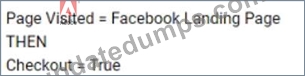
Answer: C
Explanation:
Explanation
This is the most appropriate workflow to launch a summer sale email campaign to target customers who have browsed for any summer clothing in the last 90 days. By selecting email opt in = YES as an attribute, the company can filter out customers who have not consented to receive email communications. By selecting product.browse = last 90 days and product.category = Sandals, Swimwear, Tshirts, Shorts as events, the company can capture customers who have shown interest in summer products recently. By saving the segment and scheduling the export for 7/31, the company can ensure that the segment is up to date and ready to be sent out on August 1. References: : Create a Segment : Schedule Segment Export
NEW QUESTION # 22
A B2B company wants to send out an email or text invitation to their exclusive new product webinar to current clients who have viewed their new products web page within their customer only portal and have opted into receiving communications.
Which data fields should be sent to the destination?
- A. Name
Mobile Phone Number
Opt In Flag for Texts - B. Name
Mobile Phone Number
Email Address - C. Name
Email Address
Opt In Flag for Emails - D. Name
Email Address
New Product Page Viewed Flag
Answer: B
Explanation:
Explanation
The correct answer is D because it matches the requirement given in the question. The customer wants to send out an email or text invitation, so they need to send the Name, Mobile Phone Number, and Email Address data fields to the destination. The other options do not include all of these data fields or are irrelevant for sending an invitation.
References:https://experienceleague.adobe.com/docs/experience-platform/rtcdp/destinations/overview.html?lang
NEW QUESTION # 23
A global retailer wants to send promotional discount offers to the following:
Existing customers who are:
* Within 50 miles of their nearest store
* Have made one of the following:
* Visits to the website more than 3 times in the last 2 weeks
* Purchase of items worth more than $200 in the last 2 months
* Have high propensity to purchase
This offer will be sent via SMS if the customer has subscribed to SMS. Otherwise, the offer will be sent via email.
They have made the following digital investment:
* Adobe Experience Platform
* Adobe Audience Manager
* Adobe Analytics
* Adobe Campaign
* Adobe Target
* Adobe Advertising Cloud
* CRM
Which steps should the retailer take to meet the requirement?
- A. 1. Onboard CRM data into AEP
2. Create Adobe Analytics source connection In AEP
3. Share AEP data with AAM
4. Use Look-Alike Modeling in AAM to create the segment
5. Share segment with Target and Campaign - B. 1. Onboard CRM data into AEP
2. Create Adobe Analytics source connection In AEP
3. Build and deploy a propensity score model in data science workspace
4. Create segment in AEP using the propensity score, web visits, distance from store, and purchase order data attributes
5. Share segment with Adobe Campaign - C. 1. Onboard CRM data into AEP
2. Create Adobe Analytics and AAM source connection in AEP
3. Create segment in Adobe Target for visitors with high propensity score to purchase
4. Import segment in AEP and combine with web visits, distance from store, and purchase order data attributes
5. Share segment with Adobe Advertising Cloud - D. 1. Onboard CRM data into AEP
2. Create segment in Adobe Target for visitors with high propensity score to purchase
3. Import segment in AEP and combine with web visits, distance from store, and purchase order data attributes
4. Share segment across Adobe Experience Cloud
Answer: D
Explanation:
Explanation
This is the most suitable workflow to send personalized offers to existing customers who are within 50 miles of their nearest store, have made one of the following: visits to the website more than 3 times in the last 2 weeks, purchase of items worth more than $200 in the last 2 months,or have high propensity to purchase. By onboarding CRM data into AEP, the company can leverage the profile data and identity stitching features of AEP to create a unified view of their customers. By creating a segment in Adobe Target for visitors with high propensity score to purchase, the company can use the personalization capabilities of Adobe Target to predict the likelihood of customers to purchase based on their profile and behavior data. By importing the segment in AEP and combining it with web visits, distance from store, and purchase order data attributes, the company can use the segmentation service and UI of AEP to define and evaluate their target audience based on profile attributes and behaviors. By sharing the segment across Adobe Experience Cloud, the company can activate their segment across multiple channels, such as email, Google Display Ads, Facebook, and personalization.
References: : Onboard Data into Platform : Create a Segment in Adobe Target : Create a Segment : Share Segments with Destinations
NEW QUESTION # 24
A customer is bringing in data through the following AEP Source Connectors:
* HTTP Sink Connector via streaming for transaction data
* S3 Connector for their batch Profile data coming from a Data Lake
Which segmentation evaluation is allowed9
- A. Streaming or Batch evaluation depending on the segment definition
- B. Streaming evaluation for all segment definitions
- C. Combination of Batch segments evaluation depending on the segment definition
- D. Batch evaluation for all segment definitions
Answer: A
Explanation:
Explanation
This is the correct answer because AEP allows users to choose between streaming or batch evaluation for their segments depending on their segment definition and data sources. Streaming evaluation is available for segments that use streaming data sources, such as HTTP Sink Connector or Adobe Analytics Connector, and do not use any batch-only features, such as time windows or derived attributes. Batch evaluation is available for segments that use batch data sources, such as S3 Connector or FTP Connector, or use any batch-only features. Users can also switch between streaming and batch evaluation modes for their segments if they meet certain criteria. References: : Segment Evaluation
NEW QUESTION # 25
An e-commerce company wants to use the Experience Platform Real-time CDP to contact known prospects or customers who abandon before checking out.
The following data sources are available to be imported:
* CRM system of customers
* Adobe Analytics
* Order Processing System detailing orders
The retailer uses the following tools to market to customers:
* Email
* Google Display Ads
* Adobe Target for personalization
Known prospects are defined as people who have provided an email address.
Which workflow should be used?
- A. 1. Import customer data into the profile
2. Set up Adobe Analytics as a source
3. Use segmentation to find customers who have visited a product page and added to cart but did not complete checkout
4. Send the segment of Abandon customers to Campaign and Target - B. 1. Import customer data into the profile
2. Set up Adobe Analytics as a source
3. Use segmentation to find profiles with email address and visited a product page and added to cart but did not complete checkout
4. Send the segment of Abandon customers to Campaign and Target - C. 1. Import customer data into the profile
2. Set up Order Processing System detailing orders
3. Use segmentation to find customers who have visited a product page and added to cart but did not order
4. Send the segment of Abandon customers to Campaign and Target
Answer: B
Explanation:
Explanation
This is the most suitable workflow to contact known prospects or customers who abandon before checking out.
By importing customer data into the profile, the company can enrich their profile data with CRM information, such as email address. By setting up Adobe Analytics as a source, the company can ingest online behavior data from web and app into AEP dataset. By using segmentation to find profiles with email address and visited a product page and added to cart but did not complete checkout, the company can use the segmentation service and UI of AEP to define and evaluate their target audience based on profile attributes and behaviors. By sending the segment of Abandon customers to Campaign and Target, the company can activate their segment across multiple channels, such as email, Google Display Ads, and personalization. References: : Onboard Data into Platform : Connect Adobe Analytics Data Sources : Create a Segment : Share Segments with Destinations
NEW QUESTION # 26
What must be defined for a destination to connect policies with data labels to enable data usage enforcement for that destination?
- A. Sensitive data labels
- B. Governance policy
- C. Marketing actions
Answer: B
Explanation:
Explanation
Governance policy is a feature that allows users to define how data can be used for different destinations based on data labels and marketing actions. Data labels are tags that indicate the sensitivity or classification of data, such as PII or opt-out. Marketing actions are categories of activities that describe how data is used for a destination, such as personalization or analytics. By creating a governance policy, users can connect policies with data labels and enable data usage enforcement for that destination. References: : Governance Policy Overview : Data Labels Overview : Marketing Actions Overview : Create a Governance Policy
NEW QUESTION # 27
A customer wants to send out a personalized monthly reminder email to all customers that have opted in to tell them about the monthly specials.
Which attributes should be sent to the destination?
- A. Email Address
Email Opt In Flag - B. Email Opt In Flag
Name - C. Email Address
Name
Answer: C
Explanation:
Explanation
The correct answer is B because it matches the requirement given in the question. The customer wants to send out a personalized monthly reminder email, so they need to send the Email Address and Name attributes to the destination. The other options do not include both of these attributes or are irrelevant for personalization.
References:
https://experienceleague.adobe.com/docs/experience-platform/rtcdp/destinations/overview.html?lang=en
NEW QUESTION # 28
A user wants to target customers who have browsed the products.com website in the last 30 days.
The available attributes are: Last_Website_Browse
Last_App_Browse Last_Activity
The available events are:
Website.Browse
App.Browse
Where can the user define time parameters for the segment?
- A. In the attribute "LasLWebsite.Browse" only
- B. In the attribute rLast.Website_Browse" or the event rWebsite_Browse"
- C. In the attribute 'Last.Activity" or the 'App.Browse'' event
- D. In the destination schedule Ul
Answer: B
Explanation:
Explanation
The correct answer is D because it matches the scenario given in the question. The user can define time parameters for the segment in the attribute "Last_Website_Browse" or the event "Website_Browse". The other options do not allow the user to specify the time frame of 30 days.
References:https://experienceleague.adobe.com/docs/experience-platform/rtcdp/segmentation/segment-builder-g
NEW QUESTION # 29
An engineer is scheduling a destination export for email marketing and cloud storage destinations. The customer wants to make sure unique profiles are sent over and primary identifiers are included.
What should the engineer do during configuration?
- A. While Creating the schedule:
* Check the mandatory key across the Unique identifier attribute
* Check the Deduplication Key across the Profile attributes - B. As part of Account setup process:
* Select the deduplicate option for export using Unique identifier - C. In the select attribute page:
* Check the mandatory key across the Unique identifier attribute
* Check the Deduplication Key across the Profile attributes - D. In the select attribute page:
* Check the mandatory key across all attributes in the create schedule page:
* Check the Deduplication Key across the Profile attributes
Answer: C
Explanation:
Explanation
The correct answer is A because it matches the requirement given in the question. The engineer needs to select the attributes in the select attribute page and check the mandatory key across the Unique identifier attribute and the Deduplication Key across the Profile attributes. This will ensure that only unique profiles are sent over and primary identifiers are included. The other options do not allow the engineer to select the attributes or check the keys.
References:https://experienceleague.adobe.com/docs/experience-platform/rtcdp/destinations/overview.html?lang
NEW QUESTION # 30
A fast food company just bought real-time CDP. The company wants to create a new marketing campaign to encourage existing customers who do not eat breakfast at their restaurants to try their new breakfast sandwich.
The engineer logs in and sees the following profile attributes and segments already set up.
Segments
* Breakfast Eaters
* Lunch Eaters
* Dinner Eaters
* High-Value Dinners
Profile Attributes
* Favorite Location
* Favorite Breakfast Meal
* Favorite Lunch Meal
* Favorite Dinner Meal
* Last Purchase
How should the engineer create a segment to meet the customer's needs?
- A. Favorite Breakfast Meal is Nulll or Empty
AND - B. Favorite Breakfast Meal is Null or Empty
- C. Must Exist in Lunch Eaters
OR
Must Exist in Dinner Eaters - D. Favorite Lunch Meal is NOT Null or Empty
OR
Favorite Dinner Meal is NOT Null or Empty - E. Must Not Exist in Breakfast Eaters
Answer: C
Explanation:
Explanation
The correct answer is C because it matches the requirement given in the question. The engineer needs to create a segment that excludes customers who eat breakfast at their restaurants. The easiest way to do this is to use the existing segments and select "Must Not Exist in Breakfast Eaters". The other options do not exclude all breakfast eaters or are too complicated.
References:https://experienceleague.adobe.com/docs/experience-platform/rtcdp/segmentation/segment-builder-g
NEW QUESTION # 31
After successfully ingesting profile data from a CRM system into AER a user creates a segment using profile attributes from the same uploaded data. The Segment Ul shows an estimated audience size of zero.
Which two actions can the user take to view the correct segment size? (Choose two.)
- A. Disable and re-enable the dataset for profile
- B. Change the primary identifier of the dataset
- C. Use on-demand evaluation
- D. Wait for the next scheduled evaluation
Answer: C,D
Explanation:
Explanation
On-demand evaluation is a feature that allows users to manually trigger segment evaluation and see the updated segment size immediately. Waiting for the next scheduled evaluation is another option, as segment evaluation runs periodically based on the segment refresh interval. References: : On-demand Segment Evaluation : Segment Evaluation
NEW QUESTION # 32
A company is collecting data where the source data is not automatically hashed. According to data privacy policies, the data must be hashed to all destinations when exporting any data.
What must the engineer select to correctly send the data?
- A. Transform Data
- B. Apply Transformation
- C. Enable Hashing
Answer: C
Explanation:
Explanation
The correct answer is B because it matches the requirement given in the question. The engineer must select
"Enable Hashing" to hash the data according to data privacy policies when exporting any data. The other options do not apply hashing or are not available for destinationexport.
References:https://experienceleague.adobe.com/docs/experience-platform/rtcdp/destinations/overview.html?lang
NEW QUESTION # 33
A financial services company wants to create a segment based on all people who have spent more than $400 on their credit card in the last 48 hours.
Which segment building block should be used to create this segment?
- A. A pre-existing audience of credit card spenders
- B. An aggregate of transaction events
- C. Credit card spent attribute
- D. A transaction event
Answer: B
Explanation:
Explanation
The correct answer is C because it matches the scenario given in the question. The user needs to use an aggregate of transaction events to create a segment based on the total amount spent on their credit card in the last 48 hours. The other options do not allow the user to specify the time frame or the amount spent.
References:
https://experienceleague.adobe.com/docs/experience-platform/rtcdp/segmentation/segment-builder-guide.html?la
NEW QUESTION # 34
......
Adobe AD7-E601 Exam Syllabus Topics:
| Topic | Details |
|---|---|
| Topic 1 |
|
| Topic 2 |
|
| Topic 3 |
|
| Topic 4 |
|
| Topic 5 |
|
Updated Official licence for AD7-E601 Certified by AD7-E601 Dumps PDF: https://prepaway.updatedumps.com/Adobe/AD7-E601-updated-exam-dumps.html