

[Oct-2025] Verified ISQI Exam Dumps with CTFL-AcT Exam Study Guide
Best Quality ISQI CTFL-AcT Exam Questions UpdateDumps Realistic Practice Exams [2025]
ISQI CTFL-AcT (ISTQB Foundation Level - Acceptance Testing) exam is a certification exam for individuals who want to demonstrate their competence in acceptance testing. CTFL-AcT exam is designed to test the candidate's knowledge and skills in the principles and practices of acceptance testing, including test planning, design, execution, and evaluation.
NEW QUESTION # 35
Which of the following techniques is most likely applied to ensure the quality of acceptance testing activities?
- A. Checklist-based verification of requirements to ensure their completeness and quality.
- B. Verification of the traceability between user stories and test cases to make sure it is up to date.
- C. Review of the source code to ensure traceability of user stories to system components.
- D. Eye tracking to verify the feasibility of previously defined user acceptance tests.
Answer: B
NEW QUESTION # 36
Which of the following statements regarding test execution and defect analysis is MOST correct?
- A. The document defects are assigned to a developer so that he or she can fix it for the next version
- B. Testers compare the actual execution outcome to acceptance criteria and report deviations, if observed
- C. Business analysts repeat failed acceptance test to assess the impact if the observed behavior
- D. Business analysts and testers explore the business process model to execute the acceptance test
Answer: B
Explanation:
In acceptance testing, testers execute test cases that are directly derived from user stories or requirements via their acceptance criteria. During execution, testers compare the actual outcome of the system with the expected result described in the acceptance criteria. If there's a mismatch (a deviation), it is documented as a defect or discrepancy.
This process is essential for validating that the system meets business needs. The tester's role includes reporting clear, objective findings-not fixing the defect or deciding its severity (which might involve developers or business analysts).
Option A is incorrect: Business analysts may support testing, but execution is primarily a tester's responsibility.
Option C is not fully correct: While developers may fix defects, assignment and triage follow a formal workflow and do not happen automatically.
Option D is incorrect: Business analysts don't repeat test executions; this is the tester's responsibility.
NEW QUESTION # 37
Which of the following sentences explains BEST how business process and business rule modeling can be used for ATDD?
- A. In an ATDD approach, testers use business process and business rule models to generate acceptance tests.
- B. In an ATDD approach, process models are created for initial test design but are not maintained afterwards.
- C. In an ATDD approach, business process models replace acceptance criteria.
- D. In an ATDD approach, business process/rule models must be created before the project starts.
Answer: A
Explanation:
Acceptance Test-Driven Development (ATDD) is a collaborative approach in which acceptance criteria are defined early, often before implementation starts. Business process models (e.g., BPMN) and business rule models (e.g., DMN) are essential tools to formalize how the system should behave under various conditions.
In ATDD, these models provide a structured representation of system workflows and decision logic, which can then be used by testers and stakeholders to derive or generate acceptance tests. This ensures that testing is aligned with actual business processes and requirements.
Option C is correct because it aligns with the purpose of ATDD: to use business models as a foundation for deriving acceptance tests in collaboration with business analysts, testers, and developers.
Other options:
A is incorrect - models are created as part of the project, not necessarily before it starts.
B is incorrect - models support and clarify acceptance criteria; they do not replace them.
D is incorrect - models are maintained as living documentation, especially in agile and iterative approaches.
C). In an ATDD approach, testers use business process and business rule models to generate acceptance tests.
NEW QUESTION # 38
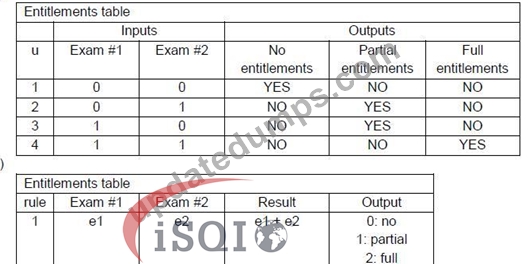
Suppose you are testing a new professional exam support system. As input the system takes two grades from two exams. For each exam the possible grade is 0 or 1 point. As output the system returns a single string - the decision about the entitlements: if the total score is 2, the candidate receives full entitlements. If the total score is 1, she receives partial entitlements. If the total score is 0, the candidate fails and receives no entitlements.
Which of the following is the correct Decision Model and Notation (DMN) model for this situation?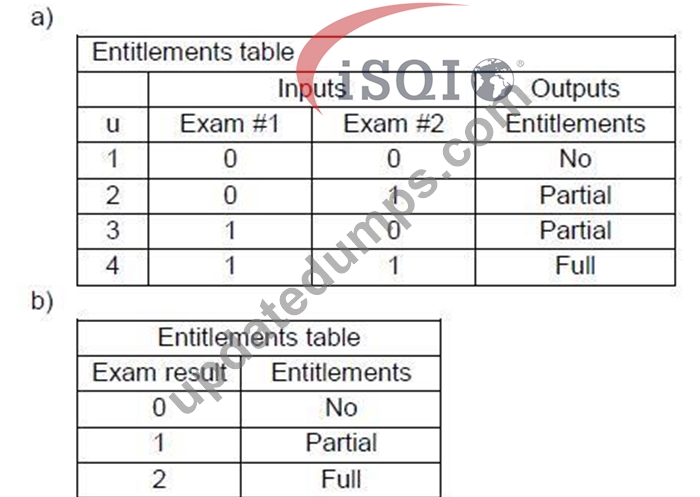
- A. Option C
- B. Option B
- C. Option D
- D. Option A
Answer: D
NEW QUESTION # 39
As a tester you participate in the project of the decision support system for granting a loan. You are asked to review the acceptance criteria for the following requirement:
REQ 3.28. The automated system records critical credit application data (CCAD. needed to support application screening.
Assume that it is well known what kind of data CCAD are. Which of the following would be the BEST example of an acceptance criterion for this requirement?
- A. The process for collecting CCAD meets corporate usability guidelines.
- B. The CCAD is not recorded if it is incomplete and a message is displayed.
- C. The CCAD record process is quick and reversible.
- D. The CCAD are stored in the MySQL relational database after each successful data entry procedure.
Answer: D
Explanation:
Acceptance criteria must be concrete, testable, and focused on observable system behavior. They define what the system must do to satisfy a requirement and help determine whether the requirement has been successfully implemented.
REQ 3.28 states: "The automated system records critical credit application data (CCAD) needed to support application screening." From this, we infer that the system must persistently store this data after data entry.
Option A is the best match because it provides a specific, observable behavior (CCAD being stored in a MySQL database after a successful entry) that can be verified through acceptance testing. It's a measurable outcome, aligned with the requirement's objective.
Other options are less suitable:
Option B introduces new behavior (displaying a message) not directly tied to the original requirement.
Option C is vague ("quick and reversible") and lacks measurable criteria.
Option D refers to usability guidelines, which is not directly relevant to the storage functionality stated in the requirement.
Exact Reference - ISTQB CTFL Acceptance Testing Syllabus (Section 1.3.2):
"Well-written acceptance criteria are unambiguous, testable, and focused on observable results."
NEW QUESTION # 40
Which one of the following usability testing techniques matches the test objective BEST?
- A. Walkthrough and thinking aloud methods can indicate difficulties users experience with certain tasks.
- B. Biometrics-based evaluation help to understand retrospectively, how users interacted with the system and to improve it.
- C. Log file analysis performed by usability experts identifies strong points of an interface that attract the user's attention.
- D. Expert reviews help to understand how users interact with a system and what is more or less visible.
Answer: A
Explanation:
Usability testing involves evaluating a product by observing real users performing tasks. The "think-aloud" method is a cornerstone of qualitative usability testing. Test participants verbalize their thoughts while interacting with the system, revealing what they understand, find confusing, or expect. This method helps identify usability problems tied to user behavior and thought processes.
Option D is correct because it directly reflects this principle - walkthroughs and think-aloud sessions highlight pain points users face while performing tasks.
Other options:
A describes expert reviews but incorrectly attributes user insight, which is less direct.
B misunderstands biometrics - they measure physiological responses (e.g., stress, eye movement) but don't explain behavior retrospectively.
C is incorrect - log files show user actions, but identifying "strong points" like visual attraction requires observation, not just logs.
D). Walkthrough and thinking aloud methods can indicate difficulties users experience with certain tasks.
=======
NEW QUESTION # 41
Which one of the following statements describes an exploratory test charter BEST?
- A. Each exploratory test charter is based on a previously defined list of activities that would be interesting to test.
- B. Acceptance testers use the exploratory test charter during the testing session to define the test oracle.
- C. Indicating that the tester should take the role of a novice user can be part of an exploratory test charter.
- D. The test charter is elaborated during the testing session according to test execution results.
Answer: C
NEW QUESTION # 42
Which one of the following sentences describes BEST a major advantage when business analysts and testers review the acceptance criteria together?
- A. A shared vision between the business analyst and the tester on acceptance criteria facilitates the design of acceptance test cases.
- B. The review of acceptance criteria helps to verify that acceptance test cases cover business processes, business rules and business risks.
- C. The review of acceptance criteria is a good practice to improve the quality of test reports.
- D. A joint review ensures that non-functional quality criteria are taken into account.
Answer: A
Explanation:
Collaboration between business analysts and testers is essential in defining and reviewing acceptance criteria.
When both roles work together, they ensure the criteria are not only aligned with business goals but also testable and clearly specified.
Option A is correct because shared understanding of acceptance criteria allows testers to design test cases that truly validate business expectations, reducing misinterpretations and increasing confidence in the product.
Other options:
B is valid but not the best - non-functional requirements are important but often handled separately.
C is partially correct but assumes acceptance test cases already exist, whereas the review often happens earlier in the process.
D focuses on test reporting, which is downstream from criteria definition and test case design.
A). A shared vision between the business analyst and the tester on acceptance criteria facilitates the design of acceptance test cases.
NEW QUESTION # 43
Which of the following statements corresponds BEST to a UX requirement analysis activity?
- A. Personas are used to analyze products or solutions from competitors.
- B. User profiles are used to determine different levels of business knowledge.
- C. Security requirements are derived from usage scenarios.
- D. Environmental conditions such as light conditions are obtained from a task analysis.
Answer: B
NEW QUESTION # 44
Which one of the following acceptance criteria relates to security requirements?
- A. Normal users shall have restricted access to private data.
- B. The graphical user interface shall comply with corporate style guides.
- C. The system shall be web-based.
- D. The system's response time shall not exceed 3 seconds.
Answer: A
NEW QUESTION # 45
Which one of the following statements describes the collaboration between business analysts and testers BEST?
- A. Business analysts collaborate on test planning and risk analysis to ensure that further on, appropriate test cases are developed and prioritized.
- B. Once the requirements and acceptance criteria have been defined, business analysts are no longer involved in testing activities.
- C. Testers participate in identifying business needs of stakeholders to better understand the business needs and related requirements.
- D. Business analysts usually cannot review acceptance tests, because they do not understand the technical details.
Answer: A
NEW QUESTION # 46
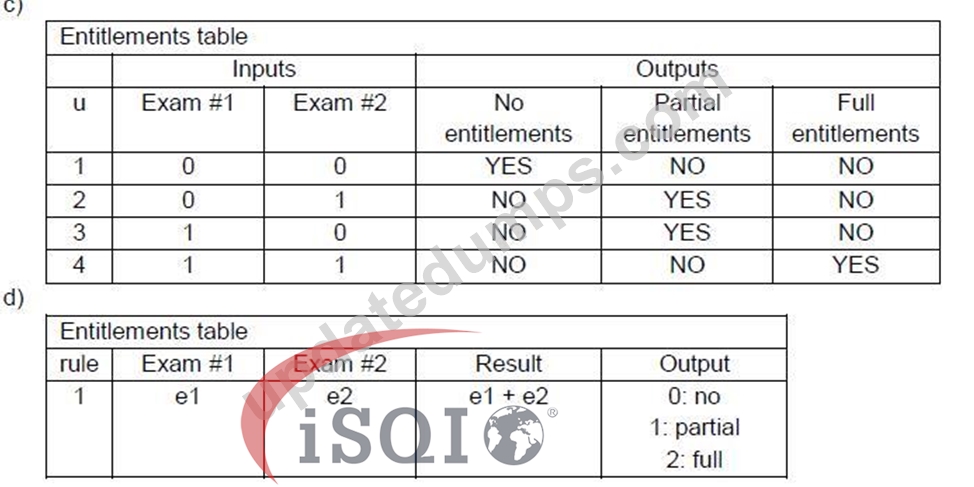
Suppose you are testing a new professional exam support system. As input the system takes two grades from two exams. For each exam the possible grade is 0 or 1 point. As output the system returns a single string - the decision about the entitlements: if the total score is 2, the candidate receives full entitlements. If the total score is 1, she receives partial entitlements. If the total score is 0, the candidate fails and receives no entitlements.
Which of the following is the correct Decision Model and Notation (DMN) model for this situation?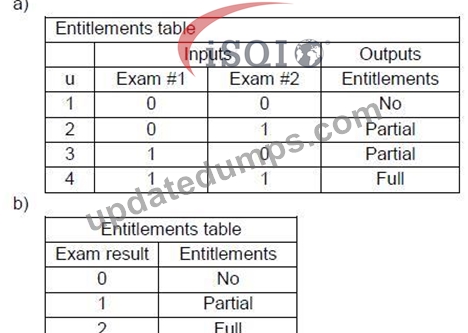
- A. Option D
- B. Option C
- C. Option B
- D. Option A
Answer: A
Explanation:
Decision Model and Notation (DMN) is a standardized approach used to model decision logic, often represented in decision tables that evaluate inputs and determine outputs. In this scenario, the entitlements granted to a candidate are based on the total score from two exams, where:
Each exam can be graded as either 0 or 1.
The combined score can be 0, 1, or 2.
The entitlements depend on the combined result:
0 # No entitlements
1 # Partial entitlements
2 # Full entitlements
Among the given diagrams:
Option A simply lists test cases but lacks explicit logic modeling.
Option B shows a mapping from total score to entitlements but doesn't model how the total is derived from the two exams.
Option C redundantly splits outputs into multiple Boolean fields and doesn't reflect how the decision is made from exam inputs.
Option D is the correct representation.
Option D uses:
e1 and e2 as inputs for Exam #1 and Exam #2.
Result as the sum of e1 + e2.
A final Output mapped based on the Result:
0 # No
1 # Partial
2 # Full
This structure accurately follows the DMN standard by expressing inputs, a derived result, and the corresponding decision output, making Option D the correct and most complete decision model.
Exact Reference - ISTQB CTFL Acceptance Testing Syllabus (Section 2.3):
"Decision tables are commonly used to express business rules that determine outputs based on combinations of inputs. DMN formalizes this structure to support automated reasoning."
NEW QUESTION # 47
Which one of the following scenarios is MOST likely to be encountered in the context of performance testing?
- A. Different workflows and use cases are performed to ensure correct performance for all user scenarios.
- B. Parameter fuzzing is performed to check the systems robustness against user voluntary or involuntary user misbehavior
- C. Usage profiles are used to cover the different configurations the system may be exposed to during operation
- D. The system is stressed by simulating various users that perform memory- intensive tasks
Answer: D
Explanation:
Performance testing evaluates how a system behaves under specific conditions, including load, stress, and endurance. Stress testing, in particular, involves pushing the system beyond its normal operational limits to identify breaking points.
Option B is correct because it describes a classic stress testing scenario: simulating users executing memory- intensive operations to evaluate system resilience and resource management.
Other options:
A describes usage profiles but is more aligned with load testing or configuration testing.
C refers to functional coverage, not performance-specific concerns.
D describes fuzz testing, which is used more for security or robustness testing than performance evaluation.
B). The system is stressed by simulating various users that perform memory-intensive tasks
NEW QUESTION # 48
Which of the following techniques is most likely applied to ensure the quality of acceptance testing activities?
- A. Checklist-based verification of requirements to ensure their completeness and quality.
- B. Verification of the traceability between user stories and test cases to make sure it is up to date.
- C. Review of the source code to ensure traceability of user stories to system components.
- D. Eye tracking to verify the feasibility of previously defined user acceptance tests.
Answer: B
Explanation:
Ensuring traceability between requirements (user stories) and test cases is a cornerstone of quality assurance in acceptance testing. It confirms that all business needs are covered by corresponding tests and helps assess the impact of changes. Traceability matrices or tools are used to track these links throughout the lifecycle.
Option B is correct because regularly verifying and updating traceability ensures that acceptance test coverage remains aligned with evolving requirements - a best practice in quality assurance.
Other options:
A (review of source code) is a white-box technique, more suitable for unit or integration testing.
C (checklist-based verification of requirements) is useful but focuses on requirement quality, not directly on testing activities.
D (eye tracking) is a usability evaluation technique and not standard for verifying test case feasibility.
B). Verification of the traceability between user stories and test cases to make sure it is up to date.
NEW QUESTION # 49
Which one of the following scenarios characterizes UX task analysis BEST?
- A. Users are qualified depending on their physical and intellectual characteristics.
- B. External conditions are considered as input for subsequent design steps.
- C. Inspirations from similar sectors are sought to identify successful solutions.
- D. Use cases are analyzed and represented through business process models.
Answer: D
NEW QUESTION # 50
Which of the following statements BEST describes the relationship between beta testing and acceptance testing?
- A. Beta testing is often used for acceptance testing of Software as a Service (SaaS) platforms
- B. Beta testing and acceptance testing are distinct testing techniques and have nothing to do with each other
- C. Beta testing and acceptance testing mean the same, but acceptance testing is the term used in Agile projects
- D. Beta testing is a specific from of acceptance testing required for Commercial Off-the-Shelf Software
Answer: A
Explanation:
Beta testing is a type of acceptance testing performed by end users in a real-world or production-like environment. It is especially relevant for cloud-based and SaaS platforms where widespread feedback is required before release.
Option B is correct because SaaS platforms often release features to a subset of users (beta users) to test the software under actual operating conditions, get feedback, and fix any defects that were not found during internal testing. This allows vendors to validate functionality, performance, and usability in diverse environments.
Other options:
A: Beta testing is not limited to Commercial Off-the-Shelf (COTS) software.
C: Incorrect - beta testing is a form of acceptance testing, not a separate unrelated technique.
D: Incorrect - beta testing and acceptance testing overlap, but they are not synonyms; the terminology does not change based on the development approach (Agile or not).
B). Beta testing is often used for acceptance testing of Software as a Service (SaaS) platforms
NEW QUESTION # 51
Which one of the following statements describes the collaboration between business analysts and testers BEST?
- A. Business analysts collaborate on test planning and risk analysis to ensure that further on, appropriate test cases are developed and prioritized.
- B. Once the requirements and acceptance criteria have been defined, business analysts are no longer involved in testing activities.
- C. Testers participate in identifying business needs of stakeholders to better understand the business needs and related requirements.
- D. Business analysts usually cannot review acceptance tests, because they do not understand the technical details.
Answer: A
Explanation:
The ISTQB CTFL Acceptance Testing Syllabus emphasizes the importance of collaboration between business analysts and testers throughout the testing lifecycle, especially during test planning and risk identification.
Business analysts contribute domain knowledge and business context, which is crucial in identifying business- critical areas, defining priorities, and ensuring that acceptance tests align with business goals.
Option A correctly identifies this collaboration. During test planning, business analysts help define acceptance criteria, identify risks from a business perspective, and support test prioritization to focus on high-value features. Their early involvement ensures that acceptance tests are meaningful and support stakeholder expectations.
Option B is incorrect as business analysts actively review acceptance tests to confirm alignment with business rules, regardless of technical complexity.
Option C is inaccurate because although testers seek to understand business needs, the responsibility for identifying those needs lies with business analysts.
Option D is incorrect; business analysts remain engaged throughout the project lifecycle, including test support and defect triage.
Exact Reference - ISTQB CTFL Acceptance Testing Syllabus (Section 1.4):
"Testers and business analysts collaborate during test planning and analysis activities to ensure the tests meet business needs and risk areas are adequately covered." Therefore, A provides the most accurate and comprehensive description.
NEW QUESTION # 52
In Agile an exploratory test session is conducted. Which one of the following concepts applies BEST?
- A. pair programming
- B. planning poker
- C. timeboxing Answer
- D. refactoring
Answer: C
Explanation:
Exploratory testing in Agile projects is a structured but unscripted testing approach where learning, test design, and execution occur simultaneously. Timeboxing is a key practice in managing exploratory testing sessions effectively.
A timebox is a fixed duration (e.g., 60-90 minutes) within which testers explore specific functionalities or risks. It encourages focus, documentation of findings, and prevents overrun or testing fatigue. After the session, testers often hold debriefs to review findings and determine next steps.
Option D is correct because timeboxing is essential for exploratory testing management.
Incorrect options:
A). Pair programming relates to development, not testing.
B). Refactoring is a development technique focused on improving code without changing behavior.
C). Planning poker is used in Agile for effort estimation, not directly related to exploratory testing.
Exact Reference - ISTQB CTFL Acceptance Testing Syllabus (Section 3.1):
"Exploratory testing is often conducted in time-boxed sessions, with a charter guiding the scope of the session."
NEW QUESTION # 53
During usability testing, the ergonomic of the products shall be checked. Which one of the following usability testing techniques matches this test objective BEST?
- A. Log file analysis
- B. Biometrics - based evaluation
- C. Checklist-based evaluation
- D. Walkthrough
Answer: C
Explanation:
Usability testing aims to evaluate the ease of use, efficiency, and satisfaction with which users can achieve tasks. When checking the ergonomics (e.g., layout, visual clarity, interaction comfort), checklist-based evaluations are particularly useful.
Option A is correct because a checklist of ergonomic/usability heuristics (e.g., Nielsen's heuristics, ISO 9241 standards) allows evaluators to systematically assess whether the interface meets established usability criteria.
Other options:
B (Biometrics-based evaluation) tracks physiological responses (e.g., stress or eye movement), which are useful but indirect and less targeted to ergonomic checks.
C (Walkthroughs) help assess usability by observing task flows, but they are less focused on layout and ergonomic design.
D (Log file analysis) captures behavior but not directly ergonomic issues like spacing, font size, or element alignment.
A). Checklist-based evaluation
NEW QUESTION # 54
The project team is currently facing a difficult situation originating from their difficulty in envisioning the future and the necessary steps to reach it together with a certain loss of motivation due to a strong feeling of stagnation. You try to unlock the situation by proposing a workshop. Which one would fit the best?
- A. You organize a day out with challenging physical exercises practiced in teams followed by an afterwork dinner and drink. After all, nothing is best for motivation than hard times together, strong common objectives and a promise of good time.
- B. You draw a staircase with 11 steps, each of them representing a major milestone of the project. The bottom of the stairs corresponds to the first day of the project and the upper step means that the project is released. You locate the present situation in the middle of the stairs. The team is asked to identify and discuss the major steps down and up.
- C. You visualize all remaining major milestones of the project, starting with today and ending with project release. Then, you ask the team to identify and discuss the necessary actions to move forward from the present situation and to reach the milestones.
- D. You ask two volunteers to play a part in front of the team. One will try to defend the project and propose positive arguments and ways forward. The other will do the opposite. You then recapitulate the major arguments of both sides and debate them openly with the team.
Answer: B
NEW QUESTION # 55
Which one of the following statements regarding ATDD / BDD is true?
- A. In both Acceptance-Test Driven Development (ATDD. and Behavior-Driven Development (BDD., test cases provide examples of product use.
- B. In both Acceptance-Test Driven Development (ATDD. and Behavior-Driven Development (BDD., acceptance test cases are written by a test automation engineer as test automation code.
- C. Behavior-Driven Development (BDD. considers acceptance test design as an activity to be handled by the test team after requirements have been finalized.
- D. In Acceptance-Test Driven Development (ATDD., test cases are written prior to the acceptance criteria.
Answer: A
Explanation:
ATDD and BDD are agile development approaches that emphasize collaboration among stakeholders (such as business analysts, developers, testers, and customers) to define clear and testable acceptance criteria before or as requirements are being finalized. Both techniques promote using concrete examples to drive development and validate understanding.
In ATDD, acceptance test cases are derived directly from user stories or requirements and written before the actual implementation starts. In BDD, scenarios are expressed in natural language (often using Gherkin syntax) to describe behaviors the system should exhibit under specific conditions. In both cases, these tests serve not only as validation tools but also as executable specifications - i.e., shared understanding expressed through concrete examples.
Option B is correct because both methodologies use examples (scenarios/test cases) to describe how a system should behave - serving as acceptance criteria.
Incorrect options:
Option A wrongly suggests BDD defers testing until after requirements are finalized - it actually promotes early collaboration.
Option C is false - in ATDD, test cases are based on predefined acceptance criteria, not written beforehand.
Option D is inaccurate - acceptance tests in ATDD and BDD may be automated but are collaboratively written first, not by test automation engineers alone.
Exact Reference - ISTQB CTFL Acceptance Testing Syllabus (Section 2.2):
"Both ATDD and BDD involve the collaborative definition of test cases before implementation to clarify requirements and serve as product usage examples."
NEW QUESTION # 56
......
Authentic Best resources for CTFL-AcT: https://prepaway.updatedumps.com/ISQI/CTFL-AcT-updated-exam-dumps.html