

Nutanix Exam 2026 NCP-CI-Azure Dumps Updated Questions UPDATED May-2026
Get The Most Updated NCP-CI-Azure Dumps To Nutanix Certified Professional (NCP) Certification
Nutanix NCP-CI-Azure Exam Syllabus Topics:
| Topic | Details |
|---|---|
| Topic 1 |
|
| Topic 2 |
|
| Topic 3 |
|
| Topic 4 |
|
NEW QUESTION # 30
An administrator needs to ensure API calls are executing successfully from NC2 to manage Azure resources.
Which cluster outbound to Azure connections are required to satisfy this task?
- A. managementazure.com
- B. apikeys.nutanix.com
- C. azure-support.nutan/x.com
- D. portal.azure.com
Answer: B
Explanation:
API Key Management: For NC2 to manage Azure resources successfully, it needs to authenticate and authorize API calls. This is typically handled through API keys, which are managed via specific endpoints.
Required Connection: The endpoint apikeys.nutanix.com is crucial for managing these API keys. Ensuring connectivity to this endpoint allows NC2 to verify and utilize the API keys needed for interacting with Azure services.
Reference:
Nutanix NC2 API Configuration Guide
Azure API Management Documentation
NEW QUESTION # 31
An organization want to use existing Azure resources to deploy NC2.
What is a valid requirement to use existing Azure resources for this task?
- A. More than two DNS servers must be used.
- B. Azure NAT gateway must be attached to the cluster management, Prism Central, and external Flow Gateway subnets.
- C. A new Azure resource group must be created where all resources, such as VNets must be created.
- D. The fastpathenabled tag must be added after creating a NAT gateway.
Answer: D
Explanation:
Resource Group Requirement: When deploying NC2 on Azure, it is essential to organize resources such as VNets, subnets, and other components in a dedicated resource group. This helps in managing and maintaining the resources efficiently.
New Resource Group: Creating a new Azure resource group ensures that all the necessary NC2 resources are isolated and managed together, avoiding conflicts with existing resources and providing a clear separation for administration and billing purposes.
Reference:
Azure Resource Group Documentation
Nutanix NC2 Deployment Guide
NEW QUESTION # 32
A company is extending a subnet from their on-premises environment to an NC2 cluster on Azure. The company is considering using either a Virtual Tunnel End Point (VTEP) or a layer 2 subnet Extension over VPN.
In which two scenarios would it be advantageous to use VTEP for this requirement? (Choose two.)
- A. Only one remote Availability Zone exists that needs the subnet extended.
- B. Multiple remote Availability Zones exist to add to the same VTEP-based extended Layer 2 subnet.
- C. Connectivity between sites already does not provided encryption.
- D. Connectivity between sites already provides encryption.
Answer: B,D
Explanation:
Scenario Analysis:
A . Connectivity between sites already provides encryption: Using VTEP in this scenario is advantageous because VTEP does not inherently provide encryption. If encryption is already provided, VTEP can be effectively used without additional security concerns.
D . Multiple remote Availability Zones exist to add to the same VTEP-based extended Layer 2 subnet: VTEP is well-suited for scenarios where multiple remote Availability Zones need to be connected to the same extended Layer 2 subnet. This allows for efficient management and seamless connectivity across different zones.
Scenarios B and C:
B . Only one remote Availability Zone exists that needs the subnet extended: This scenario does not leverage the strengths of VTEP, as it is better suited for multiple zones.
C . Connectivity between sites already does not provide encryption: Using VTEP without existing encryption is not ideal as VTEP itself does not encrypt the traffic.
Conclusion: VTEP is advantageous when encryption is already in place and when multiple remote zones need to be connected to the same extended subnet.
Reference:
Nutanix NC2 Networking Guide
Azure Networking Documentation
NEW QUESTION # 33
After creating a new Nutanix User VPC, what is needed to allow traffic to flow out of the Flow gateway VM when using the NATed Path?
- A. Edit the Internal Flow Gateway Security Group on the internal NIC to allow outbound taffic
- B. Edit the External Flow Gateway Security Group on the External NIC to allow outbound traffic.
- C. Add a default route on the Nutanix User VPC of 0.0.0.0/0 to the External Overlay network.
- D. Add a default route on the Transit VPC of 0.0.0.0/0 to the Flow Gateway.
- E. Add a default route on the Transit VPC of 0.0.0.0/0 to the Flow Gateway.
Answer: C
Explanation:
* NATed Path Configuration: When using the NATed Path, it is essential to ensure that traffic can flow out of the Flow gateway VM to external networks.
* Default Route: Adding a default route on the Nutanix User VPC ensures that all outbound traffic is directed to the appropriate network gateway.
* Configuration Steps:
* Navigate to the routing settings of the Nutanix User VPC.
* Add a default route with the destination of 0.0.0.0/0, pointing to the External Overlay network.
* Security Group Settings:
* Ensure that the External Flow Gateway Security Group on the External NIC allows outbound traffic.
* Ensure that the Internal Flow Gateway Security Group on the internal NIC allows outbound traffic (if needed for internal network flows).
* Conclusion: Properly configuring the default route on the Nutanix User VPC enables outbound traffic flow via the NATed Path through the External Overlay network.
References:
* Nutanix Flow Gateway Configuration Guide
* Azure VPC Routing Documentation
NEW QUESTION # 34
Exhibit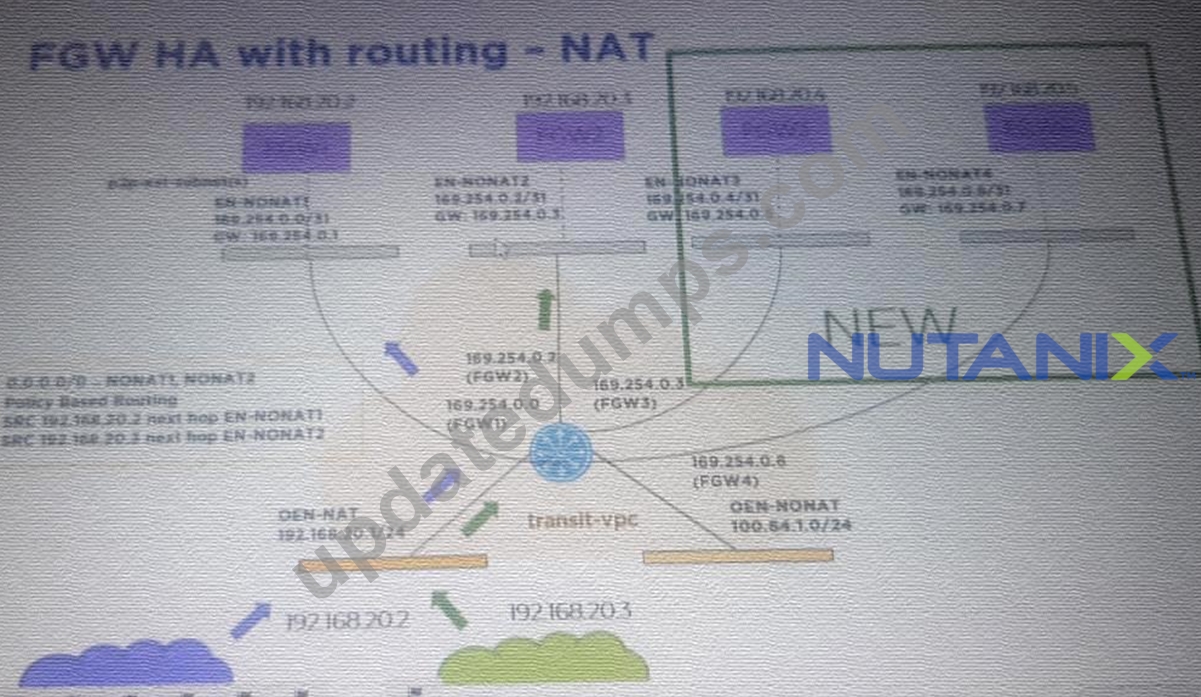
An NC2 on Azure cluster was deployed with two Flow Gateway in HA (FHW1 and FGW2). After a week of use, four bare-metal nodes were added to the NC2 cluster and additional workloads were added. The existing workloads were using floating IPs to allow inbound traffic to communicate with the running workloads on the NC2 cluster.
It was determined that additional bandwidth for north/south traffic would be needed. Two additional Flow Gateways were added (FGW3 and FGW4) from the NC2 portal configuration menu.
The existing workloads prior to expansion on the NC2 cluster will be able to use which Flow Gateways using the NAT traffic path after the expansion?
- A. They will be able to use FGW3 and FGW4 once the NC2 workloads reboots.
- B. All four Flow Gateways using a MAC/Hash algorithm.
- C. Only the Flow Gateway each workload was using prior to expansion.
- D. All four Flow Gateways.
Answer: C
Explanation:
In the NC2 on Azure cluster scenario, the existing workloads were using floating IPs for inbound traffic before the addition of new Flow Gateways (FGW3 and FGW4). The NAT traffic path established initially will continue to direct traffic through the originally assigned Flow Gateways (FGW1 and FGW2). The existing workloads will not automatically utilize the new Flow Gateways (FGW3 and FGW4) without a reconfiguration or reboot, which reassigns the NAT paths.
References
* Nutanix Flow Networking and Configuration Guide
NEW QUESTION # 35
An administrator needs to open the following ports in the firewall between an on-premises cluster and azure for disaster recovery:
* 22
* 2009
* 2020
* 2049
* 3260
* 9440
Which rile-type should be created on the firewall for communication to be appropriately established?
- A. Bi-directional (TCP)
- B. Outbound (ICMP)
- C. Bi-directional (ICMP)
- D. Outbound (TCP)
Answer: A
Explanation:
* Port Requirements: The specified ports (22, 2009, 2020, 2049, 3260, 9440) are commonly used for various services and require TCP communication.
* Port 22: SSH
* Port 2009: Used for Nutanix internal communication
* Port 2020: Nutanix services
* Port 2049: NFS
* Port 3260: iSCSI
* Port 9440: Nutanix Prism management
* Communication Type: To ensure proper disaster recovery setup, bi-directional communication is needed to allow traffic to flow both from on-premises to Azure and vice versa.
* TCP Protocol: These ports use the TCP protocol, which provides reliable communication between devices.
* Conclusion: Creating a bi-directional (TCP) rule on the firewall allows the necessary communication for disaster recovery processes.
References:
* Nutanix Networking and Security Documentation
* Azure Networking Documentation
NEW QUESTION # 36
An administrator needs to ensure API calls are executing successfully from NC2 to manage Azure resources.
Which cluster outbound to Azure connections are required to satisfy this task?
- A. managementazure.com
- B. apikeys.nutanix.com
- C. azure-support.nutan/x.com
- D. portal.azure.com
Answer: B
Explanation:
* API Key Management:For NC2 to manage Azure resources successfully, it needs to authenticate and authorize API calls. This is typically handled through API keys, which are managed via specific endpoints.
* Required Connection:The endpointapikeys.nutanix.comis crucial for managing these API keys.
Ensuring connectivity to this endpoint allows NC2 to verify and utilize the API keys needed for interacting with Azure services.
References:
* Nutanix NC2 API Configuration Guide
* Azure API Management Documentation
NEW QUESTION # 37
An administrator needs to extend an on-premises subnet to an NC2 cluster on Azure.
Which set of options should the administrator configure to complete this task?
- A. Subnet Type: On-premises VLAN subnets and VPC subnets Traffic Type: IPv6 umcasi traffic and ARP On-premises Hypervisor: Hyper-V
- B. Subnet Type: On-premises VLAN subnets and VPC subnets Traffic Type: IPv4 unicast traffic and ARP On-premises Hypervisor: AHV
- C. Subnet Type: On-premises VLAN subnets and VPC subnets Traffic Type: IPv4 unicast traffic IPv6 unicast traffic and ARP On-premises Hypervisor: ESXi and AHV
- D. Subnet Type: VPC subnets
Traffic Type: IPv4 unicast traffic and ARP
On-premises Hypervisor: ESXi, AHV, Hyper-V
Answer: C
Explanation:
To extend an on-premises subnet to an NC2 cluster on Azure, the administrator should configure:
* Subnet Type:Both on-premises VLAN subnets and VPC subnets. This ensures that the subnet can span both the on-premises environment and the Azure environment.
* Traffic Type:Support for IPv4 unicast traffic, IPv6 unicast traffic, and ARP is necessary to ensure
* proper communication and address resolution across the extended subnet.
* On-premises Hypervisor:ESXi and AHV are supported hypervisors for this type of configuration, allowing for a seamless extension of the subnet between these environments.
References
* Nutanix Hybrid Cloud Networking
NEW QUESTION # 38
Which entity should be contacted for cloud hardware support (EC2 instances, VPC, etc) related to NC2?
- A. Partner
- B. Internal IT Operations team
- C. Nutanix
- D. Public Cloud Vendor
Answer: D
Explanation:
* Cloud Hardware Support: For issues related to cloud hardware, such as EC2 instances or VPC configurations, the responsible entity is typically the public cloud vendor.
* Nutanix Responsibility: Nutanix manages the software layer and integration aspects of the NC2 service, but the underlying hardware support is managed by the cloud provider (e.g., AWS, Azure).
* Support Process:
* Public Cloud Vendor: Contact the public cloud vendor for issues directly related to the hardware, as they own and manage the physical infrastructure.
* Nutanix: For software and configuration issues specific to the NC2 service, contact Nutanix support.
* Conclusion: For cloud hardware-related support, the appropriate contact is the public cloud vendor.
References:
* Nutanix Support Guide
* Azure Support Documentation
NEW QUESTION # 39
An administrator has recently deployed an NC2 on azure cluster, but does not have connectivity back to the on-premises environment. The administrator would like to start working on configuring the new cluster.
What is the best way to get access to Prism Central?
- A. Deploy a Jump Host in an external VNet and peer the VNets for communication between Prism Central VNet and the Jump Host VNet.
- B. Deploy a Jump Host Instance In the Prism Central VNet inside a delegated subnet
- C. Deploy a Jump Host in an external VNet and peer the VNets for communication between bare-metal VNet and the Jump Host VNet.
- D. Deploy a Jump Host instance in the same subnet as the bare-metal.
Answer: A
Explanation:
Jump Host Deployment: A Jump Host provides a secure method to access the NC2 environment when direct connectivity is unavailable. Deploying it in an external VNet allows flexibility in managing network access and security.
VNet Peering: By peering the external VNet (where the Jump Host is deployed) with the VNet containing Prism Central, the administrator can establish a communication pathway. This setup enables secure and controlled access to Prism Central from the Jump Host.
Reference:
Azure VNet Peering Documentation
Nutanix NC2 Configuration and Access Guide
NEW QUESTION # 40
When configuring an alert email in Prism Central deployment within an NC2 environment, what is required in order for the emails to be sent properly?
- A. Name servers configure in Prism Central
- B. Cluster Super Admin permissions
- C. SMTP server configured in Prism Central Settings
- D. A whitelisted public cloud console endpoint
Answer: C
Explanation:
SMTP Server Configuration: To send alert emails from Prism Central, it is essential to configure an SMTP server in the Prism Central settings. This server handles the email sending process, ensuring that alerts generated by Prism Central are properly delivered to the specified email addresses.
Email Notification Setup: The SMTP server settings include the server address, port, and authentication details. Once these settings are correctly configured, Prism Central can use the SMTP server to send out alert emails reliably.
Reference:
Nutanix Prism Central Administration Guide
SMTP Configuration for Email Alerts in Prism Central
NEW QUESTION # 41
A new subnet needs to be created within Flow Virtual Networking to accommodate a new type of workload in the company's NC2 Azure instance.
Which type of network will satisfy this task?
- A. VNET
- B. Underlay
- C. Overlay
- D. VPC
Answer: C
Explanation:
Flow Virtual Networking: Nutanix Flow Virtual Networking allows for the creation of overlay networks to segment and manage network traffic.
Network Types:
Underlay: Refers to the physical network infrastructure.
Overlay: Logical network built on top of the physical infrastructure, providing flexibility for creating isolated subnets and accommodating different workloads.
VPC: Virtual Private Cloud, a network within a public cloud provider.
VNET: Azure-specific virtual network.
Requirement: Creating a subnet for new workloads within Flow Virtual Networking suggests using an overlay network for logical separation and management.
Conclusion: An overlay network within Flow Virtual Networking will satisfy the task of accommodating a new type of workload in the NC2 Azure instance.
Reference:
Nutanix Flow Networking Guide
Azure Virtual Network Documentation
NEW QUESTION # 42
A company has just adopted Nutanix as their technology of choice and is preparing to deploy Nutanix Cloud Clusters (NC@) Which step must be taken first to gain access to the NC2 console?
- A. Open a support case with Nutanix.
- B. Create a My Nutanix account.
- C. Start a free trial via Billing Portal.
- D. Navigate to doud.nutanix.com.
Answer: B
Explanation:
Initial Access: To gain access to the NC2 console, users need to create an account on the Nutanix platform.
My Nutanix Account: Creating a My Nutanix account provides access to the Nutanix console, support, and other resources.
Free Trial and Billing Portal: Starting a free trial or accessing the billing portal can be subsequent steps but require an initial account.
Support Case: Opening a support case is not necessary for initial access but might be needed for specific issues later.
Conclusion: Creating a My Nutanix account is the first step to accessing the NC2 console and other Nutanix services.
Reference:
Nutanix Account Creation Guide
Getting Started with Nutanix NC2
NEW QUESTION # 43
Which statement best describes south bound traffic to a Nutanix User VPC originating outside the BC2 cluster when using a no-NAT (routed path) having two or more Flow Gateways (FGW)?
- A. A BGP gateway runs inside of Prism Central. The BGP gateway advertises externally mutable IP addresses to the Azure Route Server, with each active FGW external IP address as the next hop.
- B. A BGP gateway runs on the CVM of the bare-metal hosts. The BGP gateway advertises externally routable IP addresses to the Azure Route Server, with each active FGW external IP address the next hop.
- C. A BGP gateway is deployed as Azure native VMs in the Prism Central VNet. The BGP gateway advertises externally routable IP addresses to the Azure Route Server, with each active FGW external IP address as the next hop.
- D. A BGP gateway is deployed as Azure native VMs in the Prism Central VNet. The BGP gateway advertises externally routable IP addresses to the Prism Central, with each active FGW external IP address as the next hop.
Answer: C
Explanation:
BGP Gateway Deployment: The BGP gateway is deployed as Azure native VMs within the Prism Central VNet. This deployment ensures seamless integration with Azure's networking infrastructure.
Route Advertisement: The BGP gateway advertises the externally routable IP addresses to the Azure Route Server. This setup allows for dynamic routing and efficient traffic management.
Flow Gateways (FGW) as Next Hops: Each active Flow Gateway's external IP address is used as the next hop. This configuration ensures that southbound traffic is correctly routed to the appropriate Flow Gateway, providing efficient and reliable connectivity.
Reference:
Nutanix NC2 Networking Guide
Azure Route Server and BGP Documentation
NEW QUESTION # 44
An administrator needs to extend an on-premises subnet to an NC2 cluster on Azure.
Which set of options should the administrator configure to complete this task?
- A. Subnet Type: On-premises VLAN subnets and VPC subnets Traffic Type: IPv6 umcasi traffic and ARP On-premises Hypervisor: Hyper-V
- B. Subnet Type: On-premises VLAN subnets and VPC subnets Traffic Type: IPv4 unicast traffic and ARP On-premises Hypervisor: AHV
- C. Subnet Type: On-premises VLAN subnets and VPC subnets Traffic Type: IPv4 unicast traffic IPv6 unicast traffic and ARP On-premises Hypervisor: ESXi and AHV
- D. Subnet Type: VPC subnets
Traffic Type: IPv4 unicast traffic and ARP
On-premises Hypervisor: ESXi, AHV, Hyper-V
Answer: C
Explanation:
To extend an on-premises subnet to an NC2 cluster on Azure, the administrator should configure:
Subnet Type: Both on-premises VLAN subnets and VPC subnets. This ensures that the subnet can span both the on-premises environment and the Azure environment.
Traffic Type: Support for IPv4 unicast traffic, IPv6 unicast traffic, and ARP is necessary to ensure proper communication and address resolution across the extended subnet.
On-premises Hypervisor: ESXi and AHV are supported hypervisors for this type of configuration, allowing for a seamless extension of the subnet between these environments.
Reference
Nutanix Hybrid Cloud Networking
NEW QUESTION # 45
......
Nutanix Certified NCP-CI-Azure Dumps Questions Valid NCP-CI-Azure Materials: https://prepaway.updatedumps.com/Nutanix/NCP-CI-Azure-updated-exam-dumps.html