

Free Sales Ending Soon - 100% Valid AB-100 Exam Dumps with 147 Questions
Verified AB-100 dumps Q&As on your Microsoft Certified Exam Questions Certain Success!
NEW QUESTION # 55
A company deploys a Microsoft Copilot Studio agent that integrates with a Microsoft Power Automate desktop flow.
You need to recommend a testing solution that meets the following requirements:
Test cases must validate the most recent changes to the agent before the agent is released.
The flow must be validated as part of the agent ' s orchestration.
What should you recommend for each requirement? To answer, select the appropriate options in the answer area.
NOTE: Each correct selection is worth one point.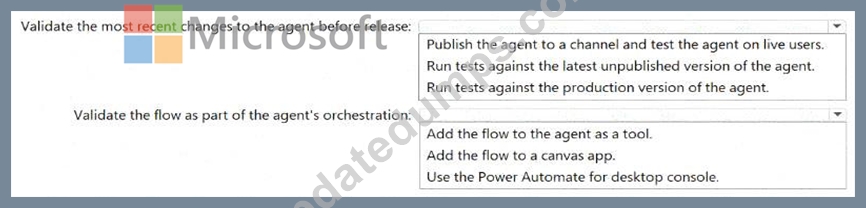
Answer:
Explanation: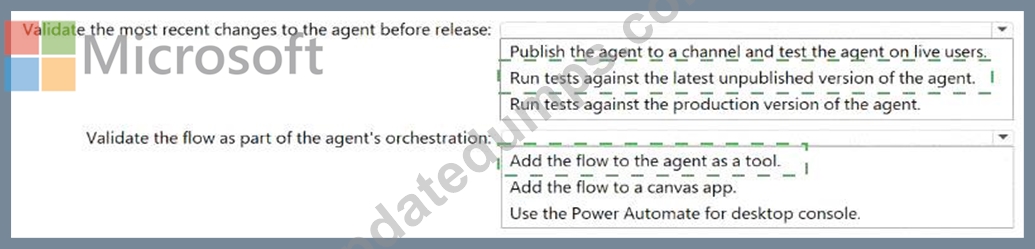
Explanation:
Validate most recent changes # Run tests against the latest unpublished version of the agent; Validate the flow as part of orchestration # Add the flow to the agent as a tool Why the first selection is correct The requirement says the company must validate the most recent changes to the agent before the agent is released . That means testing must happen on the newest working version that has not yet been published to production.
So the correct recommendation is:
Run tests against the latest unpublished version of the agent
This is the safest and most appropriate pre-release testing pattern because it allows the team to:
* verify recent changes before users see them
* catch regressions early
* validate orchestration logic in a controlled state
* reduce production risk
From an AI business solutions perspective, pre-release testing is critical for Copilot agents because even small changes in prompts, tools, orchestration, or data connections can affect:
* response quality
* workflow behavior
* escalation paths
* compliance behavior
* user trust
Testing unpublished changes ensures that governance and quality assurance happen before release, not after deployment.
Why the second selection is correct
The question also requires that the Power Automate desktop flow be validated as part of the agent ' s orchestration .
That means the flow must participate directly in the agent's runtime action path. The correct way to do that is:
Add the flow to the agent as a tool
When a flow is added as a tool, the agent can invoke it during its orchestration. This allows test cases to validate not only the conversational layer, but also the actual execution of the flow inside the end-to-end agent behavior.
From an agentic AI design perspective, tools are how agents connect reasoning with action. If the flow is meant to be part of orchestration, it must be exposed to the agent in a way that allows the agent to call it during task execution.
That is the correct enterprise pattern for validating integrated behavior.
NEW QUESTION # 56
Note: This section contains one or more sets of questions with the same scenario and problem. Each question presents a unique solution to the problem. You must determine whether the solution meets the stated goals. More than one solution in the set might solve the problem. It is also possible that none of the solutions in the set solve the problem.
After you answer a question in this section, you will NOT be able to return. As a result, these questions do not appear on the Review Screen.
A key stakeholder in your organization is championing the immediate deployment of Microsoft Copilot across all business units. Their primary justification is the belief that AI will automatically generate superior, data-driven decisions starting on day one, irrespective of the current state of organizational data quality or the alignment of existing business processes. You are tasked with providing an accurate assessment of this claim based on industry guidance, particularly Microsoft's "AI for Business" principles.
Based on Microsoft's "AI for Business" guidance, can you confidently state that deploying AI tools like Copilot will lead to better decisions with having a foundation of quality business data and well- defined, aligned workflows first?
- A. Yes
- B. No
Answer: B
Explanation:
While Microsoft's "AI for Business" guidance indeed emphasizes that AI can enable better decision-making, it critically states that this capability is not automatic or instantaneous. Instead, it explicitly requires several foundational elements:
Processing large volumes of relevant, quality business data: AI tools like Copilot depend heavily on access to accurate, comprehensive, and well-structured organizational data to derive meaningful insights. Without quality data, the AI lacks the necessary inputs to provide intelligent, contextual, or reliable outputs.
Uncovering patterns: AI's strength lies in identifying patterns and correlations within data that human analysis might miss. This process is futile if the underlying data is incomplete, inaccurate, or unstructured.
Aligning the technology to business workflows: For AI-generated insights to translate into genuinely "better decisions," they must be integrated into and relevant to existing business processes. Deploying AI in a vacuum, without considering how it fits into and enhances current workflows, will diminish its practical value and impact on decision-making.
Therefore, deploying AI tools like Copilot without an existing foundation of quality data and aligned processes will not automatically guarantee improved decisions. The AI will lack the essential context and reliable inputs needed to generate meaningful insights and drive effective outcomes.
References:
https://www.microsoft.com/en-in/microsoft-copilot/copilot-101/ai-for-
business#Customerexperience
https://www.microsoft.com/en-in/microsoft-365/business-insights-ideas/resources/grow-your- small-business-with-artificial-intelligence
NEW QUESTION # 57
A company plans to deploy an AI-based customer service app that will autonomously manage interactions, escalate complex cases, and learn from historical ticket data.
You need to perform a return on AI investment (ROAI) analysis of the app deployment. The solution must ensure that the analysis is accurate.
What should you do first?
- A. Identify and quantify all the development, deployment, and operating costs.
- B. Model the customer experience.
- C. Conduct an AI market benchmarking study.
- D. Establish the AI performance metrics.
Answer: A
Explanation:
To conduct a robust Return on AI Investment (ROAI) analysis for your Microsoft-based AI customer service application, you must first categorize and quantify three distinct cost phases:
Development, Deployment, and Operations. For a system capable of managing complex escalations and learning from historical data, your project aligns with "Advanced" or "Agentic" AI profiles.
1. Development Costs (Upfront Investment)
This phase covers the creation of the core AI logic, custom integrations, and data preparation.
2. Deployment Costs (One-Time Setup)
These are the costs to move the application from a development environment to a live production state.
3. Operating & Maintenance Costs (Recurring)
Ongoing expenses are critical for ROAI as they impact the net gain over time.
Reference:
https://emerline.com/blog/ai-app-development-cost
NEW QUESTION # 58
A company has multiple AI models that support generation of sales transactions.
Each release of the models must be reviewed by a security and compliance team before being deployed to the production environment. The security and compliance team must have access to prior versions to properly determine potential exposures introduced.
You need to recommend a solution to evaluate the impact of each deployment to production. The solution must enhance business continuity.
What should you recommend?
- A. Create a central model registry that uses version history.
- B. Establish a promotion process by using a quality gate.
- C. Implement version control for all the AI system components.
- D. Track model retirement schedules to prevent service disruptions.
Answer: C
Explanation:
To ensure business continuity and minimize risks in AI-driven sales transaction systems, implementing comprehensive version control across all system components is a critical requirement. This provides reviewers with a stable baseline to evaluate new releases against older versions, helping identify potential exposures or regressions before they reach production.
Strategic Implementation for AI Version Control
Version All Components: Do not limit version control to application code. You must track:
*-> Models: Managed iterations including weights and architecture.
Etc.
Benefits for Business Continuity
Predictability: Standardized versioning makes AI behavior more auditable and scalable.
Disaster Recovery: Allows teams to quickly reproduce or restore any previous environment state during a failure.
Regulatory Compliance: Provides the necessary evidence of "what the AI was instructed to do" at any given point, which is mandatory for regulated financial environments.
Reference:
https://www.kore.ai/blog/why-prompt-version-control-matters-in-agent-development
NEW QUESTION # 59
You are designing a low-code Al business solution by using Microsoft Copilot Studio.
The solution must include an agent that automates tasks by simulating user interactions across third-party apps and websites, such as clicking buttons, entering text, and extracting information from screens.
You need to recommend what to include in the agent.
What should you recommend?
- A. Copilot skills
- B. Model Context Protocol (MCP)
- C. a natural language understanding + (NLU+) model in Copilot Studio
- D. Computer Use in Copilot Studio
Answer: D
NEW QUESTION # 60
You are designing end-to-end test scenarios for a business solution that uses Microsoft Dynamics 365 Sales and Dynamics 365 Finance. You need to ensure that the business solution meets the following test requirements:
* Properly exchanges data between the Dynamics 365 apps
* Aligns with defined user workflows and business processes
Which type of testing should you use for each requirement? To answer, drag the appropriate testing types to the correct requirements. Each testing type may be used once, more than once, or not at all. You may need to drag the split bar between panes or scroll to view content.
NOTE: Each correct selection is worth one point.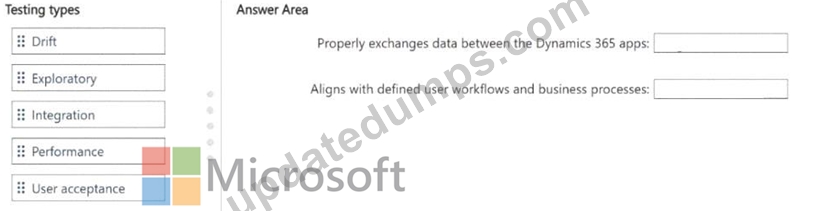
Answer:
Explanation: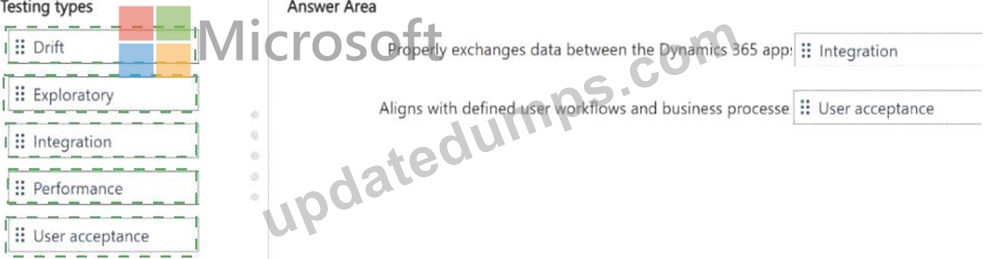
Explanation: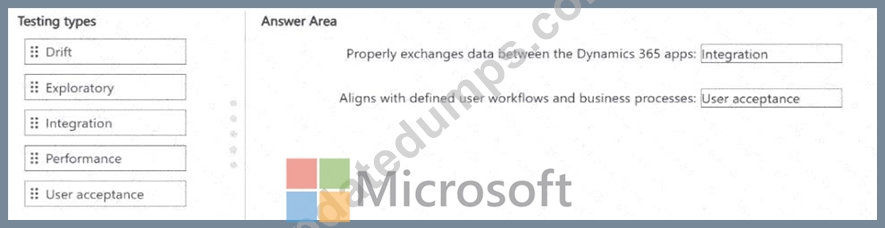
For end-to-end validation of a solution that uses Dynamics 365 Sales and Dynamics 365 Finance , the testing type should match the goal of each requirement.
For properly exchanging data between the Dynamics 365 apps , the correct testing type is Integrat ion testing.
This verifies that the systems connect correctly, pass data accurately, and maintain consistency across app boundaries.
For aligning with defined user workflows and business processes , the correct testing type is User acceptance testing. This focuses on whether the solution supports real business tasks the way users expect and whether it fits the intended operational process.
Why the other options are not correct here:
* Drift is about changes over time, often in model or behavior consistency.
* Exploratory is useful for uncovering unexpected issues, but it is not the primary match for the stated requirement.
* Performance focuses on speed, scale, and responsiveness, not workflow fit.
NEW QUESTION # 61
Scenario: Your organization wants to empower different teams with custom AI agents using Microsoft Copilot Studio. Some teams only need simple, personal productivity agents based on SharePoint content, while others need enterprise-grade agents that integrate with back-end systems and require full lifecycle governance. Leadership asks you to identify the scenarios where each Copilot Studio experience-Lite or Full-would be the correct choice.
Which three of the following scenarios align with Microsoft's recommended use cases for choosing either the Lite or Full Copilot Studio experience? (Choose three)
- A. An enterprise wants to deploy an agent to thousands of external customers and requires controlled release management and secure integration with line-of-business systems
- B. A manager wants to quickly build a personal agent that answers questions using their team's internal SharePoint files-without needing complex workflows
- C. A small project team needs an agent for summarizing emails and FAQs, created directly within the Microsoft 365 Copilot app
- D. A department needs an agent that uses multi-step workflows and connects to a custom CRM via APIs for large-scale deployment across the organization
- E. A company wants to experiment with AI by enabling all employees to create agents without any governance or lifecycle management controls
Answer: A,B,D
Explanation:
A manager wants to quickly build a personal agent that answers questions using their team's internal SharePoint files-without needing complex workflows is correct because This scenario perfectly describes a use case for Copilot Studio Lite. Lite is designed for individual users or small teams to quickly create simple, personal productivity copilots, often leveraging Microsoft 365 content (like SharePoint) without requiring deep technical skills or complex integrations.
A department needs an agent that uses multi-step workflows and connects to a custom CRM via APIs for large-scale deployment across the organization is correct because This scenario aligns with the capabilities and target audience of the Full Copilot Studio experience. Building multi-step workflows, connecting to custom APIs (like a CRM), and preparing for large-scale organizational deployment are advanced features that require the comprehensive environment and governance capabilities of the Full Studio.
An enterprise wants to deploy an agent to thousands of external customers and requires controlled release management and secure integration with line-of-business systems is correct because This is a prime example of a scenario demanding the Full Copilot Studio experience.
Deploying to external customers at scale, requiring controlled release processes, and ensuring secure integration with core business systems (which often involves complex connectors and security configurations) are all advanced requirements best met by the robust features of Full Copilot Studio.
References:
https://learn.microsoft.com/en-us/microsoft-copilot-studio/publication-add-bot-to-microsoft-teams
https://www.microsoft.com/insidetrack/blog/how-our-employees-are-extending-enterprise-ai-with- custom-retrieval-agents/
https://learn.microsoft.com/en-us/microsoft-365-copilot/extensibility/copilot-studio-experience
NEW QUESTION # 62
You need to recommend a solution to integrate a Microsoft Copilot agent with a Microsoft Dynamics 365 Contact Center chat channel.
The agent must respond to customer questions and hand off the conversation to a live customer service representative when the customer requests an escalation.
What should you recommend?
- A. Configure the Conversation Start topic.
- B. Build an agent flow.
- C. Configure the Escalate topic.
- D. Call a Microsoft Power Automate connector.
- E. Configure a skill.
Answer: C
Explanation:
To hand off a conversation from a Microsoft Copilot agent to a live representative in Dynamics
365 Contact Center, you must configure the Escalate system topic to include a Transfer conversation node. This ensures that when a customer requests an escalation, the agent seamlessly passes the full chat history and context to the live agent.
Steps to Configure the Escalate Topic
Open the Escalate Topic: In Microsoft Copilot Studio, navigate to Topics, select the System tab, and open the Escalate topic.
Add a Transfer Node:
Delete any default "no one available" messages if they do not fit your workflow.
Select the Add node icon (+), go to Topic Management, and select Transfer conversation.
Include Context (Optional): You can add a Private message to agent within the node. This message is only visible to the live representative and helps them quickly understand the customer's needs.
Save and Publish: Save your changes and publish the agent to apply the new escalation logic.
Reference:
https://learn.microsoft.com/en-us/microsoft-copilot-studio/advanced-hand-off
NEW QUESTION # 63
A customer service agent deployed in Copilot Studio is receiving negative feedback from users.
The support team reports that the agent frequently provides incorrect answers about product warranty policies. The team wants to diagnose and resolve the issue.
Which monitoring approach should you recommend?
- A. Disable the agent and route all enquiries to human agents
- B. Increase the agent's response creativity settings to generate more varied answers
- C. Review the agent's conversation transcripts and topic analytics to identify which topics are triggering incorrect responses, then analyse the knowledge source for gaps in warranty policy content
- D. Rebuild the entire agent with new topics
Answer: C
Explanation:
Effective agent monitoring starts with analysing conversation transcripts and topic analytics to understand exactly where the agent is failing. By reviewing which topics trigger when warranty questions are asked, you can determine whether the issue is incorrect topic routing, outdated knowledge source content, or poorly designed conversation flows. This diagnostic approach enables targeted fixes rather than wholesale rebuilding.
NEW QUESTION # 64
A company has an Al agent that automates the review of customer feedback stored in a cloud database.
You plan to generate monthly reports from the agent's output to provide insights into customer sentiment and guide product development and marketing.
You need to ensure that the data ingested by the agent is clean and suitable for the intended use.
What should you do to prepare the data?
- A. Translate the data into a single language.
- B. Ensure that the size of the database does not exceed 100 GB.
- C. Identify and address biased data.
- D. Sort the database by customer last name.
Answer: C
Explanation:
The requirement is to make sure the data ingested by the agent is clean and suitable for the intended use, which is producing monthly sentiment insights to guide product development and marketing.
The best answer is C. Identify and address biased data.
Why C is correct:
For sentiment analysis and reporting, biased data can distort conclusions and produce misleading recommendations Data preparation should include checking for skew, unfair representation, missing segments, and other quality issues that affect downstream decisions This aligns with responsible AI and sound analytics practice
NEW QUESTION # 65
A company has an AI agent that automates the review of customer feedback stored in a cloud database.
You plan to generate monthly reports from the agent's output to provide insights into customer sentiment and guide product development and marketing.
You need to ensure that the data ingested by the agent is clean and suitable for the intended use.
What should you do to prepare the data?
- A. Create a workflow in Microsoft Power Automate.
- B. Sort the database by customer last name.
- C. Create an agent flow in Microsoft Copilot Studio.
- D. Identify and address biased data.
Answer: C
Explanation:
To automate feedback assessment and monthly reporting, you can build an agent flow in Microsoft Copilot Studio that functions as a "data pre-processor" and "insight generator." By using Agent Flows, you can move beyond simple Q&A to create structured, multi-step processes that clean raw data before it is ingested by the agent's main knowledge base.
Step 1: Design the Feedback Agent Flow
The "Flow" acts as the bridge between your cloud database (e.g., Azure SQL, Cosmos DB) and the final report.
Step 2: Ensure Data Quality (The "Clean Room")
For the agent to give accurate insights for marketing, the data must be grounded and structured.
Step 3: Automate the Monthly Report
Once the data is clean, the agent can summarize it into a report suitable for stakeholders.
Reference:
https://cps.co.uk/insights/how-to-use-copilot-studio-to-automate-repetitive-tasks
NEW QUESTION # 66
Which framework should you use for the infrastructure migration?
- A. Microsoft Power Platform Center of Excellence (CoE)
- B. Success by Design
- C. Microsoft Power Platform Project Setup Wizard
- D. Microsoft Cloud Adoption Framework for Azure
Answer: D
Explanation:
Comprehensive and Detailed Explanation From Agentic AI Business Solutions Topics:
The correct answer is A. Microsoft Cloud Adoption Framework for Azure .
In this scenario, Fabrikam is moving from a fully on-premises environment to a completely cloud-based topology , and the requiremen ts explicitly state that:
* Azure must be used for all future infrastructure workloads
* the company must follow Microsoft-recommended methodologies for infrastructure migration to the cloud That wording points directly to the Microsoft Cloud Adoption Framewor k for Azure .
The Cloud Adoption Framework is Microsoft's primary guidance for planning and executing enterprise cloud migrations. It is not just a technical migration checklist; it is a full strategic framework that helps organizations move workloads to Azure in a structured and governed way. It covers key areas such as:
* migration strategy
* readiness assessment
* governance
* identity and security planning
* landing zones
* operations management
* organizational alignment
* adoption planning
From an AI-powered business solutions perspective, this matters because AI solutions only succeed when the underlying infrastructure is modernized correctly. Fabrikam's goals include cloud migration, Dataverse consolidation, Dynamics 365 Sales adoption, and AI-first business operations. All of these depend on a strong Azure-based cloud foundation. The Cloud Adoption Framework helps ensure that this transformation is done in a way that is scalable, secure, and aligned to business outcomes.
Why the other options are incorrect:
B). Succes s by Design
This framework is mainly used for designing and implementing business applications in a way that improves adoption, usability, and solution quality. It is highly relevant for conversational experiences , application rollout, and ensuring users g et value from solutions such as Dynamics 365 and Copilot-related implementations. However, it is not the primary framework for infrastructure migration to Azure .
C). Microsoft Power Platform Center of Excellence (CoE)
The CoE is used to establish governance , monitoring, best practices, and enablement for Power Platform usage across an organization. It helps manage makers, apps, flows, and adoption across Power Platform environments. While it is useful after adoption begins, it is not the framework used to mi grate enterprise infrastructure to Azure .
D). Microsoft Power Platform Project Setup Wizard
This is more of a project setup and configuration aid for Power Platform implementations. It does not provide enterprise-scale migration guidance for moving an organ ization's infrastructure from on-premises systems to Azure.
Expert reasoning:
When a question mentions infrastructure migration , Azure , and Microsoft-recommended methodology , the best match is almost always the Microsoft Cloud Adoption Framework for Azure . In Microsoft solution architecture and AI business transformation scenarios, this framework is the standard answer for cloud migration planning and execution.
Topic 2, Contoso. Ltd
Overview
Contoso. Ltd is a high-tech manufacturing company that uses Microsoft Dynamics 365 Finance, Dynamics
365 Supply Chain Management, and Dynamics 365 Commerce for its North American operations. The company designs and develops innovative products that have many patents and proprietary technologies. The patents and engineering designs are closely guarded secrets.
Contoso executives want to integrate and adopt Al solutions to help scale the company in preparation for an anticipated period of rapid growth.
The company has multiple legal entities and Azure subscriptions that will be used in the adopted Al solutions.
AI Adoption
The following executives will have specific responsibilities in the overall Al adoption:
* Chief Technology Officer (CTO): Select one Dynamics 365 Finance, Dynamics 365 Supply Chain Management, or Dynamics 365 Commerce prebuilt Al agent and one custom Microsoft Copilot Studio Al agent to prioritize and deploy during the initial Al adoption phase.
* Chief Information Officer (CIO): Ensure that appropriate security labels are assigned to the data used by the Al agents
* Chief Financial Officer (CFO): Analyze the return on investment (ROI) for the Al agents being deployed.
* Chief Information Security Officer (CISO): Discover and inventory Al resources for auditing.
* Chief Executive Officer (CEO): Ensure that all solutions adhere to industry-standard responsible Al practices.
All Al initiatives and agents will have a detailed business use case, a defined audience profile, and an estimated ROI that will compare the cost savings of the current process against the estimated costs of using the new Al solutions.
The company ' s research and development (R & D) department already has a custom Model Context Protocol (MCP) server that contains comprehensive product specifications and compliance data.
Prebuilt AI Agent
The CTO has NOT yet selected which prebuilt Al agent to use in Dynamics 365 Supply Chain Management The CTO wants to view available agent templates to identify which agent will add the most business value.
Depending on which high-priority Al agents are identified, its agent capabilities must be previewed in a discovery meeting with the relevant business operation stakeholders.
Custom AI Agent
Contoso has identified the following custom Al agent requirements:
* The custom Al agent will use data from Dynamics 365 Supply Chain Management to answer questions for the manufacturing team as a low-code solution.
* The custom Al agent will be accessible from within Microsoft Teams.
* The custom Al agent must be designed to eventually connect to other agents that can be selected based on their description.
* The topics used in the custom Al agent will be selected based NOT on a trigger phrase, but on a description of the purpose of the query, to make the interactions more conversational
* The custom Al agent must be able to answer questions about product specifications by using existing technologies. The product specifications are maintained by the R & D department.
* The custom Al agent must be integrated with and accessible from Dynamics 365 Supply Chain Management.
* The custom Al agent must be able to use Dynamics 365 Supply Chain Management business logic that is stored outside of the application.
Analysis, Reporting, and Troubleshooting
Contoso has identified the following analysts, reporting, and troubleshooting requirements:
* The CISO will audit all the Al solutions monthly for compliance and security.
* The CFO will analyze all the Al solutions quarterly to compare the estimated ROI against actual measured efficiencies and adoption. The CFO will use the Copilot Studio agent usage estimator to perform this analysis.
* The CISO wants to identify how much sensitive data was accessed for a given Al agent run and who accessed the data. Too much sensitive data accessed by a single user might indicate a high security risk.
* The CTO wants to track user feedback on the quality of the Al agent responses during user interactions with the agents. Consistently poor feedback will trigger an escalated reengineering discussion.
* The CEO wants a quarterly assessment of all the required metrics for their specific responsibilities. The tools used for the assessments must be Microsoft-recommended and must verify reliability, interpretability, fairness, and compliance.
* The CFO wants to identify how many interactions with the Al agents are abandoned on a given day as compared to resolved conversations. Too many abandoned sessions might indicate that Copilot Studio credits are being used inefficiently by end users.
Case study question
NEW QUESTION # 67
You need to recommend a Microsoft Power Platform solution for customer support. The solution must include Al capabilities in Microsoft Power Automate and must meet the following requirements:
* Use a centralized workspace for Al models.
* Generate short overviews from large amounts of unstructured text such as case notes or transcripts, without requiring additional training or coding.
What should you include in the recommendation for each requirement? To answer, select the appropriate options in the answer area.
NOTE: Each correct selection is worth one point.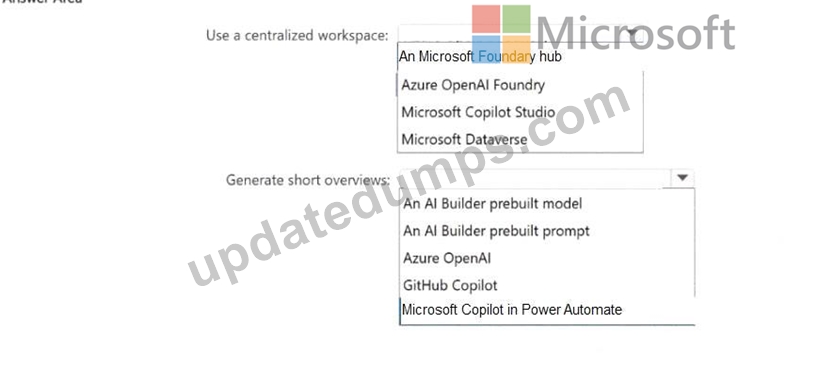
Answer:
Explanation: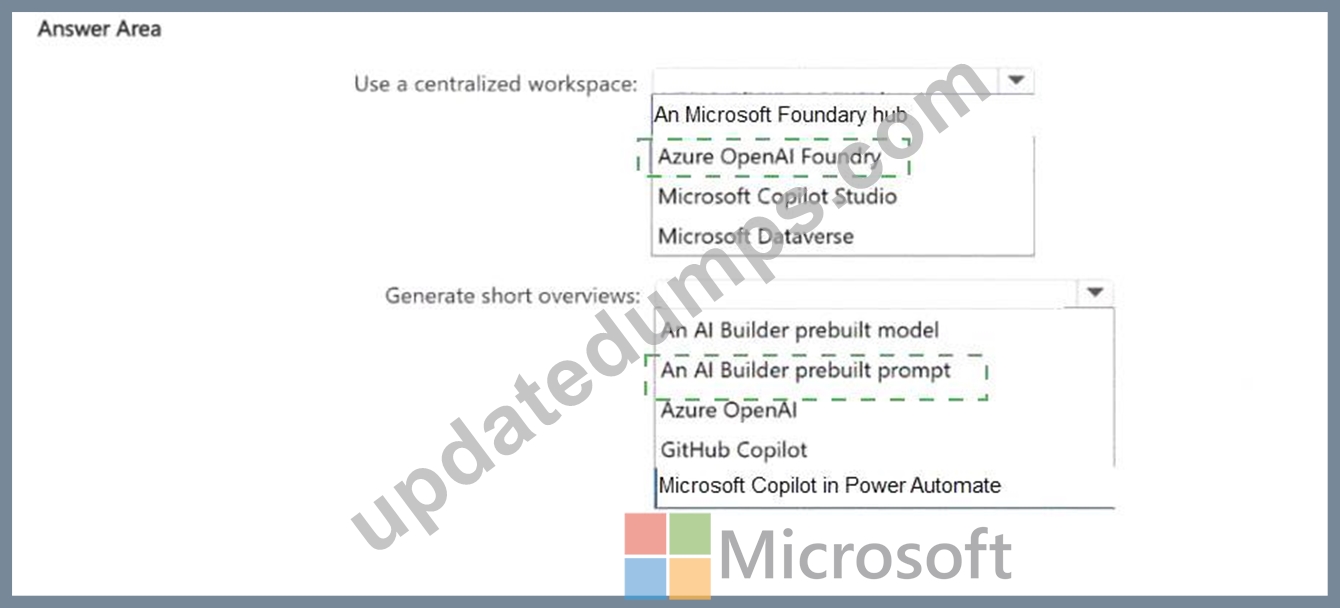
Explanation:
1. Centralized Workspace for AI Models
In the evolving Microsoft AI ecosystem, Azure AI Foundry (formerly Azure AI Studio) serves as the unified, centralized workspace for developers and organizations to build, manage, and deploy AI models.
* Unified Hub: It provides a single lo cation to access the Model Catalog, manage deployments, and perform prompt engineering.
* Integration: While AI Builder is the " front-end " for citizen developers in Power Automate, Azure AI Foundry is the foundational " engine room " where the underlying model s (including those used by prompts) are managed and governed at an enterprise level.
* Scalability: It allows organizations to host their own custom models or utilize industry-leading foundation models (like GPT-4o) which then power the downstream capabiliti es in the Power Platform.
2. Generating Short Overviews Without Training or Coding
To summarize large amounts of unstructured text like case notes or transcripts without manual effort, AI Builder prebuilt prompts are the specific solution.
* AI Builder Prebu ilt Prompts: These are ready-to-use GPT-based instructions designed for common business tasks. Specifically, the " AISummarize " prebuilt prompt is engineered to take input text and generate a concise summary automatically.
* Zero Training Required: Unlike " Cu stom Models " which require you to provide sets of historical data to teach the AI, prebuilt prompts leverage pre-trained Large Language Models (LLMs). This meets the requirement of " no additional training or coding. "
* Ease of Use: In Power Automate, you sim ply add the " Create text with GPT using a prompt " action and select the prebuilt summary prompt, passing it the text from your case notes or transcripts.
NEW QUESTION # 68
Case Study 1 - Fabrikam, Inc
Background
Fabrikam, Inc., is a global consumer goods company that is undergoing a digital transformation initiative to migrate its entire infrastructure to the Microsoft cloud. As a key element of this cloud migration, the company will implement Microsoft Dynamics 365 Sales, moving away from the current on-premises proprietary technologies used by its business-to-business (B2B) sales team.
As part of the cloud migration, Fabrikam will adopt an AI-first approach to its business solutions and implement AI solutions, wherever possible, to streamline operations.
Problem Statements
Fabrikam's infrastructure currently relies on various on-premises systems that require sales executives to use corporate computers with physical keyboards to access business information during customer interactions. Mobile phones cannot be used for these purposes, as the systems depend on keyboard input. As a result, the sales executives spend a lot of time using keyboards to search for data on several disparate systems and file servers, rather than focusing on the customers. This affects the customer experience.
Fabrikam stakeholders are concerned that users will be hesitant to adopt AI. If the AI initiatives are NOT adopted, cost savings will never be realized. Additionally, funding for future AI initiatives will depend on demonstrating an increase in AI adoption month over month. As the AI agent initiative for the sales team will be the first for Fabrikam, the rapid adoption of the agent is a high priority.
Planned Initiatives
General
Fabrikam management has prioritized AI-driven projects to improve efficiency, customer engagement, and responsible AI adoption. The current application infrastructure is on-premises and must be migrated to the cloud to support the adoption of these technologies.
Infrastructure Migration
Fabrikam plans to migrate from its current on-premises infrastructure to a completely cloud-based topology; this will include user authentication, the security framework, and, primarily, the adoption of the services by end users.
All the data from the different systems will be consolidated into a single data source - a common data model that will use a Microsoft Dataverse environment as a single source of truth (SSOT) for the sales team.
Sales Cycle Enablement
To achieve the company's objectives, Fabrikam intends to implement the following strategies to enhance the sales cycle:
- Use low-code development to create a single AI agent that has
Dataverse as its core component.
- Ensure that sales managers can access unanswered correspondence from
prospects and intervene as appropriate.
- Replace the previous proprietary software with Dynamics 365 Sales to
track sales cycles and customer interactions.
- Have the sales executives use Dynamics 365 Sales to track
interactions for open opportunities and send follow-up communications
to prospects.
- Have the sales executives use handsfree headsets to interact with an
AI agent when they have questions about internal policies or customer
data.
Requirements
Infrastructure Migration
Fabrikam has identified the following infrastructure migration requirements:
- Azure must be used for all future infrastructure workloads.
- The company must follow Microsoft-recommended methodologies for
infrastructure migration to the cloud.
- Any created AI agents must have their return on investment (ROI)
calculated to ensure that the solution will save the company money.
Sales Cycle Enablement
Fabrikam has identified the following requirements for sales cycle enablement:
- The final AI agent must follow Microsoft recommendations for a
conversational user experience.
- A designated checklist must be reviewed to ensure that the AI agent
follows Microsoft deployment recommendations for a compliant solution.
- Detailed telemetry must be logged for the first created AI agent to
help troubleshoot and optimize the agent during the initial AI agent
adoption process.
- Unexpected AI agent actions must end in an escalation to a live
representative. For example, a sales executive must be rerouted to a
representative if the agent cannot answer a question after two failed
attempts.
- The return on investment (ROI) of switching from the current process
to the future process is required for stakeholder sign off.
- The sales team must use Dynamics 365 Sales to correspond with
prospects more quickly and efficiently than currently.
- Sales managers must report on the adoption of the AI agent to key
Fabrikam stakeholders on a monthly basis.
- Any sensitive information, such as user IDs and names, shared via the AI agent must be tracked for future auditing.
Hotspot Question
Which framework should you use to meet the AI agent requirements for the sales cycle enablement? To answer, select the appropriate options in the answer area.
NOTE: Each correct selection is worth one point.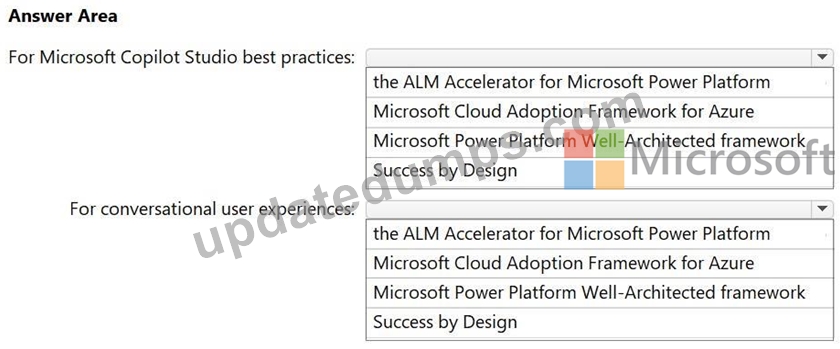
Answer:
Explanation: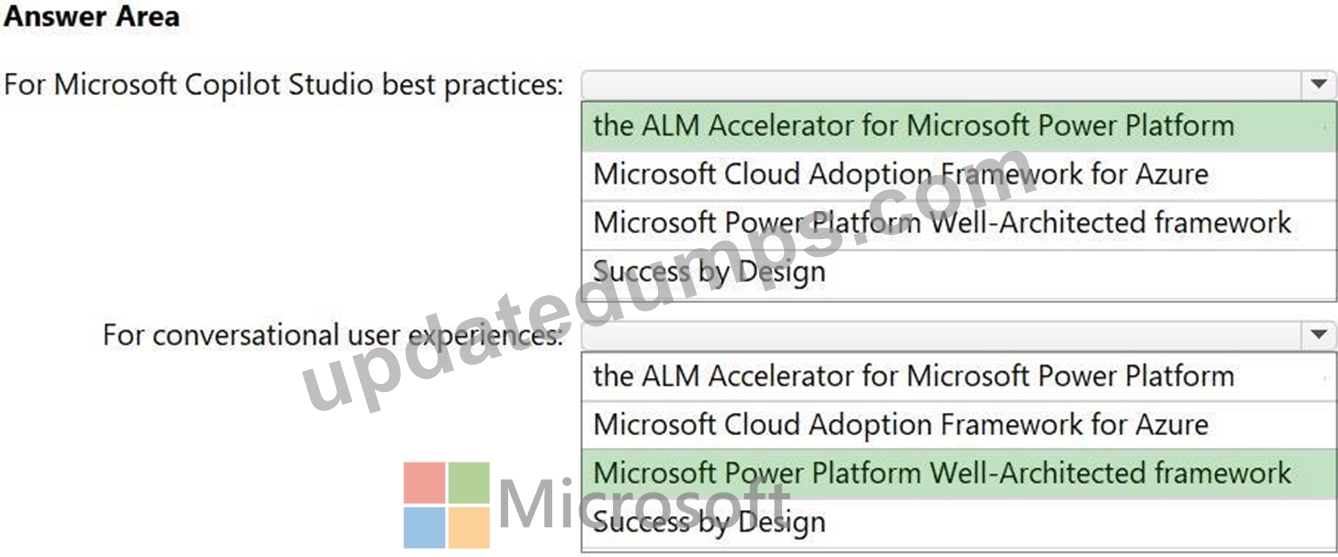
Explanation:
Box 1: the ALM Accelerator for Microsoft Power Platform
For Microsoft Copilot Studio best practices
Using the ALM Accelerator for Microsoft Power Platform is a recommended approach for managing the lifecycle of a low-code AI agent (Copilot Studio) that relies on Dataverse. It enables source control, versioning, and automated deployment of AI agents to ensure they follow Microsoft's best practices.
Box 2: Microsoft Power Platform Well-Architected framework
For conversational user experience
Utilizing the Microsoft Power Platform Well-Architected framework for a low-code AI agent (built in Copilot Studio) with Dataverse as the core data component ensures the solution is secure, reliable, and provides a high-quality conversational user experience (CUX). The framework helps align the agent with Microsoft's best practices for responsible AI, efficiency, and user satisfaction.
Scenario:
Sales Cycle Enablement
Fabrikam has identified the following requirements for sales cycle enablement:
*-> The final AI agent must follow Microsoft recommendations for a conversational user experience.
Sales Cycle Enablement
To achieve the company's objectives, Fabrikam intends to implement the following strategies to enhance the sales cycle
*-> Use low-code development to create a single AI agent that has Dataverse as its core component.
Reference:
https://learn.microsoft.com/en-us/power-platform/guidance/alm-accelerator/overview
https://learn.microsoft.com/en-us/training/modules/adopt-ai-agent-best-practice
NEW QUESTION # 69
A company plans to deploy a Microsoft Copilot Studio agent to enhance customer support.
The company stores customer data across ServiceNow, Microsoft Dynamics 365 Finance, Dynamics 365 Supply Chain Management, and Excel files in SharePoint Online.
You need to recommend a solution to ensure that the agent can deliver accurate and timely responses.
What should you recommend?
- A. Implement a model router for query handling.
- B. Implement Microsoft Power Platform connectors.
- C. Enable incremental indexing in Azure AI Search.
- D. Create custom prompts.
Answer: B
Explanation:
Microsoft Power Platform connectors are the best fit because Copilot Studio agents can use connectors to reach systems such as ServiceNow, Dynamics 365, and SharePoint-backed content, which helps the agent respond using the most current enterprise data.
Connectors let the agent call external systems and retrieve live data rather than relying on a static indexed copy, which is important for both accuracy and timeliness. Microsoft's documentation explicitly includes Microsoft services like SharePoint and Dynamics 365 among supported connector scenarios, and ServiceNow is also a common integration target for Copilot Studio agents.
Reference:
https://learn.microsoft.com/en-us/microsoft-365/copilot/extensibility/overview-copilot-connector
https://learn.microsoft.com/en-us/microsoft-copilot-studio/customer-copilot-servicenow
https://learn.microsoft.com/en-us/microsoft-copilot-studio/advanced-connectors
NEW QUESTION # 70
Note: This section contains one or more sets of questions with the same scenario and problem. Each question presents a unique solution to the problem. You must determine whether the solution meets the stated goals. More than one solution in the set might solve the problem. It is also possible that none of the solutions in the set solve the problem.
After you answer a question in this section, you will NOT be able to return. As a result, these questions do not appear on the Review Screen.
A company has a Microsoft Dynamics 365 Sales environment that has Microsoft Copilot enabled.
You need to customize Copilot by tailoring how opportunity summaries are generated or how they are presented to users.
Solution: You add fields to the opportunity summary.
Does this meet the goal?
- A. Yes
- B. No
Answer: A
Explanation:
Correct:
* You add fields to the opportunity summary.
Incorrect:
* You build Microsoft Power Automate flows to trigger customized Copilot summaries.
* You configure AI Builder lead scoring models to influence opportunity summaries.
Note:
To customize Microsoft Copilot opportunity summaries and incorporate AI Builder lead scoring data, you must configure the specific fields Copilot uses to ground its generative AI outputs.
By default, Copilot for Sales generates summaries using a set of predefined fields. To "influence" these summaries with scoring data, you need to add the predictive score and grade fields to the Opportunity summary configuration.
Step-by-Step Configuration
Switch Area: In the Sales Hub app, select the Change area menu in the bottom-left corner and choose App Settings.
Navigate to Copilot: Under General Settings, select Copilot.
Select Entity: Choose the Opportunities tab.
Add Fields:
Click Add fields.
Select the checkboxes for the fields you want to include.
You can select out-of-the-box, custom, and related table fields.
Save: Click Add and then Save your changes to update the summary configuration.
Reference:
https://learn.microsoft.com/en-us/dynamics365/sales/copilot-configure-summary-fields
NEW QUESTION # 71
A company plans to deploy a Microsoft Dynamics 365 Contact Center agent.
You need to ensure that the agent can transfer the conversation to a live customer service representative.
Which two components should you include in the solution? Each correct answer presents part of the solution.
NOTE: Each correct selection is worth one point.
- A. an Azure AI Bot Service skill
- B. Microsoft Foundry
- C. Microsoft Copilot Studio
- D. Customer engagement hub
- E. Microsoft 365 Agents Toolkit
Answer: C,D
Explanation:
Comprehensive and Detailed Explanation From Agentic AI Business Solutions Topics:
The correct answers are B. Microsoft Copilot Studio and E. Customer engagement hub .
This question focuses on enabling a Dynamics 365 Contact Center agent to hand off a conversation to a live customer service representative . That requires both:
* the tool used to build and configure the conversational agent
* the service environment where live customer engagement and routing occur Why B. Microsoft Copilot Studio is correct Microsoft Copilot Studio is the platform used to build, configure, and manage the contact center agent experience. It enables you to define conversation flows, escalation logic, triggers, and handoff behavior.
In this case, the requirement is specifically that the agent must be able to transfer the conversation to a live representative. Copilot Studio is where that escalation or transfer behavior is designed as part of the agent experience.
Why E. Customer engagement hub is correct
The Customer engagement hub provides the operational environment for customer service interactions and live-agent engagement within Dynamics 365. Once the AI agent determines that escalation is required, the live representative needs an environment to receive and continue that engagement.
From a business solutions architecture perspective, this makes sense:
* Copilot Studio defines the agent and transfer logic
* Customer engagement hub supports the human service experience after transfer Together, they satisfy the end-to-end requirement for AI-to-human handoff.
Why the other options are incorrect
A). Microsoft Foundry
Foundry supports AI model and agent development scenarios, but it is not the specific component needed for live-agent transfer in Dynamics 365 Contact Center.
C). Microsoft 365 Agents Toolkit
This is not the core component for enabling Dynamics 365 Contact Center handoff to a live service representative.
D). an Azure AI Bot Service skill
Bot skills can extend capabilities, but they are not the primary required components for enabling the standard transfer from a Dynamics 365 Contact Center agent to a live customer service representative.
Expert reasoning:
For Contact Center escalation questions, think in two layers:
* agent authoring/orchestration # Microsoft Copilot Studio
* human service environment / live representative experience # Customer engagement hub
NEW QUESTION # 72
......
Microsoft AB-100 Exam Syllabus Topics:
| Topic | Details |
|---|---|
| Topic 1 |
|
| Topic 2 |
|
| Topic 3 |
|
AB-100 Exam Dumps - 100% Marks In AB-100 Exam: https://prepaway.updatedumps.com/Microsoft/AB-100-updated-exam-dumps.html